The Itch
Trying to figure out what 'the itch' is—my drive to create and contribute to the digital commons. A review of past projects, current interests in Indigenous data sovereignty and self-hosting, and the search for what comes next.
48 posts with this tag.
Trying to figure out what 'the itch' is—my drive to create and contribute to the digital commons. A review of past projects, current interests in Indigenous data sovereignty and self-hosting, and the search for what comes next.
A laminated poster with an unsourced quote changed the trajectory of my entire life when I was a teenager. On the immutable transaction of trading days for how we spend them, the urgency of risk-taking in a world that needs it, and what it means to give everything you have before your inevitable departure.
In our current year, there is a global literacy crisis. As a result, there's a privilege in being able to read and write. Notes on Frederick Douglass, the problems you don't think about, and why the ability to write is something to be grateful for and use rather than take for granted.
Are there ethical implications of generative AI consciousness? From von Neumann's self-replicating machines to modern LLMs, we must inventory the problem of other minds, the possibility of AI consciousness, and why we ought to consider the welfare of systems that may experience something like suffering.
86% of American adults aged 18-24 are currently unpartnered; 78% of dating app users feel exhausted by online dating. How are people supposed to fall in love while the Doomsday Clock ticks at 85 seconds to midnight? On the yearning microgenre that overtook social media, Indigenous scholars decolonizing the pair bond, global feminist movements withdrawing from heterosexual relationships entirely, and what it means to be a serial monogamist finally learning the difference between Eros and Agape.
A mind-shattering concept from a first-year university class that upended how I think about humanity. Daniel Quinn's Ishmael trilogy argues that totalitarian agriculture is why civilization is in peril. On the Law of Limited Competition, the Food Race, and how farming broke humanity's equilibrium with nature.
I've been sitting with a single word change. 'Will' versus 'must' in the Latin phrase Memento Mori, and it's shifted everything for me. A meditation on mortality as obligation rather than fate, and what it means to truly reckon with the fact that we must die, and therefore we must live and love.
Nassim Nicholas Taleb's concept of 'skin in the game' is the idea that true learning only happens when you have something to lose. And I look at IndieWeb principles of using what you make to publishing under your real name. Having risk and real stakes is essential for creative work. A ship in harbour is safe, but that's not what ships are built for.
So, my silly little fanfic project blew up like crazy and received some really negative feedback. And I think I understand why. Exploring the concept of boundary spanning and cross-pollination in online communities. Drawing on organizational theory and the work of Michael Tushman. We need people who move between different online subcultures to seed ideas and build bridges.
I love time loops in media—from Groundhog Day to...hey, wait a minute. Does anybody else feel a weird sense of déjà vu? It can't just be me. Do you ever get up in the morning and feel as though you've already lived the same day?
I love time loops in media—from Groundhog Day to Haruhi's Endless Eight. What do they reveal about mortality, memory, and the human desire to escape consequence through Nietzsche's eternal recurrence?
Sixty thousand miles of blood vessels run inside each of us, more than twice around the Earth. 330 billion cells are replaced every single day. Humanity has always built civilization beside rivers because we are rivers. Always in motion, never stepping into the same current twice, carrying cells that live only days alongside neurons that will last precisely as long as we do.
Cet article de blogue est écrit en français. This blog post is written in French. Sur le jeu de mots derrière «Brenjour», l'insécurité linguistique, et l'idée qu'apprendre une nouvelle langue nous donne une nouvelle âme. Sur la recherche en code-switching et en cultural frame switching chez les bilingues, le binaire rigide du genre grammatical en français, le pronom «iel» reconnu par Le Petit Robert en 2021, l'interdiction de l'écriture inclusive par le gouvernement du Québec en septembre 2025, mon apathie face à mon propre genre, le commérage, et la platitude honnête qui émerge quand j'écris dans une langue que je maîtrise mal.
A personal plea from me to you to write your own comments. On the genAI plague of LinkedIn, Meta ads, and Medium, and the human warmth of the IndieWeb. From deviantART's old comment culture to Seneca's letters and the Vindolanda tablets, through Nietzsche's Apollonian/Dionysian divide, the Renaissance of Real in A/W 2026/27 fashion, and Charli XCX's Brat. A call to write the messy, human, from-the-heart comment only you can write.
After publishing my piece on Frances Widdowson this morning, she reached out to comment. What followed was an hour of argument, bad faith, and one remarkable final message.
Ex-Mount Royal University professor and author of 'Grave Error: How the Media Misled Us (and the Truth About Residential Schools)' believes she is persecuted by grieving Indigenous communities and woke leftist academic institutions. She has raised over $50,000 for her cause.
My testimony, from Dawkins on an iPod Shuffle down a back alley, through Buddhist libraries and a children's hospice, to Matthew's Gospel in a break room chair. My case for tragic theism: a God who creates, risks, makes mistakes, grieves them, and does not stop.
On the poets who found different terrors inside the phrase 'earn my keep'—Jeong Ho-Seung, Brecht, Heather McHugh, Kim Hyesoon—and the theological dispute over whether grace can be deserved, turning thirty in borrowed time, and the nuthatches outside who do not know the feeder was set out for them.
On the subscription economy, Walter Benjamin's aura, Pokémon scalpers, the rot of physical media, and the person at the photocopier making what the streaming model cannot touch.
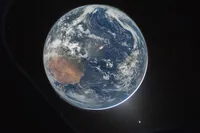
We have the first human photograph of Earth from space in 54 years, and I can't help but meditate on what it means to be human on a fragile planet in 2026.
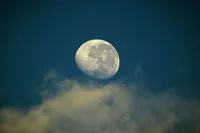
Born on April 13th, 26 years after Apollo 13's failure, I explore my personal connection to the Moon as Artemis II astronauts journey toward Her. The Moon has scientific importance, cultural naming traditions, religious significance across civilizations, linguistic ties to lunacy and menstruation, and is the first poem. The Moon unites humanity across time and space as we return to Her once again.
A few minutes before I begin writing this, I woke up into an anxiety attack. There are a lot of issues I could be writing about, the world is fraught with uncertain violence. This is a story about me, and also a story about North Darfur and Kansas and Haiti and India. I ask this: whose suffering gets reported? Whose death counts behind glass?
Exploring constitutive moral luck through Nagel and Williams alongside Nietzsche's Übermensch and amor fati, I reflect on the recursive gratitude I feel for who I constitutively am—and argue that blogging is a philosophical practice of self-overcoming: a daily, recursive Yes to existence.
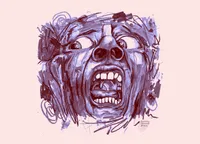
My personal exploration of schizoid personality disorder and neurodivergence. From King Crimson's prophetic song to global youth withdrawal phenomena, I examine what it means to live with a rich interior life and limited social needs, challenging pathologizing frameworks and questioning whether 'poor outcomes' are about the condition or the metrics.
How do our brains physically process stories? The neurology of narrative transportation, brain synchrony between storytellers and listeners, biocultural theory, and Indigenous storytelling traditions that collapse Western narrative structures.
What does it actually mean to build a better web, and what do we owe each other in doing so? A response to the 32-bit Café thread about trust, onboarding, and the distance between knowing something is wrong and doing something about it.
What is trust in an AI-saturated internet? And a related question, how do we reckon with the barriers to onboarding people to the IndieWeb? We must cultivate faith in our digital interactions and make independent web spaces more accessible.
Cet article de blogue est écrit en français. This blog post is written in French. Apprendre le français, le deuil et les limites de la vie — un exercice en vulnérabilité linguistique.
I've written 120 blog posts in the past 140 days, averaging 1,900 words per post. 250,000 words total on my blog currently. It's as good a time as any to review my work so far and speculate on the possibilities of my future.
Come be bored with me. Utterly bored. Within the default mode network, Heidegger's philosophy, Indigenous dream epistemologies, and personal experiences with hypnagogic states.
Liberal democracies selectively apply universal human rights, and there is a progressive failure to extend moral consideration to: Palestinians, Congolese, Rohingyans, Uyghurs, trans people, women, Black communities, Indigenous Peoples, the chronically ill, mentally ill, poor, sex workers, the disabled, the houseless, children, elderly, Jewish people, immigrants, gender/sexual/romantic minorities, incarcerated people, Romani and Dalits, and animals. True universal rights require principled solidarity beyond tribal boundaries.
Drawing on Susan Neiman's philosophy of evil, the 'missing stair' problem, and Elinor Ostrom's principles for governing the commons, I try to explore the difference between withdrawal due to burnout versus accountability, and argue that ethical communities must distinguish between systemic failures and intentional bad-faith actors while implementing graduated sanctions and accessible conflict resolution.
An open letter to the men in my life and around the world, pleading that we recognize there is so much work for us to do. A recognition of my own shortcomings and failures. Steps we can take to try to liberate the future.
My second principle for the IndieWeb requires good faith writing excludes the misanthrope. I want to reconsider that, carefully. Because the question of who gets to be here, and why, is more interesting and more complicated than I first let on.
Turning thirty during a breakup while the world unravels. Meditating on the 12,000 generations of homo sapiens that came before us, and what it means to be embodied in this particular moment of deep time.
I believe writing is sacred medicine, and I have been thinking about the writing I have been offering you over the past few months. Is it healing? Is it good? Please, let me know. I am here to give you an offering.
Reflections on an unseasonably warm February day in Calgary, contemplating the accelerating pace of change in our world and finding meaning in small moments of connection and presence.
How the inevitability of oblivion can be a source of relief, while also examining our sacred duty to make things better in the present moment through persistent, stubborn action in the direction of care.
How creative ambition transforms into a trap of endless expansion, examining YouTube essayists, neoliberal work culture, and the pressure to constantly optimize artistic output
What is the meaning of life? Is there more than one correct answer? I've decided to take a rather long-winded exploration of how different cultures approach the sacred, the dead, and the transcendent, suggesting that multiple paths can lead to the same fundamental truths.
A delightful surprise from an author I initially dismissed. Gilbert's Big Magic explores creativity as sacred play, rejecting the tortured artist myth for a lighter, more joyful approach to creative work.
CONTENT WARNING: Suicide | A matter-of-fact memoir about the endurance of loss, where Li considers grief to be regarded as having an end-point, as though there could be a finite amount felt when both of your only children choose death instead of life.
A manifesto on what we do when the world is on fire: Daywriting. The deliberate, daily documentation of ordinary existence as both personal archive and political resistance.
The lyrics 'You know the greatest films of all time were never made' is obviously not about films. It is, somehow, about how we’re living on this planet for a fragile, finite amount of time and we have something inert within us to give, to gift.
Nietzsche and Rumi had something in common: dancing. I wrote this mundane life update and found myself getting into the weeds of what's important to the physical body. What can I offer myself? How can I enact movement each day?
Can the Internet be a place we can visit again? Can it replace what malls were supposed to be for us? A blog post about what we can do with what we have.
Thoughts on embracing the ugliness of your early creations as a form of civic duty and spiritual practice. A call to action without judgement.
The liberation of realizing you can’t waste your time.