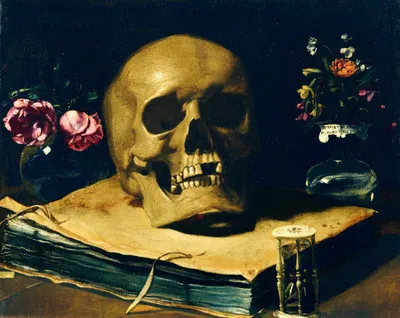
'A vanitas still life with a skull atop a book, an hourglass and two glass vases of flowers' by Giovanni Francesco Barbieri, called Guercino, ca. 1619-20. | Christie's (edited by the Author)
issue #210 of brennan.day
You Must, You Must, You Must
brennan.day — issue #210
Publisher: Brennan Kenneth Brown
Place of publication: Calgary, Alberta, Canada
Available at: https://brennan.day
Contact: mail@brennanbrown.ca
Memento Mori.
One of the most well-known Latin phrases. It's appeared in plenty of instances of pop culture. Such as in A Series of Unfortunate Events, where "memento mori" is the official Latin motto of Prufrock Preparatory School. The motto of Unus Annus (Latin itself for "One Year"), a popular collaborative YouTube experiment and channel which was set to be wholly deleted after the year was up. More recently, it was a motif in 28 Years Later as a towering Bone Temple is built, a monument made entirely of skulls.
I've known the saying since I was a kid, when death was a foreign, abstract concept less scary than a Daddy Long-legs in the basement. Nobody teaches you about death early when you're lucky.
But do you know how the saying translates into English?
PART ONE: The Difference a Single Word Makes
Interestingly, the translation I've always known has been "remember, you will die." I understood the statement as epistemic. A statement of fact about the future no different than "the sun will set." It puts death outside you, something that happens to you eventually. Something you're waiting for. You're the object of the sentence in spirit, even if grammatically the subject.
But recently, the translation I've been seeing is "remember, you must die." And this one small word change has completely shifted my perspective.
"You must die" is deontic. It's not a forecast, it's an obligation. The same grammatical register as "you must finish this" or "you must answer for this." The shift turns death from a fact you're informed of into a task you're charged with. You are given a role. You stop being a bystander to your own mortality and become someone with something to do.
Pardon the grammar lesson and linguistics, but I think this next part is really interesting. The Latin-to-English translation of Memento Mori, "mori" is the infinitive "to die", so literally "remember to die." "Memento" is imperative of "meminisse" (to remember), and "mori" is present infinitive of "morior" (to die).
The phrase literally translates as "remember to die" or "be mindful of death."
And so, the grammatical construction in Latin doesn't map cleanly to "will" nor "must." That's an English translation choice. Latin infinitives don't carry modal "will" or "must" inherently. "Mori" is just "to die." So "remember, you will die" already is a translator's free rendering, and "remember, you must die" is another.
The "must" closer to what the Stoics meant by it. For Seneca and Marcus Aurelius, the point of keeping death in view wasn't morbid forecasting, no. It was that dying well was a discipline, a duty the same way living well was. "Must" recovers that sense of necessity-as-participation: not just this will happen to you but this is asked of you, and how you meet it is yours to answer for. "Must" also echoes the old Stoic idea of ananke—necessity as the order of the cosmos, not your personal bad luck.
"Will" makes death your private fate. "Must" makes it the law everything is under, and you're simply not exempt.
Muriel Spark opened her 1959 novel Memento Mori with a string of anonymous phone calls to a circle of elderly Londoners, each one delivering the same flat, civil sentence down the line: "Remember, you must die." Spark didn't reach for "will." And there's the visual tradition of the vanitas still-lifes from seventeenth-century Holland. Skulls and hourglasses and wilting tulips arranged with the same care as bowls of fruit, reminders dressed up as decoration.
Before that, a victorious Roman general riding through the city at the peak of public worship during his triumph, had a slave standing in the chariot behind him whose job was to murmur the phrase into his ear. The most-cited version of the line comes from Tertullian, a Christian writer working two centuries after the fact: Respice post te! Hominem te memento! "Look behind you. Remember you are a man."
PART TWO: I NATURALLY MUST
Perhaps paradoxically, I am comforted by this declaration of obligation. Yes, I must die. And so must you. We all must. And so we must all live, passionately and in vivid colours. The imperative command of living is just as pressing as our obligation to our finite biological substrate, our fragile mammalian flesh bodies.
No matter how much transcendental light is within the mind of a person, we are just as much electrochemical signalling, we are just as much the sodium ion gates flicking open and shut in a thousandth of a second each time, the whole length of every nerve, your entire life.
We are just as much the iron and oxygen being carried on erythrocytes in the rivers underneath our skin, hundreds of millions of hemoglobin molecules packed into every one of those cells, each one gripping its little fist of iron, picking up oxygen in the lungs and letting it go everywhere else, over and over, about sixty seconds a loop, for as long as you're alive.
We are just as much the bundles of nerves and Prometheus' regenerative liver and Adam's sacrificial ribcage. We are always as mundane as we are sacred. Always as divine as profane.
And life is a series of deaths we must endure and find our way through. We walk through it waywardly, our gardens always in bloom with mourning and grief. And all we have is each other as we circumnavigate the impossible darkness. I've made it no secret that I'm deeply interested in death cultures around the world, and particularly in how the Western world sweeps the concept of death under the rug and pretends to live forever. As though the filament in the neon lights is everlasting, as though the skin beside our eyes and mouths never wrinkles. As though our hearts pump blood forever. As though we'll always have time to call that friend that we haven't seen in forever.
But what if I die without ever seeing you again? I've been thinking that thought for seven years, now.
I must die, the way I must write. The way these words are inevitable, not predictable. We take for granted so much that seems moving on its own. But ask a physicist and they'll tell you how nothing can generate its own energy. There is always a cost, or a primary mover. Always invisible, uncredited labour or the neglected shoulders of giants becoming sore and aching. The first law of thermodynamics tells us energy can never be conjured from nothing and never vanishes. Everything alive is energy that already existed, wearing a new shape for a while.
"Natural" is such a misnomer. We look at the wind swaying through the trees and think it effortless. It must be a simple act. Surely it must be, for it happens so often, so consistently, around the world.
But those trees have existed and evolved for millions of years, their leaves genetically crafted through generations of attempts to find the aerodynamics necessary. The leaf shape changes how a leaf flutters, how much drag it carries, even how fast it falls once it's let go, and that shape gets selected on, generation after generation, the same blind and patient way everything alive gets selected on. And the wind is a complicated consequence of the planet being heated unevenly by the Sun, by air pressure differences, by the Coriolis effect, a deflection occurring because Earth refuses to stop spinning.
Our genesis and our death are no different.
PART THREE: HURRY UP
I must die. I must live now and earn my keep. I must allow the grief of loss to pulse through me frequently and honestly.
Anything not intentionally focused upon is in the process of being lost. Our skills are lost when we go for a long-time without practice. Use it or lose it. The sourdough will stale, and the fruits of our labour will rot just as the seed of Eden is. We must do, we must urgently hurry. If I do not write, then there is no writing there when I have passed. As Eliot reminds us in The Wasteland:
I didn’t mince my words, I said to her myself,
HURRY UP PLEASE ITS TIME
Something less spoken about is how our relationships are no different. Our social bonds decay in real-time just as much as matter does to entropy. We are always in the process of losing everyone we love. Connections always require maintenance and balm and nourishment.
What a peculiar twinge. Bitter tea leaves and a walk around the park, where the women come and go, speaking of Michelangelo.
As I've already mentioned, the film 28 Years Later has the bone temple, and Dr. Kelson explains it on-screen to a boy named Spike: memento mori, remember we must die, yes. But there's another saying he teaches, memento amoris.
Remember, we must love.
swan song/coda/epilogue
Please understand there is no advice, here. There is no call-to-action. There is nothing to take away from this. You may make choices that change death's date, you may prolong or shorten your life. There is nothing to romanticize. It is likely the next 13 billion years will go by just as quickly as the 13 billion years the universe existed before we were born. This is probably the only chance at anything we get. And how strange it is to be anything at all.
No matter how beautiful the swan song, the coda, the epilogue, the book has a set amount of pages until you reach the back cover. Remember, you must die all the same.


Comments
To comment, please sign in with your website:
How it works: Enter your website URL. IndieLogin checks your rel="me" links on GitHub, GitLab, Codeberg, and email. Setup instructions.
Signed in as:
No comments yet. Be the first to share your thoughts!