Posts tagged "linguistics"

7 posts with this tag.

  • Gouache painting of a beach in flat bands of color: a violet-blue sky with four white clouds outlined in wavy black ink, a deep blue sea with a white steamboat and small black wave marks, and a red-orange shore. Loosely drawn black-line figures lie on the red sand, with white strokes marking their swimwear, and another figure sits in profile at the lower right. White brushstrokes at the left suggest beach buildings. The signature 'Golanda' is at the bottom left.

    Thank You For Today

    The holy clean and the October urge to shake the dust and start again. I have gratitude for this absurd life. On Marcus Aurelius leaving his warm blankets and existence as a freefall kicked off a precipice. On thanking the bus driver, coral growth, the Moon's tides stretching the day, and Alberta Time holding the clocks still for the first fall in fifty years. On the Haudenosaunee Thanksgiving Address spoken before anything else is done. On maarsii and kinanâskomitin, the Cree verb that won't let you give thanks without saying to whom. What are you grateful for?
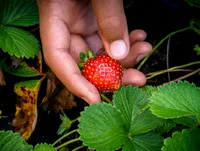
  • A hand holds a ripe red strawberry between thumb and fingers, surrounded by green strawberry leaves. Specks of soil cling to the berry and fingertips, and a few leaves nearby have yellowed and browned.

    Ode'imin: In Defence of the Berry Pickers

    On #RezTok, a berry picker is a man who comes home without the moose. On fruity men and Canada's fruit machine, Man the Hunter and the women who hunted anyway, and pemmican, the food made of meat, fat, and berries that the Métis Nation first stood up for at Seven Oaks. On the serviceberry and its many names, saskatoon wood that became arrows, and the Michif word for a little pear. On bananas being berries and strawberries not, a Supreme Court that decided the tomato is a vegetable because of when you eat it, and a Eucharist that was already made of fruit. And on ode'imin, the heart berry: love, emotional truth, healing, forgiveness, the first medicine of spring.

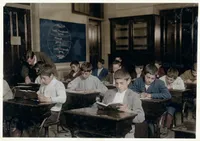
  • Colourized archival photo of a classroom full of boys at wooden desks, most bent over open books or writing with pens, in an early 20th-century schoolroom with a world map on the chalkboard and a teacher leaning over a student's desk in the background.

    Proper English is a Myth: There's No 'Correct' Way to Write

    Responding to a blog post urging people to 'please learn how to write,' I pull rank with my English degree to argue there's no such thing as proper English. Looking at the 18th-century grammarians who invented 'correctness,' the linguistic racism of policing dialects from AAVE to Jamaican Patois, and why blogging should be about meaning, not mechanics.

  • Collage numérique : une personne en mouvement flou, veste orange et sac en cuir à l'épaule, superposée à une rue illustrée en noir et blanc, avec un panneau de traverse piétonne et des éclaboussures de peinture abstraites.

    Le Flâneur, et Autres Mots Intraduisible

    Cet article de blogue est écrit en français. This blog post is written in French. Sur les mots et expressions français qui n'ont pas de traduction directe vers l'anglais, comme déjà vu, jamais vu, presque vu, dépaysement, retrouvailles, l'esprit de l'escalier, terroir, jolie-laide, sortable et flâneur; la notion de lacune lexicale; et l'importance culturelle et historique du flâneur, de Baudelaire à aujourd'hui.

  • Un panneau d'arrêt rouge couvert de collants est planté au premier plan d'une rue pavée sur la place Jacques-Cartier, dans le Vieux-Montréal. Des deux bords, y'a des vieux bâtiments en pierre avec des toits mansardés pis des lucarnes, pis on aperçoit un clocher d'église au dôme vert en arrière-plan. La rue est pleine de chars stationnés pis d'autres en circulation, pis y'a quelques piétons qui marchent sur les trottoirs, près de boutiques comme la pizzeria « Bella Vita » pis le magasin « Jacques Cartier Souvenirs ». Le ciel est tout blanc et couvert, pis y'a un petit sapin en pot près de la devanture de gauche.

    L'IndieWeb en français québécois?

    Cet article de blogue est écrit en français. This blog post is written in French. Sur la traduction des termes de l'IndieWeb en français québécois, l'état actuel des ressources francophones (wiki IndieWeb, Vincent Breton, Radio-Canada), la tradition néologique du Québec via l'OQLF (courriel, pourriel, clavardage, etc.), les termes déjà existants (blogue, fédivers, auto-hébergement), et des propositions pour de nouveaux termes comme PSSA pour POSSE, rétrolien pour webmention, et jardin clos pour walled garden. Un appel à la discussion sur la traduction des termes techniques dans les langues non-anglophones.

  • Hand-colored historical engraving of a European colonial waterfront, depicting an 18th-century port city. A broad river or harbor curves through the center, with a large sailing ship flying red pennants anchored at right. In the foreground, workers unload barrels and crates from wooden boats while several figures in brightly colored coats converse along the shoreline. Across the water stands a dense cluster of pastel-colored buildings dominated by a large domed cathedral and a tall stone tower, with additional church spires rising behind them. The sky is pale blue with soft pink clouds, giving the scene a calm, idealized atmosphere.

    On n'a pas la langue dans notre poche!

    Cet article de blogue est écrit en français. This blog post is written in French. Sur les différences entre le français québécois et le français européen, l'histoire linguistique du Québec depuis 1763, les sacres québécois comme acte de rébellion contre l'Église catholique, et le michif, la langue mixte des Métis avec ses verbes cris et noms français, son ethnogenèse au 19e siècle, et son statut de langue en danger avec moins de 1 000 locuteurs.

  • Oil painting of a vanitas still life: a human skull resting on an open book with blue-edged pages, set against a dark background. To the left, pink roses in a glass vase; to the right, a bouquet of colorful flowers with a small paper scroll bearing handwritten text. An hourglass sits on the book's edge in the lower right, and a dark, curved snuffed candle rests near the flowers.

    You Must, You Must, You Must

    I've been sitting with a single word change. 'Will' versus 'must' in the Latin phrase Memento Mori, and it's shifted everything for me. A meditation on mortality as obligation rather than fate, and what it means to truly reckon with the fact that we must die, and therefore we must live and love.

← View all tags

↑ TOP