The Itch
Trying to figure out what 'the itch' is—my drive to create and contribute to the digital commons. A review of past projects, current interests in Indigenous data sovereignty and self-hosting, and the search for what comes next.


35 posts with this tag.
Trying to figure out what 'the itch' is—my drive to create and contribute to the digital commons. A review of past projects, current interests in Indigenous data sovereignty and self-hosting, and the search for what comes next.
Yesterday, Unattributed posted a thorough dissection of my article on note-taking PKMs, analyzing my lack of intellectual rigour, nebulous wording, and poor research. I use this as an opportunity to discuss the milkshake duck phenomenon, my experience with scrupulosity (moral OCD), and how to stay visible while imperfect through self-compassion rather than rule-following.
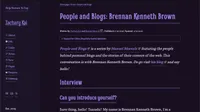
I was interviewed in Zachary Kai's People and Blogs series, founded by Manuel Moreale. I share about my background, the evolution of my blog, creative and technical workflows, philosophy on monetization, and advocacy for the IndieWeb.
As somebody who writes a lot, I've always been interested in personal knowledge management systems and note-taking apps. But what do these frameworks and methodologies actually give to researchers and the broader world? Has there been a meaningful increase of wisdom since these became popular? I went to look for an answer.
Let me be unglamorous and honest about the actual furniture of a writing life. What do my private, invisible days look like? What does it cost and what does it pay? A look at the 4 a.m. writing routine, the physical setting, and what I hope my writing will do for others.
I finally curated my blog posts into collections, revealing what I write about most: the IndieWeb, the craft of writing, community, technical tutorials, politics, culture, and more. A call to my readers to tell me what they want to see more of, and a reflection on how organizing my work helps me understand my own writing patterns and what I want to write more of.
In our current year, there is a global literacy crisis. As a result, there's a privilege in being able to read and write. Notes on Frederick Douglass, the problems you don't think about, and why the ability to write is something to be grateful for and use rather than take for granted.
Completing #100DaysToOffload twice in under two years, and somewhere along the way the wet clay hardened at the edges. Invisible ruts form inside the habits you love, and there's a difference between a window and a mirror in writing. The hermit crab outgrows shells, including the ones that still fit fine.
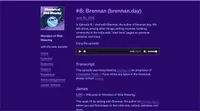
I was a guest on Episode 8 of Wonders of Web Weaving with James G. We talk about writing routines, building community in the indie web, 'start here' pages, Maple Syrup Heists, and more!
I had 448 `feat:` commits and 417 `fix:` commits. Nearly the same count, for wildly different kinds of work. Here's why conventional commits were never designed for a writer's blog, and the eleven-type system I built to replace them.
I've been writing publicly every day for seven months, and I wanted to know what that looked like for other compulsive writers. From Chesterton dictating past midnight, to Chinese web fiction authors racing through 10,000 words daily. What does their obsessive output reveal about the nature of writing itself? The volume isn't the point. The showing up is.
Writing publicly and frequently for the past seven months has saved my life. Six ways consistent public writing transformed me: cultivating curiosity, building connections, investigating rabbit holes, starting new projects, creating accountability, and seeing life's patterns in real-time. An invitation for others to begin writing without restraint.
Inspired by Good Internet Magazine, I'm starting a new volunteer-run IndieWeb publication tentatively called Long Horizon. Exploring my readiness to launch a digital and physical magazine focused on creative non-fiction and lyric essays, and seeking collaborators who want to build something meaningful on the Internet together.
Responding to criticism of 'buy me a coffee' links on blogs, I argue that asking for support isn't commodification—it's mutual aid! Exploring the economic pressures on creators, the history of mutual aid, and why the IndieWeb needs community support mechanisms to sustain independent art.
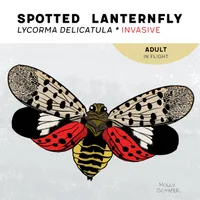
The spotted lanternfly is beautiful and terrible, an invasive species that illuminates even as it destroys. AI-generated content is flooding the Internet, and authenticity is becoming a premium commodity. We must refuse the premise that human writing is a niche product.
Nassim Nicholas Taleb's concept of 'skin in the game' is the idea that true learning only happens when you have something to lose. And I look at IndieWeb principles of using what you make to publishing under your real name. Having risk and real stakes is essential for creative work. A ship in harbour is safe, but that's not what ships are built for.
The world isn't full of critics, it's full of quiet kind people who don't get nearly enough time or attention from us because we're born with a negativity bias. We need to proactively choose to be lovers and proactively grease the quiet wheels.
My first IndieWeb Carnival entry—the theme is love letters, and I couldn't pick just one thing. A letter to the infrastructure that holds my corner of the internet together, to the strangers who maintain the open-source tools I depend on every day, and to the IndieWeb friends I've met over the past few months. And finally, to curiosity: the embarrassing willingness to fall in love with a static-site generator or a transit system or a protocol nobody's heard of, which I've come to believe is what kept me alive.
I am a compulsive archivist, terrified of losing my words, but many of history's greatest writers asked for theirs to be burned. Kafka, Dickinson, Plath, Virgil all had their reasons. A meditation on self-erasure, ego, and the difference between the writing and the written thing, with an interview with Bix Frankonis, a contemporary writer who one day decided he needed to be smaller online, not bigger.
My daily writing is a practice of releasing messages in bottles and folding paper cranes—from Montaigne in his tower and Johnson writing in poverty, to Sadako Sasaki folding 1,450 cranes in a hospital ward. What the essayists, drift bottles, and Senbazuru share, and why the attempt itself is the whole math.
A history of the word 'meme'—from Richard Dawkins coining it in *The Selfish Gene* in 1976 to Advice Dog and the death of shared internet monoculture—and what happens when you take memetics seriously as a theory of culture. Metal Gear Rising's Monsoon delivers the most honest account of how memes shape who we become. The lyric essay resists this process by design.
I snuck off school grounds to write in a back alley, shoplifting Ginsberg and Neruda from Chapters, and I'm alive and writing today because of that. Recent neuroscience confirms poetry activates the brain's dopaminergic reward system, treats anhedonia, and is—more than metaphor—medicine.
My annual birthday essay on turning thirty: examining the cross-cultural agreement—from Confucius to the Hebrew Bible to Zoroaster—that thirty is when formation ends and function begins. My dark year of depression which turned out to be preparation rather than delay, and on writing 200,000 words since, which turned out to be the same thing.
A review of the prank I pulled yesterday, in addition to serious discourse about being silly, including thoughts on the role and importance of satire and literacy. I also share a detailed technical breakdown of the scripts that I added to the prank as well.
There's tension between creative authenticity and professional presentation in the IndieWeb space. What does it mean to be taken seriously as a writer while maintaining personal joy and rejecting the aesthetic standards of capital?
Cet article de blogue est écrit en français. This blog post is written in French. Apprendre le français, le deuil et les limites de la vie — un exercice en vulnérabilité linguistique.
I've written 120 blog posts in the past 140 days, averaging 1,900 words per post. 250,000 words total on my blog currently. It's as good a time as any to review my work so far and speculate on the possibilities of my future.
I believe writing is sacred medicine, and I have been thinking about the writing I have been offering you over the past few months. Is it healing? Is it good? Please, let me know. I am here to give you an offering.
Being developmentally delayed has benefits, and I am embracing the journey of being a late bloomer in writing, web development, and life.
The newsletter platform is supposed to be the new economic engine for culture. Yet, they let hate speech fester. Why? The answer is obvious. Writing is treated as commodity instead of sacred art. But there is a solution.
A roundup of recent developments: building a terminal-based writing organizer, being interviewed by Le Monde about AI social media, and thoughts on Medium's Partner Program changes.
You don't need to be a developer to own your corner of the internet. A guide for writers, poets, and creators who want to escape algorithmic feeds and reclaim their digital presence. No computer science degree required.
A manifesto on learning to persist in your writing and to write anywhere. I'm finally pursuing my dream of being a writing instructor by starting a new, low-cost online class for those ready.
What Four Years in a Children’s Hospice Kitchen Taught Me About Craft
A Case for Independent Literary Journalism: Why I’m Going All In