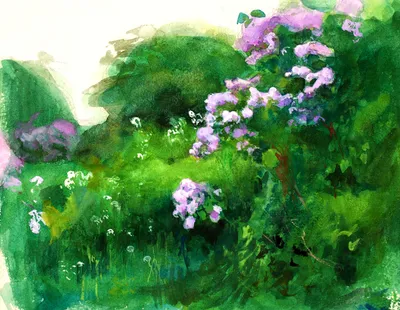
'Lilac Bush' by Eero Järnefelt, c. 1880-1937. | Finnish National Gallery (edited by the Author)
issue #205 of brennan.day
Blogging Saved My Life

brennan.day — issue #205
Publisher: Brennan Kenneth Brown
Place of publication: Calgary, Alberta, Canada
Available at: https://brennan.day
Contact: mail@brennanbrown.ca
It's finally summer out here in the prairies. The lilac bushes outside my townhouse are blooming with deep purples. A rich, powdery aroma comes from the plant. The softness of roses and jasmine with warm, nutty hints of almond, along with a crisp, slightly green freshness. Lilacs carry the meaning of being the harbinger of renewal.
It's been fifteen months or so since I graduated university and my life has been going by so quickly. It's hard to grasp that an entire year has now passed me by.
When I graduated, I could have tried to find a comfortable, well-paying job. I could have used my software development skills and English degree to work for a myriad of genAI companies who desperately need humans to fix their still-broken slop. I decided to take a chance. I decided to go all-in on writing instead.
And it's been around seven months since I began writing publicly near daily trying to make a career out of it. (I had been writing privately daily since the start of 2025, but this has been completely different.)
Writing publicly saved my life.
Putting myself out there and beginning the project brennan.day has been the best decision I've ever made. To stake a vulnerable claim to the world and share my thoughts has opened more doors and cultivated more friendships for me than I could have ever thought when I began.
Six Ways Writing Publicly and Frequently Saved Me:
Writing publicly on such a consistent, frequent basis compels wonderful things to happen.
- I am constantly on the search for new ideas. Writing so frequently means my eyes are always open wide—the world is always a place brimming with things to dedicate myself to, and be curious about. Being curious means I don't assume anything, especially my knowledge on something. I am eager to learn and to share my learning with others, regardless of what the topic is.
- I connect with people. Writing often means netizens leave comments! or sign my guestbook, or reach out via email or the fediverse, and I get to connect with people on a human-level. Beyond that, I've found friendships with people online because of being so open with my interests and passions. I've found communities on forum boards and chatrooms and microblogging all because I'm putting myself out there honestly.
- I find rabbit holes and start digging. Because there's something new I'm always writing about, I've found myself to get more investigative. I begin pulling at threads, like when I found the massive malware ring on GitHub, or reported on the 11ty Kickstarter debacle, or did a story on an Indian Residential School Denier and subsequently interviewed them, or found out Bubbles.town began with genAI usage and interviewed the creator and saw him redeem himself, at least in my eyes.
- I've started projects that I never would have otherwise. Because I wanted my own website for my writing and to move away from being dependent on Medium, I made Brennan.day from scratch. Which meant that I had to brush up on my coding and programming skills that I hadn't used in awhile. It turns out this has resulted in me doing the most web development I've ever done in my life in addition to the most amount of writing. I've transitioned from front-end to full-stack development and learned to host multiple services for other people.
- I have an accountability mechanism. Doing something public-facing so often means that there's nothing I can really hide behind. I show my work and I'm working on something every single day. There's no cubicle to hide me playing solitaire (or rather, Balatro) while the hours drone by. I am growing as a plant in sunlight, in real-time.
- I can step back and look at the dots of my life connect in real-time. It's so much easier to understand the trajectory of my life and the seasons I've been through with such an archive of writing. I never really know anything beyond what's five feet ahead of me, but in retrospect it all looks so meaningful and inevitable despite that onward unpredictability.
Writing Saving the Lives of Others
Anne-Sophie Reinhardt spent fourteen years trapped in cycles of disordered eating before a serious health scare pushed her into recovery. She began blogging her way through it. What started as a personal reckoning became Escape Diet Prison, an award-winning blog and podcast that now reaches people around the world. The writing didn't come after her healing, it was the healing.
Elen Ghulam is an Iraqi-Canadian programmer-turned-novelist who wrote her first blog post in 2003 with the line: "My life is a joke in search of a punchline." She had no idea if anyone would read it. Twenty years later, that blog became the training ground for multiple novels, a creative life she didn't know was possible, and a community of readers who felt less alone because she dared to be messy out loud. She describes early comments as "lanterns in the dark."
Leo Babauta was in debt and drowning in obligations in 2005 with no clear way out. He began a blog not because he had answers but because he was trying to find them. He wrote about each small change as he made it. By the end of 2007, he had tens of thousands of readers, had sold a book deal, gotten out of debt, and quit his job. Zen Habits was the mechanism for turning his life around.
Decades of research by psychologist James Pennebaker at the University of Texas found that writing about difficult experiences—across more than a hundred studies—measurably improves both physical and psychological health. Fewer clinic visits, reduced anxiety, relief from post-traumatic stress. The act of putting upheaval into language, of making narrative from noise, heals the body and mind.
Writing is good medicine.
Where I Currently Am
The sun warms the verdant world outside, swaying with the wind against an unblemished blue sky. I witness the world from my window as I sit at my wooden desk, stirring the same ritual, burning the sweetgrass in my same abalone shell, listening to the hypnotic repeated melodies of Evan Lo, writing on the same blog once again.
There are millions of interesting people to meet, a million stories that still need a messenger to be told. There is so much love poetry left to write. And I am the luckiest person on Earth.
I do not know what the future holds for me, or for any of us. I hope and believe there is revolutionary liberation in our lifetime. But regardless, so long as I have pen and paper, a plain text editor and an Internet connection to transmit my walking wall of words, that will always be enough for me. I am not wanting of anything beyond this.
I am so thankful I began writing in public the way I have been. I didn't wait for anyone's permission, and I didn't let myself get in my own way.
Of course, this wasn't actually an overnight success, it was built on years of writing beforehand. Of course there's a part of me that wishes I had started sooner, that thinks of all the writing I could have already had finished if I began pushing myself like this much earlier. But that's not how it works. The only timeline is this one, the only time I started was seven months ago.
An Invitation
And I hope I can inspire you to start writing, too. Or if you already are, then to write with less restraint and hesitation. To pour yourself on the page and bloodwrite, or at the very least, freewrite. The blogging world is not a zero-sum game, and we are not competitors. Contribute your thoughts to the commons, the newfound digital town square not owned by a private, for-profit corporation but instead the people once again. Each blog a table at the salon.
The best time to plant a tree was ten years ago, but the second best time is right now. This is a proverb that has allowed me to start and begin and renew over and over again throughout life.
Returning to the nature metaphors, Whitman also wrote of Lilacs. In his eulogy to Abraham Lincoln, the flowers represented perennial love for the assassinated president, and it's a poem I find myself returning to often:
(Nor for you, for one alone, Blossoms and branches green to coffins all I bring, For fresh as the morning, thus would I chant a song for you O sane and sacred death. All over bouquets of roses, O death, I cover you over with roses and early lilies, But mostly and now the lilac that blooms the first, Copious I break, I break the sprigs from the bushes, With loaded arms I come, pouring for you, For you and the coffins all of you O death.)"
Gouty writes in her analysis of the poem:
While lilacs are first to bloom, their flowers are short-lived. The heady fragrance lingers sweetly at first, but then the blooms start to die, leaving a heavy, cloying smell. One of the first flowers of spring, lilacs contain a natural compound called indole that’s found in flowers—and feces. It’s that undercurrent of the “bottom note” of fragrance that suggests decay and death.
I do not ever forget this, either. For nothing gold can stay. And we are not obligated to a single thing. For there are a million other things you or I could be doing right now. I am limited and finite and fragile, and I cannot think of what I would rather be doing with my finite time with my working mind than writing to you, visitor. Thank you for being here and reading.
Comments
To comment, please sign in with your website:
How it works: Enter your website URL. IndieLogin checks your rel="me" links on GitHub, GitLab, Codeberg, and email. Setup instructions.
Signed in as:
No comments yet. Be the first to share your thoughts!