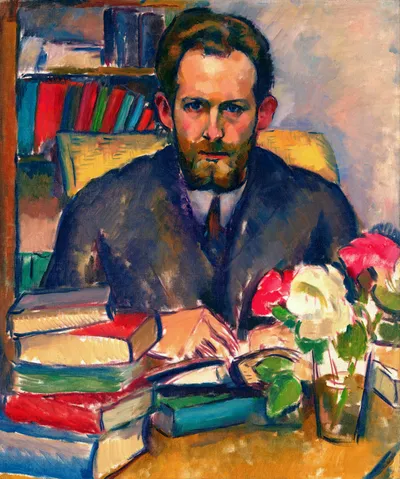
'Willard Huntington Wright (S. S. Van Dine)' by Stanton MacDonald-Wright. ca. 1913-1914. | The Smithsonian (edited by the Author)
issue #230 of brennan.day
The True, Unglamorous Life of a Writer
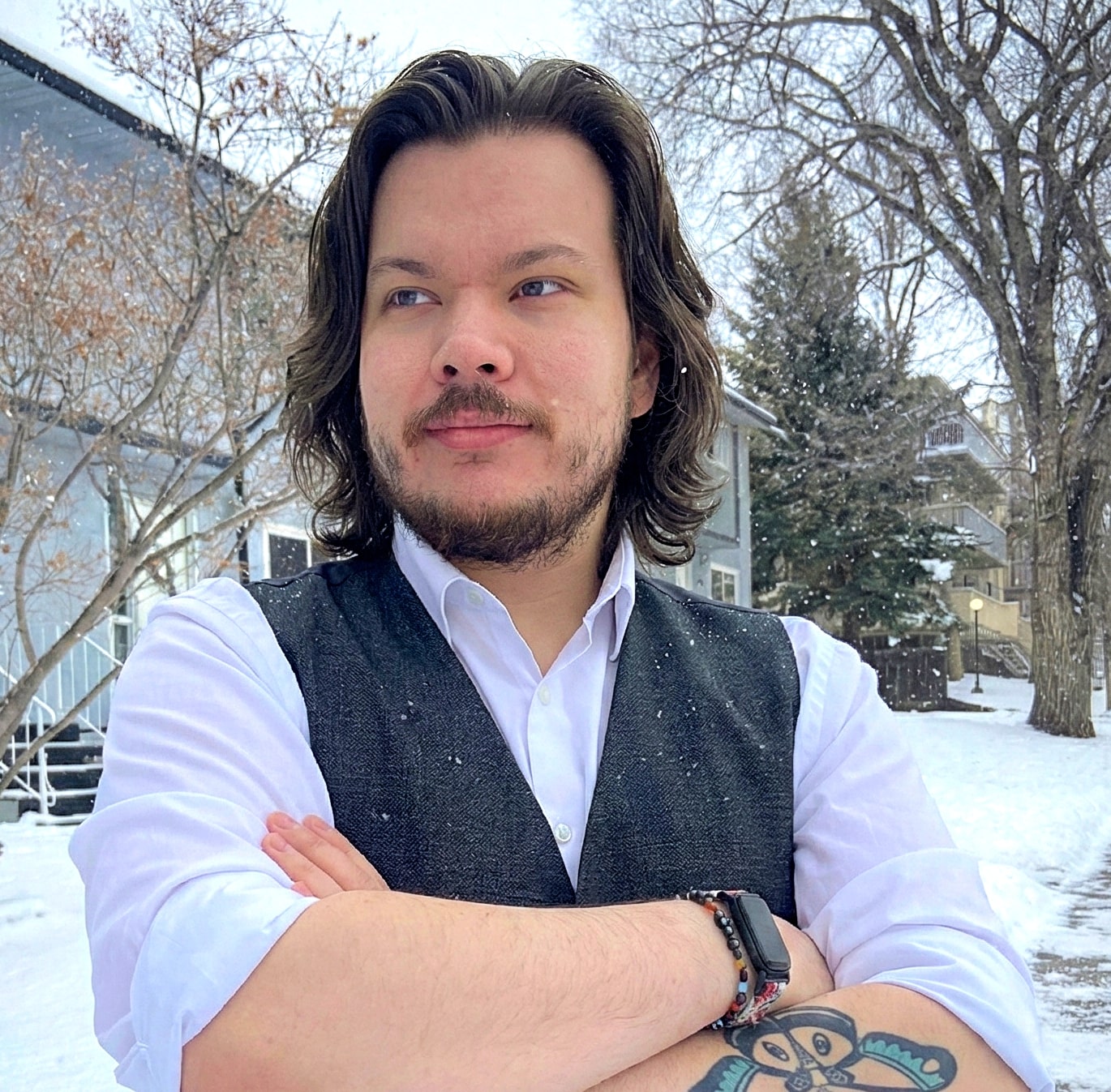
brennan.day — issue #230
Publisher: Brennan Kenneth Brown
Place of publication: Calgary, Alberta, Canada
Available at: https://brennan.day
Contact: mail@brennanbrown.ca
Let me be unglamorous and honest about the actual furniture of a writing life. What do my private, invisible days look like? What does it cost and what does it pay? (Rarely in the same currency)
What is my writing for? I need to answer this honestly. Sometimes I tell myself it's a drum, a kettledrum pounding in my head. The act of transferring that from my mind onto the paper or screen. That answer used to satisfy me, but it doesn't anymore.
For there's a cost to the body and relationships by turning the inside of your head into sentences every single day. If you've ever wondered what it would actually take to do this for real then I'll try to provide something useful here, or at least some good company.
I apologize for the sheer amount of navel-gazing in this blog post. If you aren't interested in metablogging and an author talking out loud while holding up a mirror, then I joyously recommend you skip this one for the sake of your own sanity.
I've answered the question "why do I write?" before in detail, sure, but I haven't really answered the questions "how do I write?" and "what do I hope my writing will do?" The honest version is duller than any romantic myth about writers. The honest version took me longer to find than I expected, and it isn't the answer I started with.
I think we need to take a step back and first answer the question "what are you writing on this blog, anyways?" It's a maximalist's frenzied manic dream. I do not have separate blogs for separate things, everything homesteads here.
There's the technical guides and tutorials for building your own site and blog, the polemic political manifestos, the cultural criticism and media analysis, the personal lyric essay and often my writing does not sit in one particular category but is a hybrid of the above. Too many rooms and liminal hallway logic. I'm elbow-deep in benchmarks and I'm furious about the political reality of the world. I review poetry about patrilineal damage and analyze Cree tricksters. A layman's scientific study of human society, social relationships, and institutions. Most days I don't walk between these rooms so much as fall through the floor of one and land in another, mid-sentence.
Labels
Okay, maybe it would be easier to answer "what do you call yourself?" If we're specifically talking about the writing aspect, then I am a blogger, but what does that mean? I guess I could also say that I'm a cultural commentator, a creative nonfiction writer, an independent author.
Officially, in the eyes of the Canadian government, the Statistics Canada's National Occupational Classification does have a slot for me. NOC 51111, "Authors and writers (except technical), a category for novelists, essayists, and crossword-puzzle makers under a three-digit umbrella, distinguished from the technical writers next door and the songwriters two categories over.
On a resume, I could call myself half a dozen things depending on what job I'm applying for, and all would be true and none of them would be the whole truth. Writer, author, content creator, communications professional, self-employed. On my taxes, I'm self-employed, full stop. A flattening word asked to cover essays, books, teaching, consulting, and whatever this document you're reading turns into.
Of course, there's the nebulous (and somewhat cynical) "creator" title often used by people to avoid pigeonholing themselves, and maybe to have more desirable optics and connotations—writers do have to wear many hats, after all.
The issue, maybe is the duality of stigma and romance tied to the idea of writing for a living. The stereotypes and assumptions about what a "writer" is, and what they do with their day. The working class has a mixture of envy and resentment for someone that doesn't work labour or retail (though most writers do) and can instead just type words. Many people feel as though they should be a writer but don't pursue it out of fear, or doubt, or not having the constitution to write consistently on a daily basis and keep at it.
I don't want to be talking out of my ass here, so let's actually look at where this duality comes from. The romantic half is the "starving artist" trope tracing back to the Romantic era, when the figure of the artist shifted from a Renaissance craftsman working for a patron into a solitary genius creating for art's own sake. The shift was immortalized in Henri Murger's Scènes de la Vie de Bohème and every adaptation of La Bohème since. Poverty got recast as proof of purity. Struggle became the entry fee for authenticity, and if you weren't struggling, people wondered whether you were really an artist at all.
The Authors Guild's most recent income survey found full-time published authors earning a median of just over $20,000 a year, and that's the optimistic number filtering out those reporting no income at all. The U.S. Bureau of Labor Statistics' median of $72,270 for the broad "writers and authors" category, a number mostly describing salaried technical writers and copywriters, not people trying to live off books or blogs.
Writing gets romanticized as a life free from "real" labour, and for most people who try it's one of the worse-paying professional categories there is. The working-class resentment isn't wrong to sense some unfairness in the arrangement, but it is aimed at the wrong target. I don't think I'm getting away with something. Writing is systematically underpaid, and that's mythologized as a virtue instead of a wage problem.
Now, all that said, I've been asked what my day-to-day looks like as somebody who writes for a living. And although I've written out my blogging workflow, that really only answers the process on the screen. I haven't really gone into detail about the physical setting, what my schedule looks like.
How I Write
There's the blue static glow of my monitor at the hour when the fridge hum is the loudest thing in the house. Mechanical keyboard cherry red switches clacking too loud for 4 a.m., silence rushes back in to fill the space whenever I lose the momentum for a moment. String lights hanging above where a more put-together person's desk lamp would be.
Like the few honest writers out there, I will be the first to tell you it is completely unglamorous. I am not making daily trips to the lovely independent café with amazing sandwiches and coffee only a few blocks away from me. I am not hunched over a typewriter or immersed in corkboards covered in string and sticky notes. I do not relax in a rose petal lavender-shaded bath with a warm cup of jasmine tea. Nor am I at a vibrant dive bar during slam poetry night, keeping rough notes in a worn leather pocket notebook.
No. Sometimes, I am at my desk, other times I am still lying in bed or sitting at my couch, groggy at 4 in the morning, only in a pair of boxers. Maybe I'm playing the folktronica of Flawed Mangoes or the ambient jazz of ridgeclub, but most of the time I'm in silence. I'm usually surrounded by empty cans of energy drinks (one of my only vices) and I am writing the words until I reach that magic number of 750.
Then, after the good-enough start of the first draft is done, I take a break. Sometimes for hours. During this time, I do not listen to 19th century romantic violin concertos, or indulge in heavy high-brow paperbacks like Gravity's Rainbow or House of Leaves. Instead I'm playing games of chess or Balatro, often with YouTube videos running on a second screen. I chat with my friends on IRC and check my emails (far too frequently and for no good reason). I clean up the previously mentioned empty aluminum cans, maybe listen to a podcast episode, and then I take a cat-like nap.
I typically spring back to work when I wake up, my circadian rhythm admittedly shot and my dreams vivid and absurd. I paste my words from 750words.com into Sublime text and start tracking down links and sources, facts and figures, quotes and references. Anything that adds enough fat and teeth to the writing to leave me satisfied.
Maybe I'll have a sandwich or instant noodles, a piece of fruit, definitely another carbonated beverage. It is so easy to obey the opening lines of Psalm 23, "The LORD is my shepherd; I shall not want." when you are as boring as I am. I'm sober, smoke nothing except smudge sage, I don't gamble or doomscroll. I am as dull as a bad knife.
Anyways, I then look for a lovely public domain photograph or artwork and then spend quite a bit of time editing it myself by hand in Pixlr. I find there is always more vibrant colours and highlights that can be pulled out and restored from many old photos and paintings.
Then I hit publish, and I exhale air I didn't know I had been holding. The writing belongs to whoever finds it now, and there's nothing left for me to control about it. I don't refresh the analytics or sit vigil for the first comment. I let it go the way you let a paper boat go on a current. Out of principle and mostly because by that point I'm too tired to do anything else.
Outside, the sky isn't dark anymore but isn't light either. Grey-blue, and the birds begin before the sun has decided to show up. I grind decaf, pour it slow through the Chemex, watch the bloom, and drink it black in the silence that only exists at that hour. Then I go to bed as the rest of the world is waking up, and I sleep through what everyone else calls morning.
...what do I hope my writing will do?
How do I return to form? The black tar running through the capillaries, the thin narrow rivers between arteries and veins of blood and blood. Alive? Right.
Every writer chases some version of the same rumour, passed forward from artist to artist since before we had a word for artist: that the work might matter enough to the right stranger on the right night to keep them alive.
There are a lot of artists, especially musicians and those who make remarkable pop culture, who do have fans that say their work saved their life. That the words and the characters and the story was enough to allow life to find hope despite everything else. Bibliotherapy is the deliberate or accidental use of reading and story to help a person move through something they couldn't alone. I understand this. I've tried to memorize the lyrics to songs that will keep me alive while I learned about what clinical means in the backseat.
I used to be a poet, I've written hundreds of poems, if not thousands. Art is deeply important to me. I know that a good novel will teach you something, will change your mind and heart in a way no pragmatic non-fiction book could. The narrative transportation, a theory developed by psychologists Melanie Green and Timothy Brock, is what happens when a reader becomes so absorbed in a story's world that they stop living in their own. Total attention pulled toward the narrative, mind temporarily undefended and unguarded. It's why fiction can slip a belief past you that a well-argued essay never could. You're being transported, not persuaded, and you return changed.
But I haven't been doing that, have I? I've never been a fiction writer (I gave it a try in university and got 100 pages into a CanLit slice-of-life melodrama) and I haven't written poetry in a good long while.
If I'm being pragmatic, my answer for years has been three things: I want to inform (educate the audience), inspire (motivate the audience towards good work), and entertain (keep the audience compelled and provide that creative nourishment).
But now?
Now I think the three-part answer was a beginner's map. I'm now eight months in to doing this full-time, four hundred and fifty thousand words in, two hundred-some posts in, I've mostly stopped being able to tell.
I want to be a witness who leaves a trail. I want someone, someday, mid-collapse or mid-boredom or mid-3-a.m.-scroll, to land on my writing about grief, or clowns, or Eleventy build times, and feel less alone.
The kettledrum is pounding. I used to think the writing was supposed to make the pounding quiet down. Exorcism where you get the noise out and then you're finally free of it. That isn't what happened. The pounding is louder, if anything, because I've spent these months proving to myself I can catch some of it on the way out and hand it to somebody else.
So no, this life isn't glamorous. There's no cafés or flowers or galas. There's no agent or awards or grants. There's no book deal or screenplay or accolades. I'm just a man at 4 a.m. at my keyboard, still listening for the drum and writing it down, still showing up tomorrow and doing it again.


Comments
To comment, please sign in with your website:
How it works: Enter your website URL. IndieLogin signs you in through your site's IndieAuth server if it has one (e.g. indieauth.com), or checks your rel="me" links on GitHub, GitLab, Codeberg, and email. Setup instructions.
Signed in as:
No comments yet. Be the first to share your thoughts!