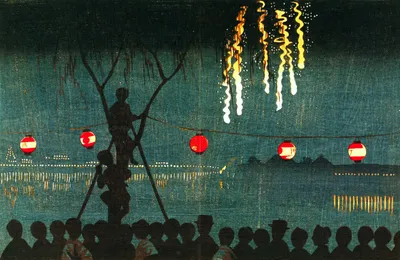
'Fireworks at Ikenohata' by Kobayashi Kiyochika, ca. 1881. | The Metropolitan Museum of Art (edited by the Author)
issue #217 of brennan.day
Shake Off the Dust!
brennan.day — issue #217
Publisher: Brennan Kenneth Brown
Place of publication: Calgary, Alberta, Canada
Available at: https://brennan.day
Contact: mail@brennanbrown.ca
It's easy to find yourself getting into invisible patterns. The mindless autopilot after doing something over and over again. The narrow rut already running deep before you even notice it. The wagon wheel doesn't need to see the groove to follow—the wheel remembers the path, sinks into it a little deeper with every pass. And then you can no longer steer.
Within the ocean, the Waves seem endless, new every time they break, but underneath they're following the same channels the tide has carved for centuries. The same sandbars, the same currents pulling in the same directions. A rut is a groove worn into something still. An ocean is a groove worn into something moving. Both shapes carved by repetition. Feeling like freedom until the day you notice you've been swimming the same lap back and forth in the same stretch of water, wearing the same furrow into the waves.
In the act of writing longform articles nearly every day for so many days, achieving #100DaysToOffload twice in less than two years. The stats for this blog are in the sidebar (or below the main content, if you're on mobile).
But in the process of doing this over and over, I've begun calcifying the act. There's a specific routine taken. It takes me far less time now to go through each step (drafting, writing, editing, publishing), but I do not want ease. I've never wanted ease. I definitely don't want automation. What was once wet clay, workable, taking a new shape every time I pressed my thumbs into it, has started to harden at the edges. I can still feel the give in the centre, but the rim is turning to stone.
Let me tell you when I began noticing the rut myself. I'm at my desk, writing what was supposed to be my next article—cursor blinking against a blank white page like a lighthouse beam sweeping an empty shore, waiting for a ship that isn't coming.
I wanted to write a piece on the weight of the term "psychosomatic" and how it's stigmatized and a tool for medical gaslighting, yet also valid in its own right. I was going to go over the history and the euphemistic treadmill (hysteria → psychosomatic → conversion/somatoform → medically unexplained → functional). As you can see, there's a lot of meat on the bones of this idea. The problem is I'm not chronically ill myself, nor am I anywhere close to an expert in medicine.
And don't get me wrong—there's merit in laypeople like me figuring out information, synthesizing different sources of understanding, and giving their opinions and takes on it. But this is something so outside of my domain, and something that requires so much care in regard to factual accuracy and precision that there's no longer room for my own voice.
And that's really what this is all about, isn't it? This question is surprisingly existential. If I take a step back from a piece and can't identify that it was me who wrote it because I'm too busy splaying out dozens of other sources and voices, then I'm not being the writer I want to be. It's the difference between a window and a mirror—one you look through, the other you look into. If I'm not careful, not intentional, then my writing fogs up the glass entirely.
There are people in this neo-blogosphere who curate links and share the work of others primarily, and I think that work is important for the thriving ecosystem of the IndieWeb. They're equally as important as those doing original writing. Similarly, people who take dense, expert-domain work and are able to communicate it to the regular, salt-of-the-Earth folk are also incredibly important. This was the work of Carl Sagan, of Bill Nye, and more recently of Michael Stevens. We need science communicators as much as we need scientists.
And I can be a communicator, don't get me wrong. I think that's what I've been trying to do with the IndieWeb—to try to convey the importance of independent web technology to non-technical writers and creators. But I can only do that because I have years of experience in both programming and writing myself. I don't have to rely on creating an annotated bibliography of academic papers and expert testimony to share my ideas. I can speak from my own personal experience, render from the heart.
Beyond the practicality, though, I am also someone who never stays at doing the same thing for extended periods of time. I am always jumping from one project to the next, like a hermit crab outgrowing shell after shell, never mind that the last one still fit fine—it's just time to move. I try to be a good steward, try to get a project to a good-enough place before frankly abandoning it, but I cannot ever be content with a single thing. Constantly recalibrating.
This includes, though, returning. Returning to my familiar oceans after letting the seafoam and trash accumulate for so many months, or years. Driftwood, plastic bottle caps, tangled fishing line, the debris that gathers on any shoreline nobody's walked in a while.
When I announced fanfiction.lol on Tumblr, I used my poetry account since that's the only account I have on Tumblr. As a result, the blog that I had been sharing my poetry on since 2021 suddenly became a resource centre and support hub for a fanfiction website.
The initial virality has died down, but it feels so weird going back to writing poetry there, now. You know? Now there's a group of different people following the account for completely different reasons, with completely different interests, and my walking wall of words will appear on their dashboards.
But I know I must return. For the tide and the shore have always been my birthright. Not the rut, not the groove created by the red wheelbarrow so much depends on.
One of my favourite spoken word pieces ever is Shake the Dust by Anis Mojgani. I return to it often whenever I start feeling myself grow tired and restless with the default status quo state of myself.
Make my words worth it.
Make this not just some poem that I write
Not just some poem like just another night that sits heavy above us all
Walk into it, breathe it in, let it crash through the halls of your arms
Like the millions of years of millions poets
Coursing like blood, pumping and pushing
Making you live, shaking the dust
So when the world knocks at your front door
Clutch the knob tightly and open on up
And run forward and far into its widespread, greeting arms
With your hands outstretched before you
Fingertips trembling, though they may be.


Comments
To comment, please sign in with your website:
How it works: Enter your website URL. IndieLogin checks your rel="me" links on GitHub, GitLab, Codeberg, and email. Setup instructions.
Signed in as:
No comments yet. Be the first to share your thoughts!