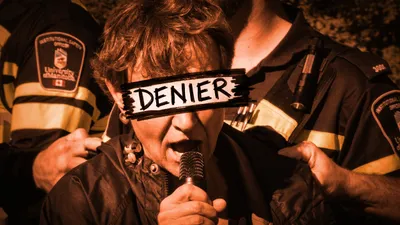
Photo: Christopher Read / APTN News (Dec. 8, 2025), edited by the Author. Original: 'Denialism close-up: APTN Investigates captures Frances Widdowson's surge', APTN Investigates.
issue #167 of brennan.day
Frances Widdowson Dedicates Her Life to Denying Residential Indian School Survivors, Then Calls Herself the Victim
brennan.day — issue #167
Publisher: Brennan Kenneth Brown
Place of publication: Calgary, Alberta, Canada
Available at: https://brennan.day
Contact: mail@brennanbrown.ca
She posted it on Facebook like a declaration of war.
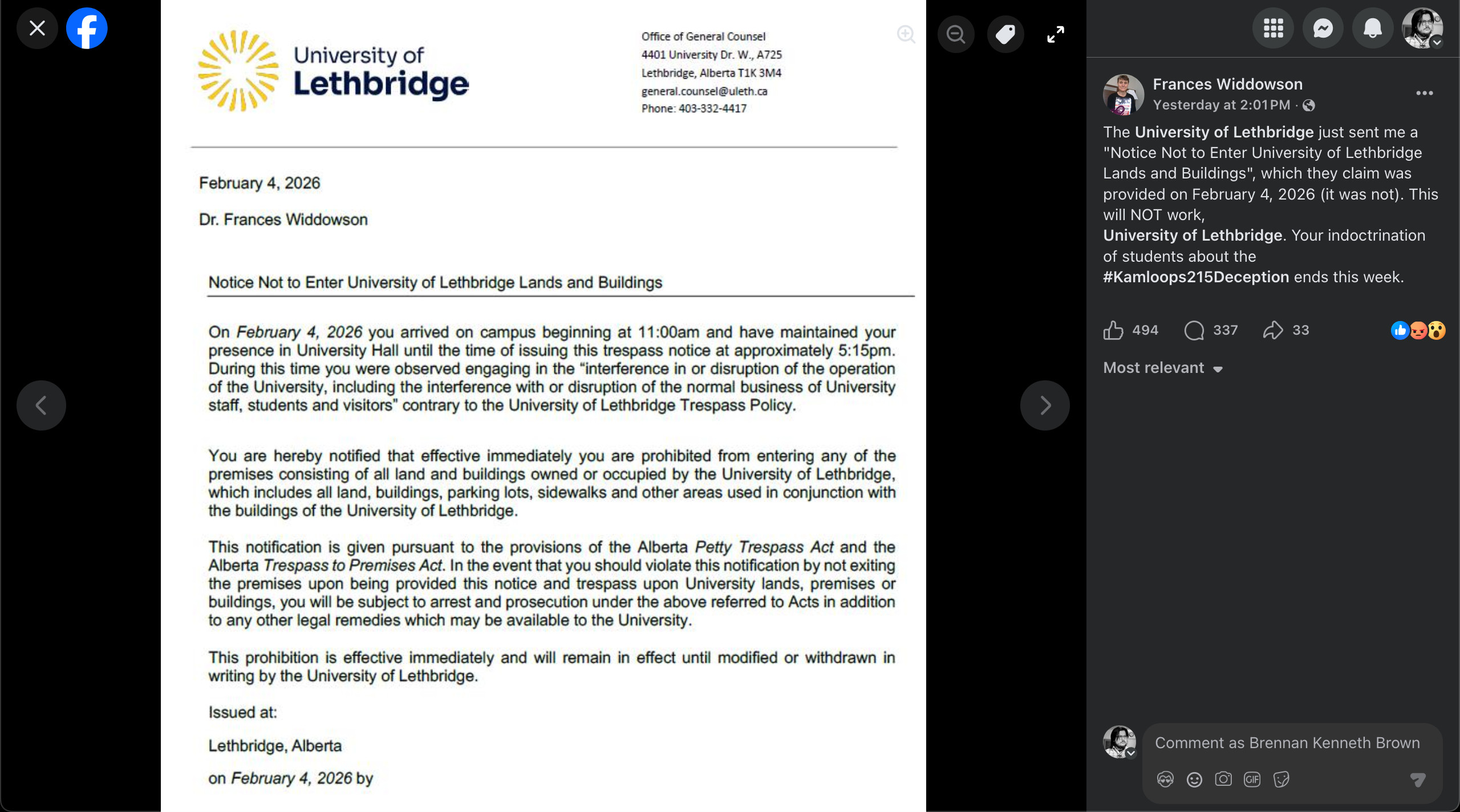
"The University of Lethbridge just sent me a 'Notice Not to Enter University of Lethbridge Lands and Buildings,'" she wrote, in that flat, defiant register that has become her brand. "This will NOT work, University of Lethbridge. Your indoctrination of students about the #Kamloops215Deception ends this week."
She calls it a deception. The children, the ones who went to school and never came home. That's the deception. Not the century of forced assimilation. Not the deliberate erasure of language, of ceremony, of kin. Not the deaths that survivors have carried in their bodies for decades, in the ache of not-quite-spoken things, in the particular silence of people who were told, over and over, that what happened to them was for their own good. She calls their pain the deception, and her crusade against that pain the truth. She announces it on social media, in all caps, with a hashtag.
And she has raised over $50,000 to fight the woke mob. Her documentary is being released in a month.
There's no good-faith debate about evidence, here. Rather, this is about who is allowed to be the victim.
I. Grounds
There is a word in Cree, askiy, that means land—but not land as property, not land as cadastral survey and title deed and municipal lot number. Land as relation. Land as the thing you are already inside of.
Frances Widdowson has spent years fighting what she calls censorship on land she does not acknowledge. She has arrived uninvited to universities she was told to stay away from, in the names of children she insists may not exist in the way their communities say they do, on ground that has never, in any legal or spiritual sense, been fully surrendered. She talks constantly about being kept out. About exclusion. About institutional doors that will not open for her.
She seems not to notice the cosmic irony of an academic settler arrested for trespassing while arguing that Indigenous claims to land and grief are overblown.
In December 2025, Widdowson arrived at the University of Victoria despite being told, the day before, that she was not permitted on the property. She was there to "initiate a good-faith inquiry," her words, into the Kamloops findings. She refused to leave when security confronted her. She was arrested. She was charged under the Trespass Act and fined $115. Less than a tank of gas. Less than a dinner for two.
She said her arrest was "an indication of an institution that is completely unmoored from its academic purpose."
What does it mean to be unmoored from academic purpose?
I am an alum of Mount Royal University, Widdowson's original institution, and I understand academic purpose as the pursuit of knowledge serving human flourishing. Not the performance of contrarianism. Not the branding of one's own exclusion as the highest form of intellectual courage. Not arriving where you are not wanted and calling the trespass notice a form of persecution.
II. Absence of Evidence
The Tk'emlúps te Secwépemc announced in May 2021 that ground-penetrating radar had found 215 anomalies, potential burial sites, on the grounds of the former Kamloops Indian Residential School. The National Centre for Truth and Reconciliation had already officially documented 51 students who died there, the dates of death ranging from 1919 to 1971.
Survivors like Garry Gottfriedson had been saying for years that something was wrong with those numbers. That children disappeared. That you would go to sleep and a classmate would not be there in the morning. "Sometimes kids would not show up in classroom," he told CBS News. "They would disappear for the next day and we knew that they were gone, but we didn't know where they were gone."
He also said this that "[w]e were made to feel ugly because we were told we were ugly. We were made to feel like we were nothing but dirt, and that has remained with me to this very, very day."
Widdowson's argument, the one that got her fired from MRU in December 2021, that she has since built an entire second career around, that fills her book Grave Error: How the Media Misled Us (and the Truth About Residential Schools), is that ground-penetrating radar does not confirm human remains. That anomalies are anomalies, not graves. That without excavation, we cannot say.
GPR does not dig. GPR reads the soil. Beaulieu herself revised the estimate from 215 to approximately 200 and called them "probable burials" or "targets of interest."
Widdowson uses the gap between "probable burial" and "confirmed remains" to suggest not that the truth is still emerging, but that the survivors are wrong. That their grief is manufactured. That the entire national reckoning—the orange shirts, the flags at half-mast, the long-overdue public confrontation with what this country did to children—was just mere hysteria. She used a story told by survivor William Coombs to suggest that survivor testimony generally cannot be trusted. She desperately seeks to discredit the accumulated testimony of people who spent their childhoods being told they were dirt.
The Union of BC Indian Chiefs, condemning her appearance at UVic, calling for exhumation of remains is "a red herring" that ignores "the abundance of well-documented archaeological, archival and testimonial evidence" demonstrating what happened at residential schools. The evidence is not absent. What's absent are the people who never came home.
III. The Anatomy of a Persecution Complex
DARVO stands for Deny, Attack, Reverse Victim and Offender. It describes the pattern that emerges when those who have caused harm are held accountable: they deny the harm, attack those making the accusation, and then reposition themselves as the true victims of the exchange. Psychologists coined it to describe individual abusers. Political scientists have noticed that it has become the foundational grammar of a certain kind of right-wing politics. The powerful, when challenged, discover that they are actually the ones being persecuted.
Sociologist Michael Kimmel calls it "aggrieved entitlement," the experience of people who believed themselves owed a certain status finding that status contested. Responding not with reflection but with rage, locating the source of their diminishment not in history or structural change but in the malice of their enemies. Rather than understanding inequality as something produced by systems, aggrieved entitlement "misdirects rage to typical scapegoats—women and minority groups—perceived to be advancing at one's expense."
Widdowson is not a man, but she certainly is an angry white woman. She was fired from MRU after an investigation found she had harassed a colleague, and there were 25 witnesses over 10 months and thousands of pages of exhibits. MRU said she "contributed to a toxic workplace environment negatively impacting the mission and reputation of the university." She said she was the victim of an "academic mob."
The woke, leftist, postmodern neo-marxists have oppressed Widdowson for years now, surely. wokeacademy.info does an excellent job championing Widdowson and fighting the good fight against... Indigenization, anti-racism, and trans activism? These are the groups that have power and are oppressing others in current-day Alberta, right?
She is also a Senior Fellow of The Frontier Centre for Public Policy, a Canadian public policy think tank which promotes climate change denialism in addition to residential school denialism. They are part of the Atlas Network of neoliberal think tanks.
Perhaps unsurprisingly, Widdowson cited her support from the alt-right darling Jordan Peterson. Peterson built a media empire on the premise that men are being silenced by an ideologically captured academy, offering solidarity to a woman whose removal from the academy was substantially connected to her pattern of disparaging colleagues, students, and the communities whose lives her so-called scholarship was about.
The persecution narrative requires that the firing be about her ideas. Not about her behaviour. Not about the testimony of the people she worked beside. The ideas. The brave, forbidden ideas.
"I tried to defend myself from that mob," she told CBC News. "I knew things were being pretty poisoned, obviously, but I thought Mount Royal still was a university that valued intellectual exchanges."
Mount Royal is my university. Where I wrote my first annotated bibliography. The place where I started to understand what it meant to make language do something true.
She walked those halls for thirteen years. She taught in those rooms. And the lesson she took from the institution is that when colleagues and students objected to her work, they were not engaging in intellectual exchange. They were just poisoning the well.
The academic freedom argument only ever runs in one direction with her. The freedom to challenge residential school survivors' accounts is sacred to her. The freedom of those survivors, and those who stand with them, to say no, not here, not on our campus? To her, that is indoctrination.
IV. #Kamloops215Deception
I want to linger on her hashtag, #Kamloops215Deception. Think about the labour required to type that. The conscious decision to frame the discovery of potential children's graves as a deception. Not a misunderstanding or methodological disagreement, but a deception. Widdowson can only see this as deliberate fraud, orchestrated lies. A community of grieving people somehow conspiring to manipulate a nation. The hashtag makes an argument in eight syllables. It calls the Tk'emlúps te Secwépemc liars without using the word.
This is how the persecution complex operates. The architecture of victimhood. Grieving Indigenous communities are not being attacked; she is defending truth. Genocide is not being denied; she is applying evidentiary standards. People and institutions aren't being harassed; she is challenging indoctrination.
The U of L's trespass notice is not a reasonable institutional response to someone who arrives uninvited to stir conflict, no, it is proof of everything she has always said. "They" are afraid of her! They cannot handle the truth!
The children—whose names are in the National Centre for Truth and Reconciliation's records, the survivors watched disappear from classrooms—they recede. Mere rhetorical figures in someone else's narrative of censorship. Evidence to prove that she is the real victim.
V. Skin in the Game
My People are the children of the fur trade, of Cree and Ojibwe and French and Scottish lives woven together along the Red River, into something new that colonial Canada spent a hundred and fifty years trying to unmake. Louis Riel was hanged. Our land was taken through scrip fraud. Our language, Michif, was driven underground. Residential schools took our children too. The system was comprehensive and the logic was total. Assimilate. Civilize. Kill the Indian in the child.
Widdowson has spent years arguing that residential schools provided educational benefits that Indigenous children "normally wouldn't have received."
The children who were forbidden from speaking their languages by physical abuse and beatings. The children who were separated from their families for years at a time, who returned, if they returned at all, as strangers. The children who survived and then spent decades surviving the survival.
What education is worth that? What benefit, weighed on what scale?
I ask this as a Métis man who walked the same linoleum hallways she did at Mount Royal, who sat in classrooms where the land acknowledgement was sometimes spoken and sometimes skipped over, who understood very early that the academy's relationship with Indigenous knowledge and Indigenous pain is complicated and imperfect and ongoing and real. "Complicated" is not the same as "deniable."
VI. Who Gets to Stay
This is what right-wing persecution complex does. Richard Nixon nursed his grievances and Barry Goldwater told white Americans they were threatened. Tucker Carlson devoted 600 segments to white victimhood while reaching three million people a night. The more power the speaker holds, or once held, the louder the cry that the power is being taken from them by an orchestrated mob. The actual dispossessed—the people whose land was taken, whose children and language were taken, whose grief is still being contested by someone with a hashtag—are recast as the aggressors.
The Truth and Reconciliation Commission documented 150,000 children who passed through the residential school system. It documented 6,000 known deaths. The system constituted cultural genocide. The word genocide is not hyperbole. It is drawn from the UN's own definition: the deliberate destruction of a group in whole or in part, which includes forcibly transferring children to another group.
The University of Lethbridge sent Widdowson a formal document telling her she was not permitted on their lands and buildings. She posted about it publicly, with caps lock and a hashtag, as evidence of censorship, of an institution so captured by ideology that it cannot allow a single dissenting voice to stand at a podium.
She received notice. Written, formal, institutional notice. A piece of paper that said "you are not welcome here." The children at Kamloops received no such courtesy.
There was no form, no due process, no arbitration hearing. There were Indian agents. There were priests. There were laws that made refusal a criminal act — that made it illegal for parents to keep their children home, that threatened fathers with prison if they did not surrender their sons and daughters to schools designed to make those children into strangers.
There was no notice. There was only the taking.
She received a piece of paper and called it persecution. They received nothing and are called a deception.
I have spent my entire life learning how to stay close to what is true even when the language is slippery, the stakes are high, and the people on the other side are very loud. Loudness is not evidence of being silenced. Performance of persecution is not persecution.
The land remembers. The land is not indoctrinated. The land does not have deception to confess.
The grounds are right there and Widdowson is standing on them.
Update: Widdowson was reached for comment and responded, you can read our interview here.


Comments
To comment, please sign in with your website:
How it works: Enter your website URL. IndieLogin signs you in through your site's IndieAuth server if it has one (e.g. indieauth.com), or checks your rel="me" links on GitHub, GitLab, Codeberg, and email. Setup instructions.
Signed in as: