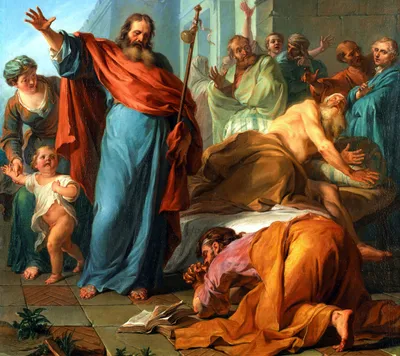
'The Miracles of Saint James the Greater' by Noël Nicolas Coypel. 1726 | Cleveland Museum of Art (edited by the Author)
issue #234 of brennan.day
Mea Culpa, When Somebody Writes Your Wrongs

brennan.day — issue #234
Publisher: Brennan Kenneth Brown
Place of publication: Calgary, Alberta, Canada
Available at: https://brennan.day
Contact: mail@brennanbrown.ca
Yesterday, Unattributed posted a long response and dissection of my article What have note-taking PKMs accomplished, really?, analyzing the lack of intellectual rigour, nebulous wording, and poor research I did throughout.
I already added an update to the post in question, so I won't get into the weeds here. I tried my best to respond graciously and with appreciation towards the author of the response. The writing was critical, but it was also fair and written in good faith. That said, seeing a 3,500-word article about me on the top of Bubbles.town yesterday certainly did give me anxiety—but that's par for the course. My chickens have come home to roost. I mean, if you're going to share your work with the world, then you need to expect the world to respond. And if you write something that's incorrect, well that's the best way to get a reply on the Internet.
Jokes aside, I am grateful that the first longform criticism I've encountered against me was a good-faith argument against my intellectual rigour. For most it usually looks different, but I'll get to that.
I care deeply about good research and good writing, and I want to make sure people do trust that I put time and effort into my writing even though I am writing frequently and quickly. Out of the two hundred articles and half a million words on this blog, I would like to think this is the first where I let myself drift carelessly from my original intention, and ended up with flimsy arguments.
Of course, I understand that "one time" isn't a meaningful argument. You can spend years cultivating goodwill and trust and have it dissolve instantly by a careless action.
All of the above is a melodramatic way to talk about an article going over a plain text file editor, and the courses and books surrounding it, obviously. I am not a journalistic institution, and the IndieWeb is kind.
But even still, there's something here I want to address.
The Milkshake Duck
I guess I want to instead take this opportunity to talk about the milkshake duck.
The term comes from a joke tweet posted in 2016 by Australian cartoonist Ben Ward (@pixelatedboat), who wrote:
The whole internet loves Milkshake Duck, a lovely duck that drinks milkshakes! 5 seconds later We regret to inform you the duck is racist.
Oxford Dictionaries noted the term in its "On the Radar" column in mid-2017, and the New York Times covered it days later. By year's end, the Macquarie Dictionary named it Australia's word of the year.
If anybody goes viral on the Internet quickly—especially for wholesome, positive reasons—then it's likely somebody is going to go through their history and find something problematic, if not immoral or criminal.
Let me give you a couple examples.
In March 2021, comedian/producer Jensen Karp tweeted that he'd found shrimp tails in his box of Cinnamon Toast Crunch, and General Mills' dismissive, gaslighting-sounding response won him massive public sympathy under the name #shrimpgate. Within a day, however, old allegations about his past treatment of an ex-girlfriend resurfaced, like how he was a "manipulative gaslighting narcissistic ex-boyfriend" who once told actress and writer Melissa Stetten "he was surprised I hadn't killed myself because my life was so worthless."
In the same year, podcaster/musician John Roderick went viral for a 23-tweet thread about making his 9-year-old daughter figure out a can opener alone for six hours before she could eat, framed as a "teachable moment." He was dubbed "Bean Dad" as the parenting backlash grew, users dug through his timeline and found old tweets with racist and antisemitic jokes, and he deactivated his account within the day. In the apology he posted afterward, he said he did it "in a panic"—needing to disappear before he could even process what was happening.
The milkshake duck echoes the lyrics from Bo Burnham's That Funny Feeling:
The backlash to the backlash to the thing that's just begun.
Perhaps because meme culture has become so heterogeneous and fractured (would "Balkanized" be appropriate here?), we get fewer milkshake ducks now, because it's near impossible to have a single entity be in everyone's timeline at once. Or, maybe we're too burned out and exhausted to give a fuck about the moral failings of some random Internet person.
Regardless, the Internet still has a tendency towards rubbernecking anytime there's a conflict or controversy aired out in public. And it has been this attitude that has given rise to drama and snark culture and gossip forums, which at their worst have woefully mutated into things like Kiwi Farms. Certainly, we should all know less about each other.
Anyways, what does the milkshake duck phenomenon have to do with my blog post? Rationally, the answer is nothing. Nobody dug up my past. Nothing hidden got uncovered. I wrote an essay, somebody found the arguments in it weak. That's not a milkshake duck at all, that's more like a peer review with better prose.
Scrupulosity
But my body doesn't know the difference. I'm somebody who has struggled with scrupulosity, or moral obsessive-compulsive thoughts, for my entire life. I hold a high (maybe impossible) bar for myself to do good, and feel as though I'm failing no matter what I do or don't do. Irrationally—because of mental illness—I see a bad article I've written as an awful moral failure. The same order of magnitude as the things that actually get people milkshake ducked.
There's "religious scrupulosity," the fear of sin, and there's secular or moral scrupulosity, the fear of simply being bad. A constant, unbearable doubt about whether you're a good person. An impaired ability to estimate threats, growing a minor failure into moral catastrophe.
Sometimes, purity culture runs on the left, borrowing the same underlying instinct evangelicalism runs on. Virtue measured by how little you can be accused of, rather than by what you actually built or gave. Standards nobody can fully meet, and a self permanently on trial for failing to meet them anyway.
I'm not sharing this as a way of negating future criticism, or as a way of asking others to treat me with kid gloves. That would be unfair and, frankly, pathetic. I write for a living and it comes with the territory—the management is my responsibility. Unattributed did nothing wrong, and I sincerely appreciate their efforts—this just goes to show how irrational and unfounded these thoughts are.
And I am sharing this in the event I have any readers who feel the same way. Whether it's due to the religious trauma of a turbulent upbringing, or anxiety associated with progressive purity litmus tests, or how every purchase feels unethical, or something else entirely. It sucks, and I really wish I could not care and move on quickly instead of ruminating.
Will I be someone that never makes a research error again? Good luck with that, publishing nearly daily. No, the answer instead is staying visible while imperfect. Publishing the correction next to the mistake instead of fixing it and hoping nobody notices. Self-compassion is one of the few things that reliably moves in the opposite direction of scrupulosity's severity. This is not something fixed with religiosity, rule-following, or getting it right the first time. It is not a game you can win.
All we can do is be gentler with ourselves than the thoughts are being with us. And extend that compassion and grace to others, too.


Comments
To comment, please sign in with your website:
How it works: Enter your website URL. IndieLogin signs you in through your site's IndieAuth server if it has one (e.g. indieauth.com), or checks your rel="me" links on GitHub, GitLab, Codeberg, and email. Setup instructions.
Signed in as:
No comments yet. Be the first to share your thoughts!