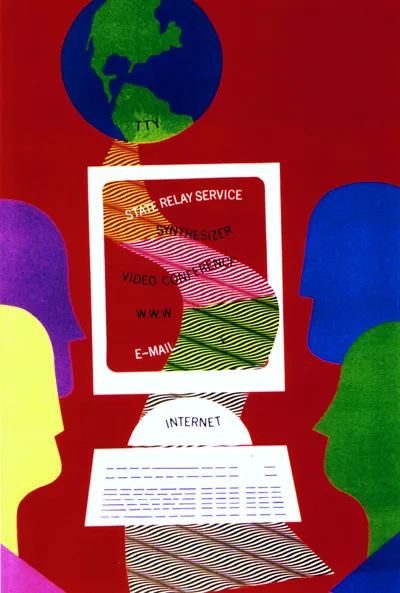
'Enhancing Communication by the Year 2000' from the National Institutes of Health (U.S.). Medical Arts and Photography Branch. 1996. | National Library of Medicine (edited by the author)
issue #294 of brennan.day
I've Never Wasted My Time Writing
brennan.day — issue #294
Publisher: Brennan Kenneth Brown
Place of publication: Calgary, Alberta, Canada
Available at: https://brennan.day
Contact: mail@brennanbrown.ca
This blog is an expression of the things I love—I love community, religion, science, good web technologies, and history, just to name a few topics off the top of my head. Of course, I also love writing. Focusing on what I love and what brings me joy is how I've been able to sustain my publishing cadence over the past year without it ever becoming a slog, or burning me out.
I'm incredibly lucky and privileged to be able to truly do what I love, but I've also cultivated the wisdom to stay firm on my values and not deviate toward something more conventional or accept others' advice when it goes against those values.
For example, there are times when, if I write "too much" on a particular topic, people will tell me I'm wasting my time and effort. That's quite an absurd premise to me! I could never consider the act of writing wasteful, nor sharing my thoughts on something I think is worth writing about. If I ever thought "eh, this isn't worth my time," then I would have far less writing and far fewer thoughts.
I always try to meet the world with good-faith curiosity. And sure, that bites me in the ass sometimes. Curiosity killed a cat, satisfaction frought it back,. I've never confronted a topic or person I've tried to avoid or shy away from.
I ♥ Internet Weirdos
Anyways, something else I really love is people; I love talking to people of all shapes, flavours, and backgrounds. There's a lot of human interest in my writing.
Something wonderful about the Internet is that there are so many weird people on it. And I'm using "weird" as an umbrella term for an incredibly wide range of folks: those who have incredible niche interests, those who are unconventional, and those with puzzling, baffling pathologies (usually those who act in continued bad faith).
A lot of the time, society is incredibly unfair and cruel to weirdos—those who have harmless (and fascinating) hyperfixations are ridiculed and mocked. Cringe culture. And there is a good argument to be made that this is the fault of irony and malignant detachment. "Typical" people ridicule those who are unashamed and vulnerable in their passion and love for something that "doesn't merit" that kind of affection or affiliation.
I love weirdos because I myself am a total weirdo. I'd never try to pretend otherwise. I'm silly—it's no surprise that April Fools' Day is my favourite holiday.
Some weirdos, though, are not simply misunderstood good people in the margins. (And it's totally unfair that such disparate groups of people get grouped together.) There are really shitty people out there who fit the bill. The reply-guys and the rage-baiters—those who are completely aware of the malice and harm they're propagating. Those who spend their finite time alive intentionally trying to fuck with or hurt people.
The most common advice you'll see is "don't feed the trolls"—the idea that any sort of interaction is the attention they're desperately in search of, oxygen for the flames. If you ignore this type of weirdo, they'll either stop acting like this or stop bothering you and go harm somebody else instead.
This has never been advice I've taken, personally.
"Don't feed the trolls" has been challenged by researchers who often find ignoring trolls doesn't stop the behaviour. Trolling often reflects deep-seated prejudices that need confrontation, rather than avoidance. The Engaging News Project found that when a recognized reporter waded into comment sections, incivility decreased by 17 percent and people were 15 percent more likely to use evidence in their comments. As one ABC opinion piece put it, "It's almost impossible to truly ignore a troll. It's like saying mosquitos are just annoying and won't hurt you and you should just ignore them."
Kyle Van Oosterum argues for "reparative civility," a Confucian-inspired disposition of turning inward to cultivate open-mindedness, tactfulness, and courage rather than withdrawing from those we find difficult. Even if empathic engagement doesn't change a die-hard troll, I can demonstrate to bystanders the practice of grace. Bradley Warfield's work on dialogic communication ethics reminds us that much online discourse is "ethically impoverished" in its other-directedness—which is why choosing to engage dialogically matters.
From Innovations and challenges in digital literacies: literacies of repair:
"In her study of the vernacular 'troll whispering' strategies of young people, Patricia Lange (2018) reports a range of techniques, from practices of 'deep listening' designed to find out what motivates trolls to collective counter-responses by affinity space participants... Among the most interesting findings in Lange's study was the intense awareness among her interviewees of their own potential for troll-like behaviour, the sense of 'an inner troll that may come out in all of us.'"
In 2016, political scientists David Broockman and Joshua Kalla sent canvassers door to door in Miami-Dade County for ten-minute conversations with voters about transgender rights. They didn't debate, but instead invited people to remember a time they'd been judged personally for being different, "encouraging active perspective-taking." The result? The study found that "conversations substantially reduced transphobia, with decreases greater than Americans’ average decrease in homophobia from 1998 to 2012. These effects persisted for 3 months."
There are other famous examples of successfully extending the olive branch. Daryl Davis, a Black blues musician, befriended members of the Ku Klux Klan. About 200 of them have quit the Klan after getting to know him.
Or Megan Phelps-Roper, who grew up on Westboro Baptist Church picket lines, spewing homophobia and other bigotry. Then, on Twitter, strangers just kept talking back to her—civilly and with curiosity. In 2012, she left the church for good, and she credits those arguments as the reason why.
The fear that engagement entrenches people—the so-called "backfire effect"—turns out to be much rarer than the study that made it famous suggested. When political scientists Thomas Wood and Ethan Porter tried to reproduce the finding across 52 issues and over 10,000 subjects, they found almost no cases of corrections making things worse.
"Nobody changed" is not identical to "nothing happened." Psychologists Sara Algoe and Jonathan Haidt coined the term elevation, which is the feeling people get from watching someone respond to cruelty with patience. A warm, motivating jolt that makes onlookers want to be more decent themselves.
I freely admit I play the game as intended, and I get down in the mud and dirt. I'm not an intelligent, detached commentator pontificating from the sidelines, somehow above it all. I'm not somebody who pretends I'm above anybody else—I'm not going to outsmart anybody who talks to me in bad faith, or claim I have the rhetorical magic to change their mind. Most conversations end where they started.
As I've mentioned in my defence of venting posts, so many of us have maladaptive coping mechanisms because that's all we knew how to do in order to survive. Don't get me wrong here—this isn't an excuse for shitty, bad-faith behaviour. And I'm also sure that, in many cases, these weirdos live comfortable, privileged lives that aren't even on the margins.
But you're still dealing with a human being here. Difficult, unlikable, cruel people are still people. You personally have every right to set boundaries and avoid and ignore people like that, but that isn't what I choose to do. I love people, and I try to meet them where they are, no matter how low that is.
I don't think giving people a chance is a fault of mine. I don't think I've wasted my time corresponding with people, or writing about that correspondence. I don't think I've wasted my time or effort trying to sincerely connect with another person. And I will continue to do that, over and over again. Because I'm a weirdo myself, clearly. Because I love reckoning with difficult, impossible things. For me, the choice to engage—over and over, with weirdos and trolls and difficult people—is a deliberate ethical practice, rooted in love and curiosity, one I've never once regretted.
My attitude of curiosity and openness is how I've been able to continue finding so many things to write about. And, frankly, tomorrow is always a blank page for me. If I write 2,000 words on a topic, then I've spent only a day or so on it, and I have thousands of days. I move on, and I find something else to write about, and today's post will most likely be forgotten in the archives and will certainly be eroded by the tides of deep time.
Time will always pass us by; the Earth will never stop rotating. Remember, we must die. Since I started this blog, I've felt that I've been spending my time wisely. I am doing the good writing and work I've always wanted to do.
Comments
To comment, please sign in with your website:
How it works: Enter your website URL. IndieLogin checks your rel="me" links on GitHub, GitLab, Codeberg, and email. Setup instructions.
Signed in as:
No comments yet. Be the first to share your thoughts!