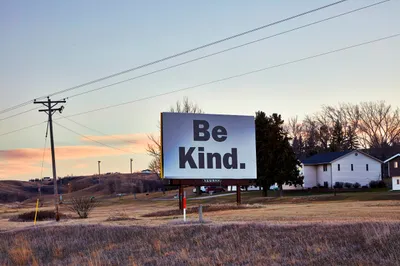
'The 'Be Kind' billboard, whose message origin or intent is unexplained, outside Minot (pronounced MINE-ott), the principal city in north-central North Dakota' taken by Carol Highsmith. 2021 | Library of Congress (edited by the author)
issue #293 of brennan.day
Kindness as First-class Citizen in Programming

brennan.day — issue #293
Publisher: Brennan Kenneth Brown
Place of publication: Calgary, Alberta, Canada
Available at: https://brennan.day
Contact: mail@brennanbrown.ca
What do you think the world has too much of, right now? There are probably a lot of answers that come to mind. Too many bills, too much being asked of us, too many stupid and dangerous people in politics, too many plates we need to constantly keep spinning. We are overwhelmed by how overwhelmed we are, and we are exhausted by our exhaustion. We are sick and tired of being sick and tired.
A few days ago, I shared the thought that You need to build what you think the world needs more of. Everyone is waiting for somebody else to.. In other words, what does the world need more of? As a random stranger noted in my replies, "everyone think the world needs more of something, but we all can't agree of what, so we are building in out own little corner." I can understand where they're coming from. People seem to be eager to demand precision in specifics, to the point where their circle shrinks detrimentally.
I would like to think that we can agree, universally, that the world needs more kindness. And I don't mean the hollow motivational poster platitude of kindness. I mean figuring out ways to ensure kindness is intentional, and integrated into our day-to-day lives of work.
Anti-Empathy
Kindness has somehow become a target of culture war. Elon Musk told Joe Rogan that "the fundamental weakness of Western civilization is empathy," using a phrase he'd been posting for months already: "suicidal empathy," coined by Canadian marketing professor Gad Saad. Saad published Suicidal Empathy: Dying to Be Kind, which debuted at #1 on the New York Times bestseller list. Then there's also Joe Rigney's The Sin of Empathy and Allie Beth Stuckey's Toxic Empathy. Somehow it's been manufactured that the problem with the world isn't a deficit of kindness, but a surplus of it.
The term "suicidal empathy" doesn't appear anywhere in peer-reviewed psychology, and Saad has never run any studies on the concept. Anti-empathy rests on vibes, not data, as there's no study behind it, evolutionary or otherwise. The modern disparagement of empathy is a deliberate way to make it easier to write off the (many) people who desperately need it. Stanford's Jamil Zaki spent over a decade studying empathy and recognizes its obvious importance. Kindness is "not a sign of weakness but a source of strength," and something you build intentionally, rather than a fixed trait.
Conservative commentators and some of the wealthiest people alive are against empathy. It's being used to justify immigration crackdowns, foreign aid cuts, and DEI rollbacks framed as necessary correctives to a society that supposedly cares too much. Once compassion is the disease, cruelty is the cure.
Kindness in Technology
On the IndieWeb wiki, you'll read up on principles like "own your data," and "use what you make," but these are all superseded by the informal eleventh principle. "Above all, have fun." You can interpret this as joy being an explicit design constraint.
Aral Balkan and Laura Kalbag's manifesto frames good technology as requiring a focus on human rights, human effort, and human experience. Technology should be easy to use, personal, private-by-default, and inclusive. You can read it as a kindness checklist for software, and it's explicitly stated as being antithetical to the philosophy guiding the management decisions of technology corporations.
"Be Kind." is what starts the code of conduct for the Elm programming language. Before anything else, be kind. Ask questions, and try to recognize XY problems. (i.e., don't let someone struggle with a workaround if a fix is upstream).
In New York City, the self-directed programmer retreat Recurse Center runs on four rules: no feigned surprise, no "well-actuallys," no backseat driving, and no subtle -isms. These are rules designed to protect people's ability to say "I don't know" without being punished. The rules are aimed at targeting common, unwitting bad behaviour. Not malice. The intent is for people to course-correct, rather than be scolded or shamed.
The most popular Linux distribution in the world is named after a Nguni Bantu concept, Ubuntu, usually translated as "I am because we are" or "a person is a person through other persons." Your personhood is relational, and your humanity is forged through your connections to others. There is the related Zulu greeting sawubona, which can be understood as "I see you" and responded to with "I am seen." I have seen, time and time again, how deeply people simply want to be seen.
And if you want to be more concise about it, there's also Wheaton's Law, where actor Wil Wheaton coined "don't be a dick" at a 2007 PAX keynote regarding sportsmanship in gaming, which spread into Internet shorthand.
On the flip side, J. Halberstam's 2011 book The Queer Art of Failure popularized the idea of toxic positivity, and what I'm advocating for here certainly is not that. Kindness means you do the right thing; it means you say the uncomfortable truth out loud and deal with things directly in order to maintain the long-term, sustainable joy of people in the community. In her 1981 keynote "The Uses of Anger," Audre Lorde argued anger at injustice isn't cruel, but rather a form of care. She drew a line between hatred, which aims at destruction, and anger, which aims at change. Kindness must hold righteous anger. Otherwise it's just avoidance.
Coraline Ada Ehmke, a fellow Rubyist and Ruby Hero award winner, spent two and a half decades making the industry kinder. She wrote the Contributor Covenant in 2014, now used by tens of thousands of open source projects, including the Linux kernel, and it exists because just telling people to "be nice" with no mechanism for enforcement doesn't protect the people being harmed. Real kindness, done right, includes boundaries, consequences, and the necessary no, not only the parts which feel good to say.
MINASWAN!
Perhaps the most well-known example of kindness as a first-class citizen in programming is MINASWAN from the programming language Ruby: "Matz is nice, and so we are nice!" Yukihiro "Matz" Matsumoto is the Japanese computer scientist who created Ruby in the mid-1990s.
Matz designed the Ruby programming language by asking what a programmer would feel, rather than what was strictly optimal for the machine. He views programming as a medium for human expression and joy. In Ruby's early days, when online message boards saw typical technical hostility, Matz’s personal kindness and positive attitude set a welcoming standard, which early adopters actively protected and propagated. The culture he created was a design output.
Sadly, a lot of people do not associate Ruby with kindness anymore. This has almost solely been the fault of Ruby on Rails creator DHH, who I have been vocally against for a while now. When people hear Ruby, they often hear "Rails," but Ruby has always been so much more than that. Ruby existed ten years before Rails, and will exist many, many years after Rails as well.
Being an early adopter of Jekyll, I actually began learning programming with Ruby myself, and I think it is a beautiful, elegant language. My friend Melo is also a Rubyist and wrote an excellent blog post going over interesting and current projects in Ruby. As she writes, there is a lot to be excited about in the Ruby world, totally unrelated to Rails! I really recommend you give it a read.
The lovely folks at Mosscap have taken on the ambitious endeavour to make a hard fork of Rails, and that will take time and technical work. But what we can do now is reclaim the philosophy of Ruby. There is nothing stopping us from choosing kindness and actively propagating the warmth and niceness of Matz that was foundational to the Ruby programming language in the first place.
When I create free and open-source projects myself, I always try to make them as accessible as possible. And I always try to make the process of using them a joyful experience. As such, I've decided to do a restoration project of a major learning resource for anybody who wants to learn Ruby themselves.
Announcing LearnWebDev.fyi
LearnWebDev.fyi is a reconstruction of the curriculum from Learn.co, a free, open-source online coding bootcamp run by Flatiron School. There are lessons on Git, HTML and CSS, Ruby, SQL, Sinatra, Rails, JavaScript, React/Redux, and more. This, too, was where I learned Ruby.
In 2021, Flatiron sadly retired the platform and moved the curriculum into its paid programs. Learn.co shut down on June 30, 2021, and the database that recorded how the lessons were organized together was also deleted. The lesson repositories stayed online in the (incredibly unorganized) learn-co-curriculum GitHub organisation, which contains a staggering 12,000 code repositories, which is what made my restoration possible.
I took the time to make some Python scrapers with RegEx to populate the site, which has 1,672 lessons available for self-study in your browser, in the original order, for free.
The lessons are rather dated, ranging from the years 2015 to 2020, but the fundamentals of programming and Ruby are the same. On the plus side, there's also no generative AI anywhere in this curriculum, as it did not exist yet. Every explanation was written by a human instructor, every lab was tested on real students, and the difficulty curve assumes you're doing the thinking yourself.
I didn't create any of the hundreds of lessons on the site. The curriculum was written by Flatiron School's faculty and team, with contributions from thousands of students, and was published under Flatiron's open content license. I just decided that it should be accessible to people again.
Avi Flombaum of Flatiron School wrote an excellent article on why the school chose to teach Ruby specifically, writing:
The most important thing for a student to first learn, regardless of language, is to fall deeply and profoundly in love with code.
Programming languages are invented for hundreds of reasons, almost all of which have to do with the environment of the code — to compile easily across platforms, to optimize parallel processing, to “run faster,” and the such. As far as I know, the only programming language in history invented for your happiness is Ruby. The Ruby language values you, the programmer, over the machine.
And concludes with:
The Ruby language encourages and empowers innovation. If a hammer is meant to be swung and a screwdriver meant to be turned, Ruby is meant to create. The Ruby tool wants you to be happy and when we are happy we can play and explore. The Ruby tool wants you to value expression and allows you to communicate as purely as a human-language. The Ruby tool wants you to be different and make the language your own. The Ruby programmer inherits these values and they fuel the creative human spirit.
Comments
To comment, please sign in with your website:
How it works: Enter your website URL. IndieLogin checks your rel="me" links on GitHub, GitLab, Codeberg, and email. Setup instructions.
Signed in as:
No comments yet. Be the first to share your thoughts!