
'Spider Web' by Big Cypress National Preserve. 2013. | Flickr (edited by the Author)
issue #305 of brennan.day
The Better Web / The Human Web / The Living Web

brennan.day — issue #305
Publisher: Brennan Kenneth Brown
Place of publication: Calgary, Alberta, Canada
Available at: https://brennan.day
Contact: mail@brennanbrown.ca
It's been a few days since my article on Claude Code being used to develop various IndieWeb tools, and in that time Aaron Parecki has written a response.
I will be candid and admit that I had a bit of a crisis of faith when I was first researching this. I've spent a year and written hundreds of thousands of words on the indie web and the consequences and harms of generative artificial intelligence. I have been advocating for people to create with their own mind and hands, and to fall in love with the work and the messy, human flaws and mistakes that come with it.
I thought for a brief moment that this was a turning point, that the stubborn endurance of continuing to push for humanity and handcrafted code and art was circling the drain and that this new frontier was just a new normal we all had to adjust to.
Then, of course, I came to my senses.
To start, Parecki writes that these services would have been shut down had he not begun using Claude to update them. This is a false dichotomy. Parecki could have put in the difficult work of updating the codebases himself by hand, and rallied others interested in preserving and maintaining these services.
Of course, it's totally within Parecki's rights to shut services down and not go through the (often thankless) hassle of trying to continue to hold up infrastructure. The people holding up the Internet are not many, and they have been doing so for decades in some cases.
Parecki is also correct that people can look for alternatives because the specifications (he helped create) and open protocols mean that anybody can make their own infrastructure. In general, we need more people willing to learn difficult things and put the work in. You need to build what you think the world needs more of. Everyone is waiting for somebody else to.
Where I Disagree
One of the things I fundamentally disagree with Parecki (and many other devs) on is the idea that "understanding matters more than tools." There is a compartmentalization happening here. The tools are part of the craft, of the art itself. What you choose and how you use it matters. Tool usage is part of the understanding.
Parecki writes how "code was never the interesting part", and really, that breaks my heart. Programming and computer science have beautiful artistic merit. I think of the fast inverse square root in Quake III Arena or Ruby Koans. Read this write-up on Knuth from fifty years ago on the subject.
Now, again, Parecki doesn't have to agree with me or enjoy code, but this is part of something I think is extremely important: leadership responsibility. Parecki is one of the founding members of IndieWebCamp, and this is the IndieWeb. I understand the desire to emphasize and prioritize modularity and pluralism—to stress that these are free concepts anybody can create and implement with.
But that is, in an important way, shirking the responsibility you have as a founder. You created multiple services that a lot of people use, including me, and many of those people view the harms of silo'd corporate social media platforms as similar to the harms of generative artificial intelligence.
Tantek Çelik, another co-founder of the IndieWeb movement and subculture, currently works at Mozilla, a company that suffered backlash for also becoming genAI-first. The new CEO of the company gave the Firefox browser an AI killswitch in response.
Parecki writes that an important "IndieWeb principle is have fun.", and I agree. But not fun at the expense of others. Generative AI is not a neutral tool, and you cannot use it separate from the environmental, psychological, artistic, and financial damage it continues to proliferate.
Where is genAI not allowed?
There are an increasingly smaller number of places where zero genAI is present—both in the real world and online digitally. Yesterday, Pillowfort.social announced that it's shutting down in December, which is one of the only existing platforms that has a full-on genAI ban. One of the most prevailing sentiments of users who will have to find a digital identity elsewhere is that Pillowfort made them feel safe.
If the uppercase IndieWeb as a brand wants to be permissive and allow genAI, there's nothing I can do about that.
But I made a promise to myself that I would not go gentle into that good night. And what I can do is use the time, energy, and abilities I have to continue trying to carve out a space that disallows genAI and is for people. We will continue making a better web, regardless. A human web. A living web.
Ani To Pisi
Here in Mohkínstsis, there is a Siksika creation story called Ani to pisi, the spiderweb. From the late Elder Clement Bear Chief and his younger brother, Elder Roy Bear Chief, holding the story for twenty years before understanding what it could teach. In the story, Creator instructs the spider to wrap the world and the people in it in his web and bring them down here, and he does as he's told. "Ani to pisi welcomes everyone into its web and does not segregate anybody." The teaching is simple: "If there are problems anywhere on the web, it will vibrate, and if you feel those vibrations, you are supposed to go and help." And "we need to celebrate good vibrations too. We are all one."
In September at my alma mater, Mount Royal University, hundreds of students, staff, and community members join hands to form a giant human spiderweb while drummers send vibrations travelling across it. A study of the 2024 enactment describes collective effervescence, awe, and a strengthened commitment to reconciliation.
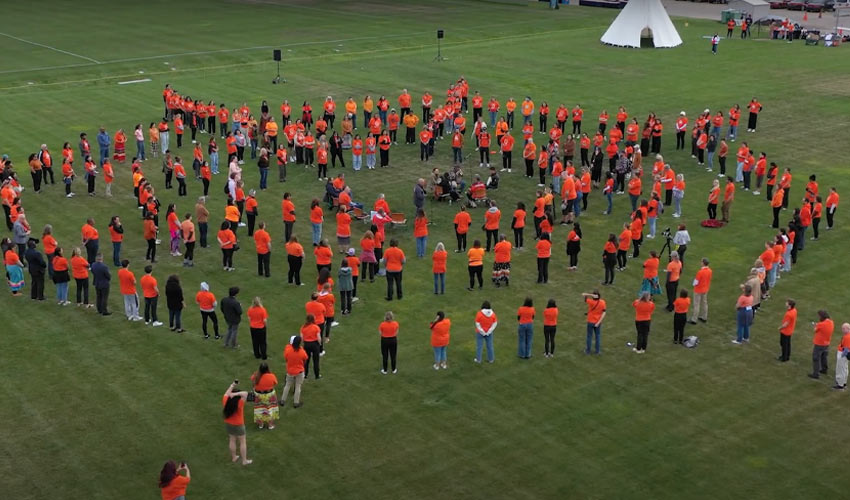
I think there is a reason we named this thing we're building the web. We are all strands, as our creations we share. When a service goes dark, when a maintainer burns out, when a community loses the one place that made them feel safe, gossamer breaks and the whole web trembles.
I encourage anybody who runs a platform, or holds a leadership position in a community, to take a hard stance and disallow genAI in the first place. And I encourage everyone else to learn the skills required for the difficult, long-term (and unglamorous) work of maintenance. We can make a new wiki, hold our own meetups, and organize and build the infrastructure needed to continue onward.
Our collective resistance is meaningful, but only if we stay stubborn and insistent. Tyr wrote in response that we "can’t rebuild everything as fast as it is getting ruined," and there's truth to that. We will never match the speed of the machine. We are wonderful slow humans. And if we aren't the people who continue to refuse and resist, then who will?



Comments
To comment, please sign in with your website:
How it works: Enter your website URL. IndieLogin signs you in through your site's IndieAuth server if it has one (e.g. indieauth.com), or checks your rel="me" links on GitHub, GitLab, Codeberg, and email. Setup instructions.
Signed in as: