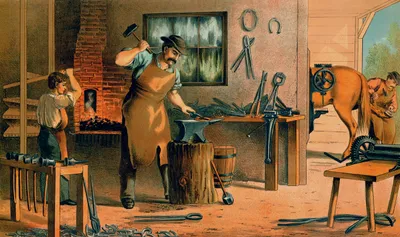
'Prang's aids to object teaching - trades and occupations - plate 4 - blacksmith' by Louis Prang & Co. (L. Prang & Co.) of Boston. ca. 1861–1897. | Digital Commonwealth (edited by the Author)
issue #301 of brennan.day
I Love Sharing Cool Stuff Made By People

brennan.day — issue #301
Publisher: Brennan Kenneth Brown
Place of publication: Calgary, Alberta, Canada
Available at: https://brennan.day
Contact: mail@brennanbrown.ca
Yesterday, I wrote a diary entry on Dreamwidth cataloguing the computers I own after my 2015 MacBook Pro died due to a swollen battery I couldn't afford to repair. While this was meant to be a simple inventory, writing it made me pause and realize that I really have so much, and that I've been under-utilizing both my time and what I own.
And I think most of us underestimate what we can do, starting right now, with the things we already have. We tell ourselves that we need the better tool, the right season when we have more time, the gear acquisition syndrome scratch that never gets fully itched. Meanwhile, everything needed for a creative, contemplative, useful life could already be sitting in your house.
I also shared a new little note on my homepage asking people to share things with me that they made (with their human hands) that I could write about. I've already gotten a number of responses, and I think there's a nice unintentional throughline.
Make Things!
To start, Maya Zimmerman shared the various games, visual flash fiction, music, and font she made on itch.io, and I get so inspired by devs like that. I think a great gateway into game development is by creating interactive fiction, poetry, and prose. There are a lot of free tools available for this:
- Twine for browser-based hypertext stories
- Ink and its editor Inky for branching prose
- Inform 7 for parser IF, written in a programming language that reads like English sentences
- Decker, a HyperCard-like tool for 1-bit creations
- Bitsy for tiny narrative games
- Ren'Py for visual novels, where you can use public domain images or your own digital art.
And from there, you can get into full-on game development:
- Godot (free, open source): go through the "Your first 2D game" tutorial, use Pixel Studio for the art (free on mobile).
- TIC-80 (free edition): a 240×136 fantasy console with code, sprites, and music all in one tool.
- GB Studio (free): drag-and-drop Game Boy games that compile to ROMs that are shareable as itch.io web builds.
- devkitARM + Tonc (free): GBA homebrew in C, tested in mGBA.
I've tried to branch out creatively a little myself. I've started a small digital art sketching habit, which isn't hard to get into if you already own a tablet. You don't need the expensive, brand-name stylus or well-known paper-like protector. The ones I got were affordable: an ESR paper-feel screen protector and a Metapen A8. And the same goes for software—there's no need to pay the ridiculous subscription fee for Photoshop (especially now).
Speaking of genAI, Stuart shared with me two interesting websites. NoAIlist.org catalogues over 300 projects that are explicit about not having any generative AI work. The second is ScienceFind.org, which is a "tool that suggests science wikipedia.org articles for learning/studying. Learn something new every day!" Isn't that lovely?
While I'm on my soapbox, I'd love to recommend Lyon's idea to add a /carless page to the slash pages of your site.
Our Incredible Journey
Next, my friend and 11ty expert Adam asked me about what's happening with Deno and Bun. Deno being bought by Cloudflare—a company I already would advise you to stay away from as best you can. For those unaware, Deno is a fast, open-source runtime for JavaScript, TypeScript, and WebAssembly. Unsurprisingly, CF is killing the Deno runtime immediately after the purchase was announced:
We will support the Deno runtime for another year with monthly releases containing bug fixes and security updates. After that year we will end our development of the Deno runtime. Deno will remain open source, and we welcome others who want to continue its development.
Bun is an all-in-one JavaScript and TypeScript runtime, package manager, bundler, and test runner powered by the Apple JavaScriptCore engine. It was acquired by Anthropic, the creators of the LLM chatbot Claude, back in December. Only a few days ago the headline appeared "Claude Rewrites Bun's Million Lines of Code in 11 Days for $165,000", which is an anti-pattern you should avoid (not brag about)—and that I've already written about.
What I'll say about this is that there is no tool, product, or service (open source or otherwise) that is safe from the hands of a corporation willing to buy and destroy it. The Tumblr blog Our Incredible Journey has an extensive archive of acquisitions turning into shutdowns for many years now.
One of the reasons I'm a JAMstack developer that doesn't use JS frameworks is because there is no company that can buy HTML or CSS or vanilla JavaScript. When you get to the bare fundamentals of development, and you focus on those, not only are you avoiding undue bloat, you're also ensuring the longevity and robustness of your web development.
Other Cool Things
There are so many people still making cool things with their own two hands and wrinkly pink brains. Eltrac shared with me his project of "a new Webmention receiver in Clojure (a beautiful Lisp dialect)." He was compelled to make this, as the original Webmention.io by Aaronpk is being rewritten from Ruby to PHP using Claude Code. As Eltrac wrote—and I agree—that seems to be "solving one problem with another." Regardless, Eltrac is also looking for people in the IndieWeb who are into functional programming languages like Clojure (which has a no genAI policy). I myself dabbled in Haskell before, but it's really something I need to get back into!
Eltrac is also helping out ch0ccyra1n with development of Golda, a "fork of Hugo (the static site generator) with LLM-generated code stripped off" which I think is a great initiative!
Finally, there were a few other things that weren't messaged to me directly that I am excited about, and that I'm going to share nonetheless!
The first is ApricotBB by Brindly, which is his take on modernizing forum software. I participate in several forums regularly myself, and I have to say this already looks seriously awesome. I will probably get a forum of my own going just to use it once it's released!
Next, I want to share a blog post by Hakkerman (who I wrote about previously in regards to coffee and mutual aid), about how to support small Bubblers. Bubblers here meaning people who participate on Bubbles.town, an aggregator I've written about previously. I think the advice in general is good: invest more time in smaller creators! Look for small view counts and upvotes. Hakkerman rightly calls me out for being on the front page all the damn time, but I'm heartbroken he doesn't think I'm quirky or eclectic. It was a real wake-up call that I need to recalibrate myself and write more weird shit!
A Tiny Atlas of Free Things
Finally, here's a bonus atlas of free things if you'd like to add something to your bookmarks folder!
- Listening: Radio Garden (a spinning globe of every live station on Earth!), NTS, BBC World Service, plus whatever your national public broadcaster and campus/community stations are—for me, that's CBC Listen, CKUA, CJSW 90.9, and ICI Radio-Canada. Your local public library probably has Freegal, Libby, or hoopla. Plus LibriVox audiobooks (recorded by human voices only!), and field recordings on Freesound and radio aporee ::: maps.
- Podcasts: BBC In Our Time, CBC Ideas, CBC Unreserved, The Documentary Podcast, Philosophize This!, The History of Philosophy Without Any Gaps, and author talks via the Library Speakers Consortium.
- Reading: Project Gutenberg (plus Gutenberg Canada, Project Gutenberg Australia, and Canadiana), Wikisource, the Internet Archive, Open Library, Standard Ebooks, Library and Archives Canada. For zine culture, the Queer Zine Archive Project, ZineWiki, and Broken Pencil.
- Watching: Kanopy and Qello Concerts (free with many library cards), the NFB, CBC Gem, TVO Docs, DW Documentaries, Al Jazeera Documentary, NHK World, Thought Maybe, and the Internet Archive's film collection.
- Learning: Open Yale, MIT OCW, freeCodeCamp, The Odin Project, my own LearnWebDev.fyi, OpenLearn, Saylor, LinkedIn Learning (free with many library cards), and the catalogue-of-catalogues Class Central.
- For practice: Exercism, Project Euler, Advent of Code, and OverTheWire's wargames.
- Languages: Anki, Clozemaster, Language Transfer, Mauril (Canada-only), RFI's Journal en français facile, ICI TOU.TV, and TV5MONDE. For sign languages: Lifeprint, SignBSL, and Spread the Sign.
- Making:
- Art: Krita, MediBang Paint, FireAlpaca, GIMP, and Inkscape; instruction from Drawabox and Ctrl+Paint; timed references from Line of Action and Quickposes; daily prompts from Inktober.
- Music: musictheory.net, JustinGuitar, Ableton's Learning Music and Learning Synths, Chrome Music Lab, and for recording, Audacity, LMMS, or GarageBand on anything Apple.
- Games & IF: itch.io and its jams, the IFDB, the Interactive Fiction Community Forum, the IFComp, and year-round jams like the Global Game Jam, 7DRL, Ludum Dare, GMTK, and js13kGames.
- Zines & paper: this one-sheet folding guide, Dirty Little Zine, the tildeverse zine, Austin Kleon's blackout poetry, origami.me diagrams, and Canon's Creative Park.
- Photography: Fuji X Weekly film-simulation recipes and Snapseed for editing.
- Repair: iFixit guides and Repair Café events.
- Outside:
- Citizen science: iNaturalist, eBird, Merlin, Pl@ntNet, Zooniverse, SciStarter, and Globe at Night.
- Phenology & fungi: most countries have a phenology network, like Alberta PlantWatch, USA-NPN's Nature's Notebook, or the Woodland Trust's Nature's Calendar; a regional mycological society like the Alberta Mycological Society (or NAMA's member clubs), and NAMA's spore-print how-to.
- Birding: xeno-canto, Birds of the World (free via many libraries), BirdLife International partners, and free field trips from your local naturalist club (mine are Nature Calgary's at the Inglewood Bird Sanctuary).
- Sky: Stellarium, Heavens-Above, the WMO International Cloud Atlas, AuroraWatch (Canada), and the interactive light-pollution map.
- Walks & maps: Geocaching, plogging logged with Litterati, OpenStreetMap via StreetComplete, Every Door, or Organic Maps, Mapillary, Jane's Walk, and the sit-spot practice.
- Contributing to the Commons: become a Wikipedian via the interactive tour or the Wikipedia Adventure, then help with Citation Hunt, the Typo Team, a WikiProject, the Community Portal, and the Teahouse. Beyond that: Wikimedia Commons (Wiki Loves Monuments runs every September), Distributed Proofreaders (Canada) for Project Gutenberg, translating free software on Hosted Weblate (11ty, Lagrange, WriteFreely, and Halloy are on there), narrating for LibriVox, and transcribing for the Library of Congress's By the People and the Smithsonian Transcription Center.
- Spritiuality: the Examen, lectio divina with Pray As You Go or Lectio 365 (good passage sources: the First Nations Version, the Psalms, Rilke, Mary Oliver), Death Cafés, meditation with the Plum Village App or UCLA Mindful.
- Métis and Indigenous Heritage: michif.org (Southern Michif course), Rupertsland Institute (Northern Michif), the Virtual Museum of Métis History and Culture, speakmichif.ca, and Library and Archives Canada.

Comments
To comment, please sign in with your website:
How it works: Enter your website URL. IndieLogin signs you in through your site's IndieAuth server if it has one (e.g. indieauth.com), or checks your rel="me" links on GitHub, GitLab, Codeberg, and email. Setup instructions.
Signed in as:
No comments yet. Be the first to share your thoughts!