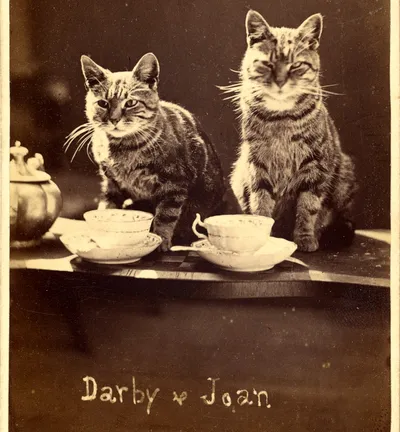
'Darby & Joan' by Henry Pointer, ca. 1865 | Getty Museum (edited by the Author)
issue #202 of brennan.day
Yes, Buy Them a Coffee: Support and Mutual Aid on the IndieWeb

brennan.day — issue #202
Publisher: Brennan Kenneth Brown
Place of publication: Calgary, Alberta, Canada
Available at: https://brennan.day
Contact: mail@brennanbrown.ca
Another day, another blog post responding to a blog post. For what else is the Internet for? I stumbled upon Hakkerman's article, "No, I Won't Buy You a Coffee" and felt a strong urge to correct a fundamental misunderstanding. Because this topic isn't just about blogging or the IndieWeb, it's about figuring out how we can create a liberated future of independent art.
I've already written an article about how you can support indie creators, and why you need to. I'll try not to be redundant here.
To start, Hakkerman says he's exhausted with the "rampant capitalization [sic] and constant advertisements" of the world. And I'm sure countless many would agree with this sentiment.
But let's take a step back and interrogate why people are asking for support in the first place.
Maybe you've had a job that hollowed you out. Where you felt like limestone hollowed by water, grain by grain, over years. At the end of your shift, you sit down at your laptop. You open a tab. You start to write. A blog post about a television show you love, or a deep-dive on software, or an essay about the neighbourhood you grew up in. You post it for free as you always have. And somewhere at the bottom, almost apologetically, you put a link: If this meant something to you, you can buy me a coffee?
That's what we're talking about. That's what Hakkerman can't stand.
Hakkerman isn't wrong about capitalism's draining effects, but he is wrong about what that tip jar is.
According to recent data, wages have grown 0.24 percentage points slower than inflation over the past year. Even workers who got raises are making less than they were before. The median salary in the United States sits around $59,384 annually, a reasonable figure until it dissolves against rent, groceries, and a world getting more expensive every quarter. The gap between what workers produce and what workers earn has been widening since the 1970s, when policy choices favouring deregulation and the suppression of labour unions severed the link between economic growth and worker compensation. Corporate profits in the United States have more than doubled as a share of GDP since 2000. The money is there and is not going to workers.
And those workers are exhausted. Research suggests that nearly 85% of workers experienced burnout or exhaustion in 2025, with almost half forced to take time off for mental health. The World Health Organization defines burnout as a syndrome of chronic workplace stress. Exhaustion, cynicism, a creeping sense of ineffectiveness. This is just the standard condition of working life.
So, when someone comes home from that job and opens their laptop to write, for free, for the love of it, for the flickering hope that their words will find someone, and they put a link at the bottom? The appropriate response isn't to see an advertisement. The appropriate response is to see a person.
Hakkerman argues that "creatives should get compensation in the same way as everyone else" but "that doesnt [sic] mean that every instance of creativity should be a venue for profit," and that "this is not the place to equalize it." I believe this is where our fundamental disagreement lies.
I am a firm believer that most people urgently need to pick up a creative hobby, and that hobby should be completely separate from monetization and commodification. And I also agree that, yes, hobbies cost money (though the amount is certainly far less than what consumerist culture leads people to believe).
But when people are asking for someone to buy them a coffee, at the bottom of a blog that is available to read for free, this is not commodification. This isn't turning a hobby into extractive labour. No, this is a human asking another human for support even if that support isn't a requirement.
I recognize we are all in different places financially, and many people cannot afford a recreational budget to spend being a patron of the IndieWeb, but that's not everyone.
On Mutual Aid
Dean Spade, legal activist and professor at Seattle University School of Law, defines mutual aid as "collective coordination to meet each other's needs, usually from an awareness that the systems we have in place are not going to meet them." Spade distinguishes mutual aid sharply from charity. Charity flows downward from those with power to those deemed "deserving", and on the terms of the giver. Mutual aid flows between instead, it is horizontal and rooted in a recognition that your survival and mine are bound together. When I support you, I am also building the kind of world I want to live in.
The term was coined by the 19th century anarchist Peter Kropotkin after he observed animals in the Siberian wilderness collaborating with one another rather than competing for survival. The practice is ancient and Indigenous. Resource sharing, reciprocity, and collective care are all ancestral technologies.
As early as the 1780s, there are records of mutual aid traditions in Black communities in America, pooling resources to cover health costs, burials, support for widows and orphans, and the construction of Black alternatives to white exclusionary infrastructures.
This isn't capitalism sneaking in the back door of the IndieWeb. This is a person offering what they have (their words, their time, their knowledge, their care) and asking, without demanding, for something in return. Mutual aid doesn't ask you to prove you deserve it. It meets people where they are.
And the IndieWeb does need to figure this out. If we support each other more, through the grassroots community mechanisms akin to mutual aid, then there is far more ethical longevity and sustainability to this great digital experiment.
I'm sure I don't need to tell you that the ways people can make money often degrade the quality of their writing and site, whether that's intrusive advertising (such as AdSense), dishonest product reviews, or aggressive affiliate linking.
It's exactly because of this that people need ethical, non-exploitative ways to make money with their work. Platforms like Ko-fi, which launched in 2011 as a simple way for fans to give creators small gifts without taking a cut on one-time tips, and Buy Me a Coffee, both exist to solve this problem.
Personal Disclosure
I also want to add that my own personal blog, brennan.day, does not make anything beyond what the few wonderful people supporting me through Ko-fi and my Toonie Club provide. I don't run any advertisements, take sponsorships, or use affiliate links. And I never will. The only costs associated with my blog are the domain on Porkbun, which runs $10/year.
That said, I am one of those few very lucky writers that can say that I do make a living blogging online. I'm enrolled in Medium's Partner Program, where I syndicate my blog posts on the platform and I'm paid based on views, reads, comments, etc. when I paywall my content. The wonderful thing is, though, that they allow me to have my writing on my own site with no paywall, so it really is a win-win. And it's important that you read this and go support another blogger instead of me, if you feel so inclined.
The entire point of creative endeavours like this is to escape the "draining nature of capitalism," as Hakkerman states, and I completely agree. But support is needed for this, and that support is actually antithetical to capitalism.
The Public Broadcasting Service
Maybe you're one of the many people that has, at some point, watched PBS on television.
The Public Broadcasting Service is an American public broadcaster and non-commercial, free-to-air television network. Founded in 1970 following the passage of the Public Broadcasting Act of 1967, which President Lyndon B. Johnson signed into law with the promise that this new network would "belong to all the people," PBS was conceived as a space on the airwaves for what its founders called an "urgent need": programming that addressed educational, social, and cultural demands that commercial television couldn't (or wouldn't) meet. It was built to be a civic forum, with news, public affairs, arts, and children's programming. All for the people who couldn't afford cable or didn't have access to anything else.
Federal funding flowed through the Corporation for Public Broadcasting (CPB), a private nonprofit that distributed money to over 1,500 locally operated public television and radio stations, with much of the remainder going to PBS and National Public Radio. The CPB received approximately $535 million annually, a small slice of the federal budget to sustain a public media infrastructure that reached into rural communities, reservation lands, and urban neighbourhoods alike.
The Trump administration changed that. In May of 2025, Trump signed an executive order aiming to eliminate federal subsidies to PBS and NPR, alleging political bias. His executive order immediately cut millions in Education Department funding for PBS children's programming, forcing the system to lay off a third of PBS Kids staff. By July 2025, Congress voted to rescind $1.1 billion in CPB funding—the full amount allocated through the next two fiscal years—as part of a $9 billion package of cuts. By August 2025, the CPB announced it was beginning an orderly wind-down of its operations. Most of its staff were told they would lose their jobs on September 30th.
What happens when a public commons is stripped of its public funding? You probably know the answer already. PBS has asked this of viewers for fifty years, in those pledge-drive weeks when the regular programming pauses and someone stands in front of a camera and reminds you that PBS exists due to:
Support by viewers like you. Thank you!
That's what the IndieWeb needs, now more than ever.
The next time you read something on a personal site that matters to you, and you see a small link at the bottom, I want you to consider: what kind of internet are you building with your dollar? What kind of world?
Buy them a coffee. Or don't. If you can't, if you won't, that's fine. The writing is still there either way. That's the point. But if you can, and you're holding back because you've decided that asking is undignified, that wanting is capitulation, that the presence of a tip jar makes the whole thing somehow compromised? Then you're mixing up the revolution and the enemy.


Comments
To comment, please sign in with your website:
How it works: Enter your website URL. IndieLogin signs you in through your site's IndieAuth server if it has one (e.g. indieauth.com), or checks your rel="me" links on GitHub, GitLab, Codeberg, and email. Setup instructions.
Signed in as: