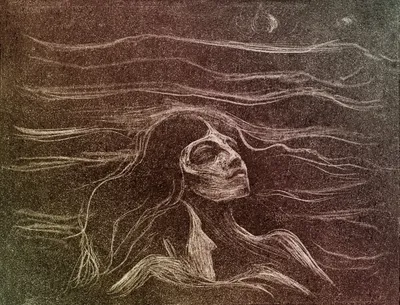
'On the Waves of Love' by Edvard Munch. 1896. Original from The Art Institute of Chicago. | Rawpixel (edited by the Author)
issue #254 of brennan.day
The Weight of Words

brennan.day — issue #254
Publisher: Brennan Kenneth Brown
Place of publication: Calgary, Alberta, Canada
Available at: https://brennan.day
Contact: mail@brennanbrown.ca
I have been mulling over free speech since my previous post on the topic. Despite the response my blog post got from BD's crowd, I myself am certainly not anti-free speech.
I've come to realize that my fundamental difference with absolutists is that I believe giving everyone a seat at the table, including those who would erode the rights of everyone else sitting (if given the opportunity) only permits free speech in the short-term. I believe taking extraordinary measures with extraordinary circumstances is necessary to allow everyone else to maintain their freedom of speech indefinitely.
John Rawls, and his notion of reasonable pluralism, is a society built on real disagreement, but that doesn't owe a seat to every disagreement, only to the ones that accept that other people are allowed to exist and be wrong. A reasonable doctrine would never use power to erase the doctrines sitting beside it. The unreasonable ones are the ones that would. The accommodation a free society extends isn't unconditional tolerance dressed up as principle, and the unreasonable doctrines are the ones that would resort to "the oppressive use of state power" to erase the rest. No amount of politeness in the meantime changes what they're asking for a seat to eventually do.
Beyond this, I've written before about how I'm limited by Canadian law as to what I'm allowed to host on my transformative works archive fanfiction.lol, and I certainly don't agree with that whatsoever.
Anyways, while there were quite a few responses to my post on free speech within the IndieWeb that seemed to miss the main point I was trying to drive home, there was one anonymous comment in particular that I found myself agreeing with:
I'm not understanding how [Brennan]'s opinions became so important to some.
Now this, I can sympathize with. If I wanted prestige or clout I would be doing everything I could to get a job at an institutional publication with name recognition. Instead, I write here, wholly independent and on my own. My opinion is certainly not important. Beyond this, I am not a good person, and I am often foolish as well. The scant bylines I have are from chance, mostly.
Now, that doesn't mean I just write whatever-the-fuck, I have standards. Why? Because no matter what, words have weight—and I try my best to be mindful of what I write and speak into the world. As I've written before, humanity has long thought the act of writing is magic. To write something out doesn't merely communicate it symbolically, but manifests the actual thing into the reader's mind. That is no small thing.
Many of us (myself included) lose the reason why we're writing or speaking in the first place. We become engrossed in the granular fine points of a conversation and then are surprised we're buried to the head in quicksand.
What Does ALL Dialogue Need?
I try to centre myself on what Paulo Freire, Brazilian educator and philosopher, thought about dialogue:
“If I do not love the world, if I do not love life, if I do not love people, I cannot enter into dialogue.”
This is easy to nod along to in the abstract, but it's wrenchingly difficult to practice when the person across from you is irritating, wrong, or hostile. And that is when the principle matters most—and it's also when most of us, myself included, fail.
And, from his book Pedagogy of the Oppressed, chapter 3:
Dialogue cannot exist, however, in the absence of a profound love for the world and for people. The naming of the world, which is an act of creation and re-creation, is not possible if it is not infused with love. Love is at the same time the foundation of dialogue and dialogue itself.
I think if you ask people what their core values are, you'd hear the same answers often: trust, growth, unity, safety, family. And how distant these values become in the screenvoid of cyberspace. As though there is an amnesia somewhere between the keyboard and our fingers.
Of course, I don't think this is true for everyone. An excellent counterexample is the creator of omg.lol, Adam Newbold, who has been consistent with his principles and efforts any time I've spoken to him, no matter what the consequence of that may be. He's been the one to push me to stop using Cloudflare and several other important issues.
The world is in dire need of more people like Adam—of people willing to be vocal and urge our friends to do better, and to believe they can do better. Adam never comes from a place of being critical or morality, they always centre compassion and inherently believe I (and others) are capable of showing more mindful compassion ourselves.
And, I think similar to Chris Ulmer, Adam is not a saint. It does not take an extraordinary amount of courage or love to stay convicted with your principles and believe in the other people in your life similarly. Anybody could do what he does, and I try my best to do the same for others in my own life.
I'll give an example of this—it would probably be better if I didn't mention specifics, but I have mentioned previously that I personally really dislike vagueblogging. An Internet friend of mine, Rina, wrote a blog post about how she wouldn't stop saying a certain slur and presumed that Americans of the United States were uniquely offended by the word, and noted how ubiquitous the word is where she's from. A different culture and a non-native understanding of English aren't excuses, but they do complicate things.
And I responded directly, with how the word is actually rather hurtful in all the English-speaking world, and that it is particularly hurtful when aimed towards those with disabilities.
Less than a day later, she wrote another post admitting she was wrong and apologized:
"first, i need to say thank you to the people that showed me kindness, even if i probably didn’t deserve it, namely brennan and vigil. this is how you make someone think things through"
What is Permitted? (The World is a Cruel Place)
Connecting this back to BlueDwarf, SpaceGhost does actually have rules against name-calling and threats, which I think is a good idea for a public forum—but does this not inhibit people's ability to speak freely? It does, and I think that's okay. The Internet is full of ad hominem and name-calling. Not every space needs to be a free-for-all; the question is whether the boundaries are drawn in service of love or in service of comfort.
If love is the foundation of dialogue, what do we do with people who refuse to reciprocate? If I extend grace and someone uses it to trample others, am I complicit? The small-web spaces I inhabit have to answer this daily, and their answers vary wildly.
Anyways, the next day, Rina made an update to her site that was clearly a joke about North Korea and was subsequently banned from 32-bit Café because the joke was regarded as racist—which it obviously isn't, at least in my opinion.
Abolitionist organizer Mariame Kaba spent decades arguing for a hard distinction between punishment and accountability. Punishment asks who broke the rule, and what do they deserve? Accountability asks what happened, what does repair require, and how do we make it less likely to happen again? Kaba's point was not that harm doesn't matter—it's that exile doesn't produce the safety it promises, only the look of it.
It's certainly none of my business how an external platform decides to moderate and who they decide to ban, and for what reason—but I am allowed to write my thoughts about it on my blog.
Maybe this was simply the straw that broke the camel's back, but as I mentioned in my previous post, there are so few of us that care about the small web. And, far more important, we are too quick to disregard those that rub us the wrong way.
What do we do with this, past believing it? I don't think reverence for your own words arrives as a mood before you sit down to write. It needs to be built into the process, the way you'd handle anything that could wound someone if you're careless. Read the sentence back as though a stranger wrote it to you on your worst day. Ask what you're conjuring, not just what you're arguing. What is the gap between what you meant and what the words alone will carry once you're gone and can't explain? Treat the space between drafting and publishing as a place where you're still allowed to change your mind about what you're about to summon into the world.
I will continue to extend grace and benevolence, and try to explain where others only respond with contempt and scolding, or blocking and banning. This is not toxic positivity, but it certainly is a stubborn optimism. An undying belief in believing in the better of people and the power of words.
The world is a cruel place, and therefore I will not be.
Comments
To comment, please sign in with your website:
How it works: Enter your website URL. IndieLogin checks your rel="me" links on GitHub, GitLab, Codeberg, and email. Setup instructions.
Signed in as: