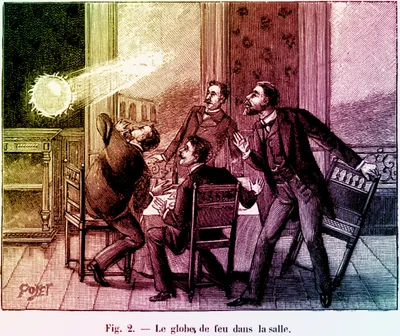
'Fig. 2. — Le globe de feu dans la salle' (The fireball in the room)' by Louis Poyet. 1901. | Wikimedia Commons (edited by the Author)
issue #253 of brennan.day
Our Skies Contain Sprites, Elves, Trolls, Pixies, Ghosts, and Gnomes

brennan.day — issue #253
Publisher: Brennan Kenneth Brown
Place of publication: Calgary, Alberta, Canada
Available at: https://brennan.day
Contact: mail@brennanbrown.ca
Have you heard of ball lightning? Maybe you have. It's known as an odd weather phenomenon, thought of as supernatural. The oldest written record of it may be an illuminated manuscript from an English monk in 1195, describing a fire-globe dropping out of a storm cloud that fell into the river Thames, logged in medieval chronicle and rediscovered by modern researchers in 2022.
Humans have been watching hissing, drifting orbs of light appear out of thunderstorms since before we had the words to record them, and every culture used similar vocabulary: spirits.
In Japan, it's called hitodama, translating to "human souls," the glowing balls thought to be spirits of the dead, untethered from their bodies and wandering. In English countrysides, the same lights were will-o'-the-wisps, mischievous fairies leading travelers off the safe path and into the bog. In the Australian Outback, they're Min Min lights, fuzzy orbs that follow you at night.
In Argentina and Chile, the Mapuche call them Anchimayen, the souls of the dead, mischievous spirit creatures appearing as small glowing lights in the Andes. In 17th-century Devon, England, a fireball tore through a church during a service, the Widecombe fireball, and was understood by villagers as either the Devil, or God's judgment on a congregation caught sinning at prayer. A century after that, the occultist Aleister Crowley described a "dazzling globe of electric fire" appearing in the cottage where he was staying, which he claimed shocked his hand slightly before it exploded.
Scientifically, ball lightning[1] is described as a hissing, glowing sphere. It can be red, orange, yellow, or blue. Sometimes trailing the smell of sulphur, appearing during or just after a thunderstorm, drifting through the air or hovering close to the ground, and vanishes after only a few seconds, sometimes with a pop or an explosive crack.
Even now, there is still no single accepted physical explanation for it. Plasma models treat it as a self-contained, temporarily stable bubble of ionized gas. Other theories explain it as silicon combustion, microwave-trapped fields, or maybe even quantum effects. None of them account for the full range of credible sightings on their own, including the reports of ball lightning passing straight through closed windows without breaking the glass.
But the sky has so many mysterious, barely-witnessed phenomena. There's a constant pulse and surge of electricity.
Of magic.
Perhaps I'm a romantic, and the naming conventions for these phenomena are why I'm so captivated by them. Between the troposphere and stratosphere, there are blue jets, which can have upward superbolts beyond conventional cloud-to-air discharges.
But higher than that—in the mesosphere and ionosphere? There are whimsical electrical-breakdown phenomena. There are the tendrils of sprites. There are elves, and there are also trolls and pixies, ghosts and gnomes. Let me explain.
Blue Jets
Blue jets are luminous electrical ejections shooting upward from the tops of active thunderstorms into the stratosphere, reaching heights of 80 kilometres (50 miles). Unlike standard lightning, they streak upward in narrow, cone-shaped beams at speeds near 100 kilometres per second, lasting for less than a fraction of a second.
The first video recording of any of these transient luminous events (TLEs) was footage from a space shuttle mission in 1989, and it wasn't until February 2019 that scientists finally watched a blue jet from start-to-finish. An international team using ASIM—a bank of cameras and sensors the European Space Agency bolted to the outside of the International Space Station in 2018—recorded a jet erupting from a storm near the island of Nauru in the Pacific.
Danish physicist Torsten Neubert described the ignition point as a "blue bang," a ten-microsecond flash near the top of the cloud shooting skyward for less than a second, climbing 52 kilometers before it burned out. The mechanisms of the blue jet were only published for the first time in Nature in 2021. Scientists divide jets into three types: blue jets, blue starters (which don't make it as far), and gigantic jets, an even rarer version that can travel all the way to the ionosphere itself.
Red Sprites (and their tendrils)
Red sprites are large-scale electrical discharges that flash reddish-orange in the upper atmosphere at altitudes of 50 to 90 km (31 to 56 mi) above major thunderstorms. Often resembling giant jellyfish or carrots. Only lasting a few milliseconds, triggered by powerful positive cloud-to-ground lightning strikes.
The "tendrils" the sprites have refer to the glowing, hanging filaments of red sprites—large-scale electrical discharges flashing high above massive thunderstorms. The microphysics of how their fine, jellyfish-like tendrils are structured and propagate remains an active area of atmospheric research.
The word "sprite" has origins in 1300 CE as a variant of spirit, by way of the Old French esprit and the Latin spiritus, meaning breath or soul. For centuries it was a catch-all term for elves, fairies, ghosts, and apparitions of nearly any kind, without much taxonomic care.
When 20th-century atmospheric physicists needed a word for a phenomenon that flickered into existence for a few thousandths of a second and then was gone, leaving behind no trace (and almost no chance of confirmation), they were named sprites (air spirits) specifically for their elusive nature, a scientific christening from folklore.
The ELVES
Above the red sprites are the ELVES (a backronym for Emissions of Light and Very Low Frequency perturbations due to Electromagnetic Pulse Sources). They're massive, rapidly expanding ring-shaped glows. They occur about 100 km above thunderstorms in the ionosphere, spanning up to 400 km wide and also lasting less than a single millisecond.
Elves were only identified in 1990, discovered by the Mesoscale Lightning Experiment, and their doughnut-shaped glow is the visible signature of an electromagnetic pulse slamming into the bottom of the ionosphere and briefly heating and ionizing it into light. The elves expand outward at close to the speed of light, gone before you could possibly see.
Trolls, Pixies, Ghosts, and Gnomes
Scientists studying the upper atmosphere kept finding smaller, weirder, harder-to-catch TLPs. A cryptid taxonomy was thus created above our heads. Trolls, pixies, ghosts, and gnomes. And man, it's hard to find writing xpecifically about these.
A TROLL (short for Transient Red Optical Luminous Lineament) forms in the immediate aftermath of a sprite, appearing as a red spot with a faint tail, sometimes finishing with a thin red streak trailing back down toward the storm. An afterimage of an afterimage.
Pixies are, fittingly, the tiniest of the family. Unusual, sharp points of white light that flare over a thunderstorm and vanish in around sixteen milliseconds. Unlike sprites and jets, pixies don't appear to be tied to any specific lightning strike. They seem random, and aren't really understood. For years after they were first noticed, sightings stayed sparse and largely anecdotal; it wasn't until space-based instruments came online in the 2000s, like the ISUAL satellite launched in 2004, that researchers had a reliable vantage point.
Gnomes are similar to pixies. Small, brief spikes of light that shoot upward from the anvil-shaped top of a large thunderhead, lasting only a few microseconds, a fraction of the time it takes a hummingbird's wing to beat once. Unlike trolls, neither pixies nor gnomes were ever given a scientific backronym.
GHOSTS (Green emissions from excited Oxygen in Sprite Top) are the newest TLP, and the least understood. A faint green glow that flickers into being after a red sprite forms, directly above it, and disappears again within milliseconds. Ghosts weren't documented at all until 2019 (article in Russian), and even now they only seem to trail about one in every hundred sprites.
Researchers using an instrument called GRASSP (the Granada Sprite Spectrograph and Polarimeter) have spent years aiming their equipment at the precise altitude where a ghost is likely to appear, a task one investigator has compared to a mix of luck and expertise, because there is no way to predict exactly when or where the green will show up. The leading hypothesis is that ghosts share a mechanism with the aurora borealis: the same excitation of oxygen atoms that paints the sky green over the poles tucked into the wake of a sprite.
A green flash of light, rarely born from a grander red one, invisible from the ground, discovered only within living memory. An active scientific mystery using language we borrow from folklore.
Thomas Ashcraft, who photographed ghosts in 2015, notes that "there are no articles in scientific journals regarding this phenomenon."
The Magic of Science
Scientists spent the twentieth century discovering an entire second sky above the one we already knew, and named it after sprites, elves, trolls, ghosts, gnomes, pixies. These names weren't handed down by any official naming body in bureaucracy, as you might be able to tell; they were given by the researchers and enthusiasts who witnessed the phenomena in a scientific context.
The mystery always comes first, and you need language for it immediately. The oldest words we have for flickerings at the edge of visibility and that defy explanation are folklore. When 20th-century physicists needed language for something ephemeral, luminous, and barely provable, new words were not conjured up, no. They reached back into the reservoir that produced will-o'-the-wisps and hitodama and the Anchimayen. Naming the unexplained after spirits isn't a failure of scientific rigour, it is what science has always done.
We need to respect nature, and the glory we barely get to witness. The solar irradiance and electrodynamic tethers, the magnetotellurics of our atmosphere and our planet's magnetic field. Naming things in nature after such whimsical things is a way to do that—to elevate the natural to supernatural while still being explainable, still being tangible and of-this-world.
Often, materialist skeptics deny themselves the joy and mirth that comes with the things that cannot be proven or knowable in empirical science. But it's a false dichotomy, and to be a scientist one must have curiosity and an openness to anything.
Richard Feynman used to tell a story about an artist friend who held up a flower and told him that science ruined it, that pulling a thing apart to understand its mechanism eliminated beauty. Feynman disagreed completely. He could see the same flower his friend saw, he said, and then he could also see further into it: the cells, the pigments evolved so an insect could see them, the still-unanswered question of whether that insect experiences anything like aesthetic pleasure at all. Understanding didn't subtract from the flower's beauty for him. It only ever added to it. More mystery the closer he looked, not less.
Philosopher Helen De Cruz has written on awe and wonder as parts of scientific practice—the same feeling a religious person might call numinous, she argues, shows up constantly in the working lives of professional scientists, and it's one of the emotions motivating people to keep pushing past the boundary of what's currently understood. And researcher Michael Cuzzolino studied scientists' own accounts of their work, and found awe is woven into the process, present in the day-to-day work of not-knowing and slowly, partially knowing.
Kristjánsson points out that before the Enlightenment, the idea that scientific inquiry could be self‑transcending, and even ecstatic, was part of the Western intellectual tradition. It was only in the 18th century that awe started being treated as a threat to the new ideal of the rational, controlled, autonomous self. Enlightenment thinkers were wrestling with the sublime. Edmund Burke, as Ryan explains, rooted the sublime in terror and self‑preservation, opposing it to rational composure, and Kant treated it as a test that reason could ultimately pass, only by retreating to a higher moral ground. Wonder was domesticated into something smaller and more manageable, while awe remained suspect. This false dichotomy between cool reason and ecstatic experience is only a few centuries old, and we are not bound to it.
I want to note that everything I've written about is only in the domain of atmospheric electricity, there are hundreds of different specializations in science, thousands of different parts of our universe to explore, from the impossible small cellular world, to the even smaller atomic and chemical, to the impossibly vast and wondrous heavenly bodies. That's what they are, aren't they? Heavenly. The mere fact they exist is transcendental; the magic is already within our world.
Some of the above cultural legends and folklore are hypothesized to be ball lightning, others have different theories. ↩︎




Comments
To comment, please sign in with your website:
How it works: Enter your website URL. IndieLogin checks your rel="me" links on GitHub, GitLab, Codeberg, and email. Setup instructions.
Signed in as:
No comments yet. Be the first to share your thoughts!