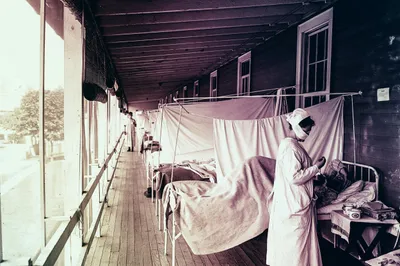
Walter Reed Hospital flu ward (ca. 1910–1920). Original from Library of Congress | Rawpixel (edited by the Author)
issue #180 of brennan.day
The Hondius Pneumonia (Low Risk Assessment)

brennan.day — issue #180
Publisher: Brennan Kenneth Brown
Place of publication: Calgary, Alberta, Canada
Available at: https://brennan.day
Contact: mail@brennanbrown.ca
I.
Blue-black water, cold getting into the bone even through a cabin window. The MV Hondius somewhere in the South Atlantic. Somewhere below deck, a 70-year-old Dutch man has a fever. Headache. Abdominal pain. The ship's doctor sees him. He dies on April 11. His body stays on board for thirteen more days.
By the time anyone calls the WHO, it is May 2. The ship has been at sea for a month. Thirty passengers have already disembarked at Saint Helena. They are home in the Netherlands, in Singapore, in Texas, or in Ontario. Sleeping in their beds, taking the bus, sitting in waiting rooms.
The risk to the global population is stated to be low.
II.
On December 30th, 2019, a global infectious disease surveillance network, staffed largely by volunteers, called ProMED flagged a cluster of pneumonia cases in Wuhan, China with an unknown cause. An ophthalmologist named Li Wenliang sent a message to colleagues that same week warning them to wear protective equipment. He was summoned by police and forced to sign a statement admitting to "making false comments." He contracted the virus from a patient. He died on February 7, 2020.
On January 14, 2020, the WHO tweeted that preliminary investigations found "no clear evidence of human-to-human transmission."
On January 30, they declared a Public Health Emergency of International Concern. On March 11, they finally used the word pandemic. By then, it was already everywhere. Many were already going to die for want of action taken earlier
Who was right in January 2020? A handful of epidemiologists on Twitter. A science journalist named Helen Branswell at STAT News, who had been covering it carefully since the first week of January. A sociologist named Zeynep Tufekci, who wrote in February that we needed to prepare now. An epidemiologist named Eric Feigl-Ding who tweeted "HOLY MOTHER OF GOD" on January 24 after seeing the first reproduction number estimates. He was mocked for it.
III.
I won't lie by omission. The Andes virus does not drift through the air. Not through subway cars or church basements. It spreads through close, sustained contact—shared breath, shared saliva, the intimacy of caring for someone who is dying. A 2018–19 Argentine outbreak began at a birthday party and deepened at a funeral wake. Not a grocery store and not a school. The transmission coefficient is different from a respiratory pathogen.
The WHO's current assessment that human-to-human spread requires close, prolonged contact is thankfully based on decades of outbreak data this time, not wishful thinking.
IV.
The incubation window for Andes hantavirus is four to forty-two days. Someone exposed on April 15 may not know until late May. The thirty passengers who disembarked at Saint Helena left before a single test had been run. They came from twenty-three countries. Every case so far has a traceable link to the ship. The moment that stops being true, the low-risk framing collapses like a lung under fluid.
The worst-case scenario here is not another pandemic. It's slower and messier—dispersed household clusters, healthcare workers exposed, contact chains that can't be reconstructed. It's the 2014 Ebola model, not the COVID model. Ebola in 2014 killed eleven thousand people and overwhelmed entire health systems.
V.
The right answer in January 2020 was to say that we don't know yet, and that is the emergency.
Not "the risk is low" and not "there is no evidence of widespread transmission." Honesty would be declaring that there is an unknown pathogen spreading among humans, and we are lagging behind on it, and we need to move as if it is worse than we hope.
That's the sentence I want to hear now. Not panic. Not the grinding, ambient dread of another March 2020. Just honesty about the gap between what officials know and what is actually true—and the diligence that gap demands from all of us while we wait for the incubation window to close.
The Hondius is docking in Tenerife. The passengers are going home. The rodents along a road-trip route in Argentina are being tested. Somewhere in a lab in Johannesburg, a PCR machine is running.
We are watching. That, at least, we have learned.
Comments
To comment, please sign in with your website:
How it works: Enter your website URL. IndieLogin checks your rel="me" links on GitHub, GitLab, Codeberg, and email. Setup instructions.
Signed in as:
No comments yet. Be the first to share your thoughts!