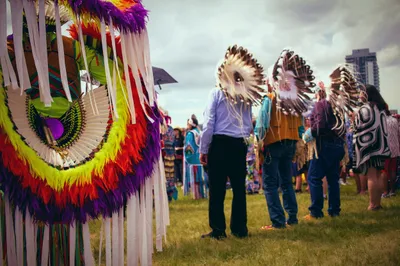
First Nations elders watch the Canada Day festivities in Calgary, Alberta. July 1st, 2022. Photographed by Dwayne Reilander | Wikimedia Commons (edited by the Author)
issue #179 of brennan.day
Where is the Indigenous Cultural Revolution?

brennan.day — issue #179
Publisher: Brennan Kenneth Brown
Place of publication: Calgary, Alberta, Canada
Available at: https://brennan.day
Contact: mail@brennanbrown.ca
Fred Moten and Stefano Harney's The Undercommons: Fugitive Planning & Black Study describes a space of collective refusal and radical study existing beneath the institutions of the master. In the hold of the ship, in the field, in the church hidden behind the plantation, in the block party at the end of the dead-end Bronx street. The undercommons is a practice, a gathering of the refused, refusing back. Black culture, Moten and Harney argue, found its undercommons in the very conditions of its oppression. Stolen people, crammed into ships, pressed into fields. From that horror blossomed the rhythm and call and response, a musical theology that the captors could never extinguish.
Moten and Harney were not writing about Turtle Island. And yet there is something in the concept that keeps arriving at the treeline, keeps turning up at the edges of rez, keeps sounding like a drum in a shopping mall. Something saying this was already here.
PART ONE: The Beautiful Success of Black America
In 2001, Robert L. Johnson became the first Black billionaire in America after selling BET, Black Entertainment Television, to Viacom for three billion dollars. He had built a cable empire and a cultural empire. This business was a signal. Black people had successfully carved out a frequency in the electromagnetic spectrum.
In 2020, nearly two decades later, Tom Love of the Chickasaw Nation entered the Forbes billionaire list through Love's Travel Stops & Country Stores, a chain of truck-stop convenience stores. The comparison is not made to diminish either man. One sold a television network that beamed Black culture back to Black people across a continent. The other sold coffee, sandwiches, and diesel. I am trying to understand what this gap means.
I am trying to understand why two groups of people, both systematically destroyed over centuries by the same European colonial project, arrived at such different places of cultural power, and what the mechanics of those differences are.
Understand that these situations cannot be flattened to easy comparison whatsoever. Tuck and Yang caution us, writing that "solidarity is an uneasy, reserved, and unsettled matter." Settler colonialism operates through elimination, through the seizure of land for permanent occupation, in a logic distinct from (if entangled with) the logic of chattel slavery. To flatten these is a "settler move to innocence," a way of making the conversation easier than it should be.
An answer begins with the body.
Where the Body was Placed
The Transatlantic slave trade, more accurately called the Transatlantic human trafficking rings, took approximately 12.5 million people from the African continent and deposited them into a shared geography of oppression over four centuries. Stripped of their languages, nations, and cosmologies. In a terrible and brutal act of colonial reduction, they were homogenized.
Not fully and not willingly, and certainly not without enormous loss. But the shared condition of American chattel slavery created the conditions for a shared culture. A new people. African American. The blues is born in Mississippi. Gospel is born in the terror of the plantation. Hip hop emerges in 1973 in the South Bronx, at a block party at 1520 Sedgwick Avenue, where DJ Kool Herc isolates the percussion break of a funk record and creates, from two turntables and a crowd of people with nowhere else to go. An entirely new art form. When you concentrate suffering and compress pain, there's something that sustainably burns.
The Great Migration—six million Black Americans moving from the rural South to the urban North between roughly 1910 and 1970—is essential here. Chicago, Detroit, Harlem, the Bronx. Density. Proximity. Shared language. A concentrated, critically massed population with a shared enemy. The record labels follow. The radio stations follow. The money—eventually, partially, extractively—follows.
There are approximately 476 million Indigenous people worldwide. Roughly 6% of the global population spread across more than 90 countries and speaking an estimated 4,000 languages, most greatly endangered. In Canada, there are 1.8 million Indigenous people, about 5% of the total population. In the United States, roughly 3.7 million.
We are not a diaspora. We are a dispossession. The difference between what has occurred between Black people and Indigenous Peoples is of direction. Enslaved Africans were removed from their land and concentrated. We were removed from our land and scattered. Isolated, contained, fenced. The reserve system, the reservation system. None were communities, but rather administrative units. Quarantine zones. The geography of elimination.
The cultural revolution of Hip hop required density. The block party, the apartment hallway, the shared wall between too many people with too much pain and genius. The South Bronx of 1973 was economically abandoned, deliberately starved by Robert Moses's freeway policies, but God, it was full. Hundreds of thousands of people in a few square miles. Fullness is the condition of possibility. Rez has always been designed to prevent that fullness.
The Impossible Mosaic of Language
Blues became jazz, jazz became soul, soul became hip hop. When the African American cultural revolution happened, it always happened in English. One language. The language of the colonizer remade and reclaimed and bent back until it cracked open into something new. African American Vernacular English is a linguistic achievement, a creole forged in captivity and successfully becoming the mainstream that white teenagers worldwide speak its idioms. Shared language is required to propagate.
We have no equivalent. There are over 70 Indigenous languages still spoken in Canada, from Cree to Anishinaabemowin to Inuktitut to Michif. Michif is my language, the Métis creole of French and Cree, a beautiful linguistics of the border-crossing creating me.
Each Indigenous language carries a worldview, a cosmology, a way of organizing experience that is irreducible to any other. None are interchangeable. These are not the building blocks of a shared pan-Indigenous culture in the way that shared English was the building block of a shared Black American culture. And many are nearly gone or already extinct.
Our Culture
None of which is to say we have built nothing, for the evidence against that is loud and beautiful. The Halluci Nation, formerly A Tribe Called Red, emerged from Ottawa's Electric Pow Wow parties in 2008 and became a sonic argument that Indigenous culture was present and alive, not preserved under glass but beating under bass. Their powwow step is traditional First Nations drumming and vocal chanting pressed against dubstep, hip hop, moombahton. In 2025, they became the first independent Indigenous artists from North America to surpass 100 million streams on Spotify. The 2016 album We Are the Halluci Nation, named for a concept given to them by Santee Sioux activist and poet John Trudell, was described by Pitchfork as "politically thrilling and immediate." Manitoba's Premier, Wab Kinew, called what ATCR represented an "Indigenous Music Renaissance."
Tanya Tagaq, Inuk from Nunavut, practices throat singing. Cherie Dimaline, Métis, writes The Marrow Thieves, a dystopia in which Indigenous peoples are hunted for their bone marrow—the one thing settlers cannot take, until they do—and wins the Governor General's Award and reaches the school curriculum. Lido Pimienta screams in Spanish and Kogi. This is the cultural reclamation I am asking about, and they are happening.
But a singular band crossing 100 million Spotify streams is not the same as the entire genre of hip hop. The Halluci Nation is, as Bear Witness himself has said, carrying a weight of representation, of being one of the only Indigenous acts visible at this scale. The Globe and Mail reported that their position "at the forefront of an explosion of Indigenous music... placed a lot of weight on the group's collective shoulders." No singular Black artist carries the entire Black culture on her back. There is one Halluci Nation.
APTN, the Aboriginal Peoples Television Network, is the world's first national Indigenous broadcaster, launched in 1999 in Winnipeg. APTN's annual budget is $47 million. BET, when Robert Johnson sold it, was valued at three billion.
The Conditions for Cultural Production
Black cultural revolution was possible because the conditions of anti-Black oppression accidentally created the conditions for cultural production: Concentration, shared language, a single enemy legible from a single geography. The undercommons could form because the undercommons had critical mass, demographic mass, the mass of shared suffering in shared space.
What was done to Indigenous peoples on this continent was designed to prevent exactly that. Scatter. Fragment. Contain. Define legally out of existence. Destroy the language. Take the children. "Indigenous" means many different, specific, irreducible things. Métis, Cree, Anishinaabe, Haudenosaunee, Tlingit, Wet'suwet'en. A unified cultural identity can never fully cohere the way "Black American" cohered under pressure. Slavery destroyed people and created community by accident. Settler colonialism on this continent destroyed community on purpose. It was the community—the web of our relations, our language, our children—that it was designed to eliminate.
Patrick Wolfe, the Australian settler colonial theorist, wrote that settler colonialism is "a structure, not an event." It doesn't end and it is operating, now. In the ongoing second-generation cut-off stripping status from the children of status women who marry out. It continues in the reserve geography that prevents the density hip hop required. It continues in the loss of languages, each one a universe of meaning that does not translate into English, that carries no commercial value in the streaming economy, that dies one elder at a time.
There are 27 Black billionaires in the world as of 2026, managing a combined $121 billion. There is one Indigenous billionaire. Tom Love and his fortune built on truckers needing coffee. I do not begrudge him his coffee empire. I am asking what the gap means, and I think I have arrived at an answer, or the beginning of one.
The gap is what you get when you take Peoples and try to make them disappear not by concentrating them but by dispersing them, not by forcing them together but by keeping them apart, not by making them forget their homeland, but by making them forget each other.
I am Métis. I carry Michif in my ancestry and English in my mouth and a growing fury in my chest about what was taken and a growing tenderness about what remains. I do not know what our revolution will look like. I know it will not come from a billionaire selling a cable network. I know the revolution will not be televised. It will come from the throat. From the drum. From our continued, enduring presence and existence despite everything.
We are the tribe they cannot see. We are still here. We are learning, slowly and with enormous difficulty, to see each other.
PART TWO: "In the Bush, We Were Always Already There" // Notes Toward an Indigenous Undercommons
The Logistics
Blood quantum is a concept with no Indigenous origin. It was invented by white settlers, a pseudoscientific calculation of "Indian blood" as a fraction of a person's lineage, and imposed beginning in the late 19th century as a mechanism of elimination. The more Indigenous people intermarried, the smaller the fractions became, and the fewer people met the threshold, and the fewer people remained legally, bureaucratically Indigenous. The federal government used it to strip land and limit treaty obligations. The Dawes Act of 1887 required a quarter-blood minimum to receive land allotments. Over ninety million acres were transferred from Indigenous to predominantly white settler hands through this mechanism alone.
In Canada, the Indian Act operated similarly and still does. Existing for 149 years and counting. Legislation determining who could be "Indian," who could leave the reserve without a pass, who could vote, who could practice ceremony, who could hold land, who could educate their children, who could be a person in the eyes of the state.
Indigenous women who married non-Indigenous men lost their status for decades; their children lost their status; the contraction deliberate and legal. Scholar Pamela Palmater has argued the Act's descent-based rules will eventually lead to the extinguishment of First Nations as legal and constitutional entities, unless changed. The blood quantum system is a slow-motion administrative genocide.
Compare this to the so-called "one-drop rule" in the United States, which operated in the opposite direction—anyone with any African ancestry was classified as Black. This was a tool of oppression too, of course, designed to ensure that the children of slaveholders and enslaved women remained enslaved. But as a demographic mechanism, it expanded the community. It created a larger, more unified group with shared political interests and shared cultural experiences. The architecture of anti-Blackness built community by accident. The architecture of anti-Indigeneity was designed to fragment.
I know what it means to sit at the edge of the question are you really?, to have your fraction of belonging interrogated by bureaucrats and, sometimes, by other Indigenous people. Lateral violence. Blood quantum is not only government policy. It is a psychic wound we have inherited, and in some cases inflicted on each other. How can you build cultural renaissance on foundations actively dissolving beneath you?
Moten and Harney call it "logistics." The management of movement, of bodies, of populations through administrative space. Canadian colonial governance did not only dispossess land, it organized bodies. Assigned them to parcels. Timed their movement. "Our object is to continue," said Duncan Campbell Scott of the Department of Indian Affairs, "until there is not a single Indian in Canada that has not been absorbed." Logistics. A plan.
And credit. The reserve system held land "in trust," which is to say, First Nations people did not legally own the land they lived on, even as it was their ancestral territory. They were in perpetual debt to a Crown that had stolen the collateral. Harney and Moten say that debt cannot be paid off. Debt is a structure of ongoing capture, not a ledger awaiting resolution. The numbered treaties were debt instruments. The land "cessions" were credit agreements. The unpayable debt is the point.
Study in the Hold
Residential schools were explicitly designed to destroy cultures. Children were taken—stolen—from loving families and placed in brutal, racist institutions built on the motto "kill the Indian, save the child." Tiny bodies beaten for speaking their languages. Beautiful hair destroyed. Separated from loving siblings. Assigned numbers and stripped of names. The last residential school in Canada did not close until 1996, the year I was born. There are grandparents alive today who lost their grandchildren to these schools.
One hundred and fifty thousand children passed through the residential school system over more than a century.
This trauma isn't far-off, black-and-white, or historical. The wound is open, current and active. Intergenerational. What was targeted for erasure and elimination? Language, story, and ceremony, the knowledge held in the body of the elder and passed to the child—what Moten and Harney would call the undercommons. The fields holler. The break beats. What was taken from us was not just culture but the capacity of transmission.
This is what the state called "education." Schooling, not study. The management of persons toward administered outcomes. The production of subjects who would surrender their relationship to land, kin, ceremony—who would become legible to the state, taxable, settleable, absorbed.
When you take the children away from the elders for a hundred years, you sever the cord. The body has no one to learn from. The knowledge dies with the last speaker, the last ceremonial practitioner, the last storyteller. The hold is not only a site of capture. The hold is also where the social is made, fugitively, in the darkness, from what the captors could not see or did not think to forbid.
But children whispered Anishinaabemowin under the covers, passing songs between dormitory walls. But the children taught each other what had been taught to them by their grandmothers before the Indian Agent came. The school newspapers "carefully created an English-only fantasy for readers, but may also attest to the success of students' secrecy: perhaps official school documents did not report that students still knew Indigenous languages because schools were unaware of this."
The school called it failure. Government reports, read contrapuntally, were "more forthcoming in how students continued to speak their language, though they framed such resistance as failure." We call it study.
Fugitive study. No curriculum, no grade, no recognized institution. Studying that happens in the break, in the undercommons, in the surplus of social life that governance cannot fully account for or contain. Children running away toward home. The running was also study, a testimony to what is known about where home is, even when the state has tried to make you forget.
Gift Against the Credit
Robin Wall Kimmerer writes of the gift economy, older than any word for economy, rooted in Potawatomi relationship to plants, to land, to the non-human persons who give without accounting. "The awakening of a wider ecological consciousness requires the acknowledgment and celebration of our reciprocal relationship with the rest of the living world." This is botany and ceremony insomuch as political theory. She is also, without naming it, writing the undercommons.
Because the undercommons is what happens when communities refuse the logic of exchange. Refuse to convert everything into a transaction, a credit, a debt to be repaid on colonial terms. Moten and Harney's concept of debt is not Kimmerer's gift, but they share a refusal. The gift economy does not owe, and instead circulates. Feeding without a ledger.
The Potlatch was banned under the Indian Act from 1885 to 1951. Why? Because Potlatch is a ceremony of redistribution—of giving, of building relationship across communities through gift rather than accumulation. The living enactment of gift economy. Nothing to tax or mortgage.
After being banned, the practice went underground and continued in secret. The legislation against Aboriginal peoples "did not stop Aboriginal practices but in most cases drove them underground, or caused Aboriginal peoples to create new ways of continuing them without facing persecution." Drove them underground. The undercommons is the underground. The potlatch continued in the undercommons for sixty-six years. The gift survived the credit.
The Surround
Imagine 22,000 square kilometres of unceded territory. The size of the state of New Jersey, or the countries Belize or El Salvador. Imagine this land while the RCMP deploys snipers, helicopters, and dogs to remove you. Imagine your sacred headwaters running beneath you and a pipeline drilling toward them from the far side of an injunction. Imagine the legal system of the occupier announcing, as a British Columbia Supreme Court judge did, that though you may "believe in your rights under Indigenous law to prevent the plaintiff from entering," but the law does not recognize this.
Moten and Harney call it the surround. The condition of being encircled by power while refusing absorption into it. The reserve is the surround made spatial. The injunction is the surround made legal. The RCMP raid on Wet'suwet'en territory, with snipers aiming at a cabin, an axe and a chainsaw at the door, is the surround made violent.
The Wet'suwet'en Hereditary Chiefs did not consent. They issued an eviction notice. They declared that Coastal GasLink and the RCMP were trespassers on their Yintah. They rebuilt the camps. Sleydo' (Molly Wickham) said, of defending Wedzin Kwa:
"They will not drill under our sacred headwaters because we're going to defend this space until the end. We're not going anywhere."
This is fugitive planning, a declaration rooted in a law far older than the Canadian state, a law grounded in the land. Glen Coulthard calls this "grounded normativity," the ethical framework that emerges from long-standing place-based relationships, from what the land teaches about responsibility. The Wet'suwet'en do not need the Canadian state to recognize their law in order to practice it. They practice it, and that practice is the undercommons.
The Fugitive University
In the Northwest Territories, near Yellowknife, on the Chief Drygeese Territory of the Yellowknives Dene First Nation, there is a university that can only be reached by bush plane, snowmobile, or dog team. It is called Dechinta, the Wiìliìdeh Yatì word for "bush." It is the only fully land-based accredited post-secondary program in the world.
At Dechinta, students tan moose hides, fish, gather medicines, learn governance by living. Elders are faculty. The land is the curriculum. As Leanne Betasamosake Simpson—writer, activist, faculty at Dechinta—has said:
"Indigenous education is not Indigenous or education from within our intellectual traditions unless it comes through the land, unless it occurs in an Indigenous context using Indigenous processes."
Moten and Harney distinguish between schooling (the production of administered subjects) and study, which is "a mode of life" that escapes and exceeds institutional management. Dechinta is study. And it is also accredited by the University of Alberta. It holds both. It works from within the institution while refusing to become it. The undercommons do not flee the institution but occupy it, working the institution against its own grain, while "always being in but never of" the university's administrative logic.
Drum as Fugitive Technology
In December 2012, in shopping malls across Canada, something strange began to happen. People gathered. A drum started. A round dance spread from the food court outward, drawing in shoppers, children, elders, strangers. Idle No More.
"When you hear the drum, holy heck, you can't get away from it. You're propelled towards it."
Inexplicable, joyful, disruptive, ungovernable. The mall is the space of commerce, the space of credit, the space of colonial consumption. The round dance interrupted this, however briefly. Not a protest in the registered, permitted, recognized sense. Not a demand addressed to power. A direct act of resurgence, as one scholar called it. A direct act of sovereignty.
Betasamosake Simpson, in As We Have Always Done, argues Indigenous resistance "is a radical rejection of contemporary colonialism focused around the refusal of the dispossession of both Indigenous bodies and land." The goal "can no longer be cultural resurgence as a mechanism for inclusion in a multicultural mosaic." The round dance is not asking to be recognized, not for a multicultural display case. It is practicing sovereignty in the space of the surround. The drum does not need an audience. The drum is not performing. The drum is meeting.
Land is the Undercommons
The undercommons is the land. Coulthard and Simpson write that "grounded normativity teaches us how to be in respectful diplomatic relationships with other Indigenous and non-Indigenous nations with whom we might share territorial responsibilities or common political or economic interests." The ethical framework is inseparable from the land that generates it. Remove the land and you remove the conditions of possibility for the undercommons itself.
This is what makes Indigenous undercommons distinct from, and irreducible to, the Black radical tradition Moten and Harney draw from. Wynter asks us to reconceptualize being human as praxis—as a making, a doing, a refusal of the colonial category of Man. Indigenous resurgence adds that this praxis must be place-based. The land is not backdrop. "Our people's belief is that we are part of the land. The land is not separate from us. The land sustains us." The undercommons here is not an abstract social space. It is the specific boreal forest, the specific river, the specific ceremony, the specific Nishnaabeg constellation.
Kimmerer teaches that "paying attention is a form of reciprocity with the living world." Attention given freely, as a gift, to the world that gives back. The undercommons as the structure of reciprocal attention.
The Incommensurable and the Shared
Decolonization is not a metaphor, as Tuck and Yang have written. Decolonization "is not an 'and'." It is not simply another social justice project to be added to a progressive coalition. It demands the return of land. It has "a different perspective to human and civil rights based approaches to justice, an unsettling one, rather than a complementary one."
Moten and Harney's undercommons is, in the end, a framework developed from and for Black life under anti-Black racial capitalism. A scholar working in Aotearoa writes that Moten and Harney's later work is "important to think with and through, especially in a settler colonial context," while acknowledging that "fugitive here signal[s] the opposite of settling." The fugitivity of Blackness and the rootedness of Indigenous sovereignty pull in different directions. The hold of the ship and the dispossession from the land are different violations of different relationships to place.
The Antipode essay that responds critically to Tuck and Yang argues that their critique risks collapsing the Black-Indigenous-settler triad into a dyad—that preserving incommensurability must not mean severing the conversation between Black and Indigenous freedom projects.
The hold, the surround, study, fugitive planning, the shipped, debt—all resonate with Indigenous experience in Canada without being identical. The resonance is not fusion. The resonance is the beginning of a conversation between freedom projects that have different origins, different stakes, and therefore, different gifts to offer each other.
The potlatch, carried underground for sixty-six years in the mouths and hands of the people the state called wards of the Crown. The children whispering languages into dormitory darkness, framing their resistance as failure so the school would not see it. The Wet'suwet'en Hereditary Chiefs, on unceded land, issuing eviction notices to the RCMP. The round dance breaking out in a mall in Saskatoon, propelled by a drum that could not be permitted or denied. The Nishnaabeg constellation, the Dene knowledge passed on the land at Dechinta, the sweetgrass braided to remember what the university forgot.
Moten and Harney write that the undercommons is not built. Rather, it is found. It is what was already organized "every day and every night amid the general antagonism." It is the surplus of social life that administration, logistics, governance, and credit cannot fully contain.
On Turtle Island, that surplus has a name in countless languages. In every ceremony continued. In every river that is also a legal order, a kinship, a body, a prayer. The undercommons was never a new idea, it was the condition of survival. The undercommons is always our land.
Comments
To comment, please sign in with your website:
How it works: Enter your website URL. IndieLogin checks your rel="me" links on GitHub, GitLab, Codeberg, and email. Setup instructions.
Signed in as:
No comments yet. Be the first to share your thoughts!