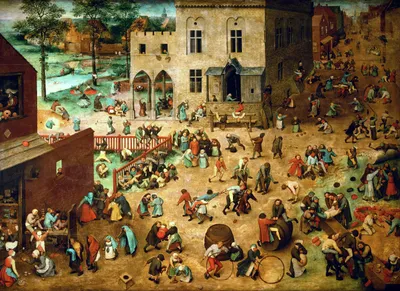
'Children's Games' by Pieter Bruegel the Elder, 1560. | Source (edited by the Author)
issue #161 of brennan.day
Good, Standard Work: Creating the Commons
brennan.day — issue #161
Publisher: Brennan Kenneth Brown
Place of publication: Calgary, Alberta, Canada
Available at: https://brennan.day
Contact: mail@brennanbrown.ca
I want to begin with a confession: I have way too many emails. A lot of people struggle with inbox zero, but I probably have more inboxes to check than some people do emails. I have multiple Outlook addresses, multiple Gmails—you know, the personal ones, the university ones, the professional ones. And of course, with my grey hat, the burners.
One of my burners is good.standard.work@gmail.com and I made it a long time ago. I have been mulling over how to make good, standard work for a while. Work that doesn't solely benefit me, or a specific company, but the closest definition of "everyone" possible. I want to be a good digital steward.
What does it mean to be a good digital steward, though? Perhaps the question is a little silly, given how important and under-discussed the question of how we ought to be good stewards to the physical land we live and nourish ourselves on. Maybe the two questions aren't really that far apart.
The Pastoral Origins
I discussed the origins of the commons already in my article on accounting for evil. In 1968, ecologist (and eugenicist) Garrett Hardin published in Science, the infamous "The Tragedy of the Commons." He wrote about a pasture, open to all. He argued that every herdsman, being rational, would add more and more of their own cattle, until the viability of the land collapses. It was an inevitable tragedy which arose from inherent human nature.
The essay went on to become one of the most cited—and most vociferously refuted—scientific pieces of the 20th century. Hardin's argument was taken up eagerly by free-market economists, by the political right, by the World Bank and the IMF as scientific cover for privatization policies around the world. In Canada specifically, conservative lobbyists used his logic to justify dismantling Indigenous communities' land rights. People who were interested in their own individual wealth gleefully pointed to the paper as evidence that shared things failed and private things survive.
Of course, he got the history wrong. In England, where the word "commons" originates, the shared pastures weren't unruly free-for-alls. Of course not. They were governed by layered and locally designed rules called "stinting," setting precise limits on who could graze how many animals, and when. These systems worked—sometimes for centuries. The commons weren't destroyed by overuse, no, they were destroyed by enclosure.
Beginning in 1604, thousands of parliamentary bills privatized more than a fifth of the English countryside, and the people who depended on those lands fought, and lost, and were dispossessed. What Hardin called inevitable human nature was actually the historical novelty of losing your land. The commons were stolen, and then they were being blamed for the loss.
Elinor Ostrom dedicated her career examining communities around the world, and how they actually managed shared resources. She documented over 800 cases, ranging from forests to fisheries to groundwater basins to irrigation systems. She found cooperative governance was not only possible, but common. People are not, it turns out, simply selfish herders! In 2009, she became the first woman to win the Nobel Prize in Economics for her work proving this. The Royal Swedish Academy said her research had "demonstrated how common resources can be managed successfully by the groups using them." Not governments. Not corporations. The groups themselves. Hardin's tragedy was merely a tragedy of the imagination.
So, what are the commons, exactly?
With the origin story out of the way, let's define what these words mean to us now. I think it's important we're all on the same page.
What are the commons? The cultural and natural resources accessible to and managed by a community instead of being privately owned. These shared resources—water, air, land, or digital spaces—are governed through collective social practices, norms, and stewardship for the common good.
Hm, okay, what is the common good, then? The shared interests, benefits, and conditions—safety, education, and infrastructure—benefitting all, or at least most, members of a community. The collective well-being rather than individual gain, requiring social cooperation to ensure resources are available to everyone. (Which, often, requires government action.)
In other words, the "sum of conditions of social life" allowing people to fulfill themselves. To trust people know how to flourish once the floor underneath of them is solid enough to stand on.
I have been trying my best to contribute to the commons through the little ways I can. I write my essays for others without a paywall on my own domain. I've built open-source blog themes and projects and released them under the AGPL, which means if you build on my work, what you build must also be free. I am planning to run a low-cost online writing school and ran Write Club at Mount Royal University because I believe writing is a civic practice and not a commodity. I do these things because I have the ability to—because the IndieWeb gave me the tools and the philosophy to make things that (hopefully) outlast any particular owned platform.
The IndieWeb defines a "commons" as something that can be mirrored, forked, and survived—something that, if the original disappears, the community can reconstitute or improve upon. The test is simple: if the platform shuts down tomorrow, does your work survive? If the answer is no, you're not in the commons. You're in a silo. This is exactly why it's important to control your data and publish what you want on your own terms. The commons cannot exist on a for-profit corporate server. Own your data. Use what you make. Document your stuff. Open source your stuff.
I've seen some people on the IndieWeb say that they don't want to save the world, that this is just their hobby. But I think the misunderstanding is that those are not mutually exclusive. Actually, I believe they are the same thing. To create a website from scratch with your personality, and to write and share about your life are not small things—these are the connective tissue of humanity. To document and share your life is resistance. The act of trying and sharing your humanity online and building community are all answers to the question: how will civilization survive? Our indomitable spirits and continued maintenance of humanity must not be understated.
The Guides
The commons, especially digital, need more guides. Not written down, but living humans. Those who came before and are willing to share and explain. Teachers and mentors. Elders.
For the commons to survive, people need to have confidence that what they know matters, and needs to be shared openly and freely. We are too short-sighted in our thinking, planning for months or years instead of decades and centuries.
Think of the civil engineers who spend their lives on massive projects for their children's lives. The cathedrals of medieval Europe took generations to build. No single architect saw them completed. The builders understood they were working inside of something larger than one lifetime. "Planting seeds in a garden they never get to see."
Indigenous traditions across Turtle Island have Elders, those who have moved through enough experience to begin offering it back. The Elders hold the stories—the long view that colonial modernity continues to collapse at our detriment. To know which plants grow back after fire. To know the original names of things. To carry the knowledge which allows cultural perpetuity to be possible. Not just survival, but the survival of meaning.
I was given gifts by those who came before me—language, land knowledge, ceremony—and to not share those gifts means they die. I know I could do a better job of contributing, myself. Not just documenting my code, or writing tutorials, or building things that others can build on—but actively finding the people who are further back on the path and offering a hand. The commons need stewards and stewards need to be made.
The Underlands
Robert Macfarlane wrote a book titled Underland: A Deep Time Journey. In it, he discusses what lies beneath forests. Macfarlane walks the Epping Forest with mycologist Merlin Sheldrake and encounters the "wood wide web." A network of fungal threads called mycorrhizal hyphae that connect tree root to tree root beneath the soil, allowing individual trees to share nutrients, send chemical warnings about insects and disease, and transfer resources from the old and dying to the young. What looked like isolated, competitive organisms—each tree fighting for its share—was a distributed community, maintaining itself through invisible, cooperative infrastructure functioning for more than 400 million years.
Macfarlane writes that the network is "at least as intricate as the cables and fibers that hang beneath our cities," he added, "you look at the network, and then it starts to look back at you."
Now look up. Not at roots, but at branches. If you stand in the right place and tilt your head, you'll see a network of absences. The outermost branches of neighbouring trees grow close—almost touching—and then stop. No overlapping or crowding. Between each crown, a thin channel of sky remains open, the canopy forming what looks like a precisely engineered jigsaw puzzle of leaves and light. This is crown shyness—a term coined in 1955 that scientists still don't understand. Each tree leaves room for the others. Each tree refuses to take everything.
Below ground, roots share. Above ground, branches make space. The commons have existed long before we have.
The Inverted Pyramid
Abraham Maslow's hierarchy of needs—the triangle that starts with food and safety at the bottom and tapers to "self-actualization" at the top—is taught in schools everywhere. It's presented as a map of psychological human motivation. Meet your basic needs first, then climb toward your potential. The individual is the apex. The self as the destination. What most curricula leave out is where Maslow got it.
In the summer of 1938, a thirty-year-old Maslow spent six weeks at the Siksika (Blackfoot) reserve in what is now southern Alberta—the traditional territory of the Blackfoot Confederacy, the Siksikaitsitapi, people who have lived and governed this land for thousands of years. He travelled to test a theory that social hierarchies depended on dominance. He found no such thing. Instead, according to Blackfoot scholar Ryan Heavy Head, Maslow encountered a society with "astounding levels of cooperation, minimal inequality, restorative justice, full bellies, and high levels of life satisfaction." He estimated that 80–90% of the Blackfoot people had a quality of self-esteem he found in only 5–10% of his own population. The observation, Heavy Head says, totally changed his trajectory. He came home and wrote the hierarchy of needs.[1]
The problem is what he did with what he saw. In the Siksika model, as presented by University of Alberta professor Dr. Cindy Blackstock, self-actualization is not the apex but the foundation. You arrive on Earth already whole and worthy. The community's role is to help you live out your potential—not earn it. You serve the community, in turn. Above the individual self comes community actualization—the goal that every member of the group manifests their purpose and has their basic needs met. And above community, reaching into the sky, is cultural perpetuity. The responsibility to pass the knowledge on, across generations, long after you are gone.
Maslow inverted it. He put the self at the top—turned an Indigenous model of collective flourishing into a Western ladder of individual achievement, and didn't credit the source. [2]
I believe the commons are sacred. They are the infrastructure through which people become themselves, fully, together. Not a compromise between individuals. They are the precondition for individuals to exist in any meaningful sense.
How Do You Contribute?
What does it actually look like, to contribute? In open-source spaces, most imagine it requires a computer science degree, a lot of free time, and a fluency in git. It doesn't.
- You can contribute to the commons anywhere you are on the skill continuum. If you write, publish your writing publicly—not behind a paywall, not on a platform that will one day evaporate, but somewhere of your own, or somewhere archival and open. The Internet Archive is a commons. Wikipedia is a commons. Your own domain, your own blog, is a commons when you write and share freely.
- If you code, release what you make under a license that says it must stay free. The AGPL, the GPL, the Creative Commons licenses—legal instruments designed to preserve the commons against enclosure. The work is not for others to privatize. Instead, it is to be used, improved, and given back.
- If you teach, document your process. Write a tutorial. Make a video. Answer the question in the forum even when it's the tenth time someone has asked it, because for that person it's the first time. Elinor Ostrom's eighth design principle for managing commons is nested enterprises: healthy commons are always layered, always connected to other commons, always part of something larger than themselves. Your knowledge is a node in that network. When you share it, you strengthen the mycelium.
- If you carry the kind of knowledge that comes from living close to something for a long time, find ways to pass it down. The civil engineer who spends a career on a dam never lives to see the irrigation it makes possible. The grandmother who teaches her grandchildren the names of plants in a language the state tried to erase is doing the most important infrastructure work in the world. Cultural perpetuity is never automatic. It is tended, in the same way a garden is tended.
And if all you can do right now is show up—to a club, to a community, to an open-source project's issue tracker, to a meeting, to a neighbour's porch—that is enough. The IndieWeb's first principle is ownership. But the lived practice of the commons is something even simpler: presence. Being there.
All Our Relations
Underneath everything, the commons are our relations to one another. The ongoing commitment between people to maintain something together, resisting the ease of enclosure.
Below the soil, a honey fungus in the Blue Mountains of Oregon covers four square miles of ground, threading nutrients between trees that don't know they are connected, sustaining organisms that seem, from above, to be entirely separate. What looks like competition is cooperation. What looks like isolation is network.
We can look at the systems we've inherited—the enclosures, the privatizations, the Hardinian myths—and decide the tragedy was never inevitable. It was a choice made by people who profited from it, and we can make different choices to build something for everyone once again.
good.standard.work@gmail.com is a burner email address I made years ago, in the hope that I would one day have somewhere to put it. A manifesto, maybe. Or a practice. Or just a reminder to myself on the days when it all feels futile that the work doesn't have to be grand. It just has to be good. It just has to be standard, meaning the standard it sets, the thing it models, the small corner of the world it benefits and holds in trust.
Plant the seeds. You won't see every garden in your life. But others will. And somewhere under the soil, the threads are already there, already reaching.
From "What I Got Wrong: Revisions to My Post about the Blackfoot and Maslow" by Teju Ravilochan, Colette Kessler, Vidya Ravilochan: Maslow did not himself use a pyramid. The pyramid was a visual shortcut for Maslow’s Hierarchy created by Douglas McGregor, Keith Davis, and Charles McDermid in the 1950s to introduce the Hierarchy of Needs in management training and textbooks. The simplicity of the diagram is perhaps one reason this formulation of Maslow’s Hierarchy of Needs is so well known. They indicate that “most criticisms of Maslow’s theory are critiques of McGregor’s interpretation of Maslow”. Furthermore, while Maslow did believe there was a Hierarchy of Needs, he didn’t argue that we had to meet one need completely before meeting other needs. ↩︎
While there are many Blackfoot who do see Maslow’s actions as exploitative and as an act of theft, prominent Blackfoot researchers saw Maslow as encountering a culture vastly different from his own, which completely shifted the trajectory of his inquiry. His time at Siksika was an inspiration for the learning journey he went on, conducting his own experiments and research, that eventually led to the creation of his Hierarchy of Needs. ↩︎


Comments
To comment, please sign in with your website:
How it works: Enter your website URL. IndieLogin signs you in through your site's IndieAuth server if it has one (e.g. indieauth.com), or checks your rel="me" links on GitHub, GitLab, Codeberg, and email. Setup instructions.
Signed in as: