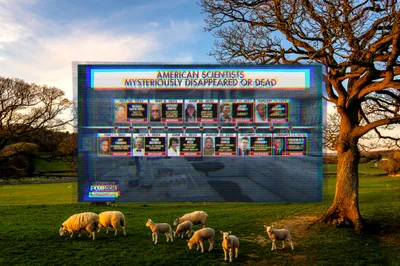
Foreground: Fox 13 Seattle, video still, April 20, 2026. Background: Silverdale Evening by Ian Livesey, April 22, 2021, public domain. (edited by the Author)
issue #178 of brennan.day
PATTERN RECOGNITION
brennan.day — issue #178
Publisher: Brennan Kenneth Brown
Place of publication: Calgary, Alberta, Canada
Available at: https://brennan.day
Contact: mail@brennanbrown.ca
I.
Nuno Loureiro was born in Viseu, a small city in central Portugal, in 1977. As MIT's president Sally Kornbluth would later write about him, even as a little boy, "when everyone else wanted to be a policeman or a fireman," Nuno already wanted to be a scientist. He studied physics in Lisbon at Instituto Superior Técnico, then earned his doctorate at Imperial College London, then did postdoctoral work at the Princeton Plasma Physics Laboratory and at the UKAEA Culham Centre for Fusion Energy. He joined MIT's faculty in 2016, was granted tenure in 2017, and was named director of the MIT Plasma Science and Fusion Center, MIT's largest lab in 2024.
His specialty was magnetic reconnection: the process by which oppositely-directed magnetic field lines in a plasma break apart and snap back together, converting stored magnetic energy into kinetic energy with tremendous, sudden violence. Magnetic reconnection is responsible for solar flares, the largest explosions in the solar system, releasing energy stored over weeks in minutes. It is responsible for the aurora borealis. And it is one of the central problems standing between humanity and practical fusion energy, because it is one of the mechanisms that makes plasma in a tokamak so difficult to contain. Understanding magnetic reconnection was understanding how to trap a small star long enough to power a city.
His colleagues remembered him as someone who would write equations on the whiteboard without notes, as if pulling them directly out of the air. "If you think about the physicist drawing equations on the board," said Bruno Gonçalves, a former colleague calling from Lisbon, "he was this type of guy." He loved pickup football. He had three daughters. He had recently said: "Fusion energy will change the course of human history. It's both humbling and exciting to be leading a research center that will play a key role in enabling that change."
On the evening of December 15th, 2025, he was shot in the foyer of his apartment building in Brookline, Massachusetts. He was transported to Beth Israel Deaconess Medical Center and pronounced dead in the early hours of December 16th. He was forty-seven years old.
Investigators quickly linked his murder to Cláudio Manuel Neves Valente who had opened fire on Brown University's campus in Providence, Rhode Island, killing two students just two days earlier. Valente had attended the same physics programme at Instituto Superior Técnico from 1995 to 2000, the same years as Loureiro, graduating first in his class, one place ahead of Nuno. He was later found dead by a self-inflicted gunshot in a storage unit in Salem, New Hampshire. The murder weapon matched. The forensics lab confirmed it.
This is a closed case. There's the known motive of jealousy, obsession, and the long-fermenting poison of a rivalry two decades old. There is a confirmed perpetrator. There is no mystery here, only grief for a man who wanted to trap a small star, dead in his own doorway.
II.
Carl Johann Grillmair was born in Calgary in 1959. He spent nearly three decades as a research scientist at Caltech's IPAC center in Pasadena, collaborating on the Hubble Space Telescope, the Spitzer Space Telescope, and the Wide-field Infrared Survey Explorer. In 2007, he was lead author on a landmark study that captured enough light from exoplanets to identify molecules in their atmospheres for the first time. He published 147 peer-reviewed papers. He received the 2011 NASA Exceptional Scientific Achievement Medal.
He lived in Llano, an unincorporated community in the Antelope Valley, in the high Mojave Desert region of Los Angeles County. He chose it for the dark skies. He had built his own small observatory on the property and spent evenings studying the cosmos. He flew gliders and sailplanes. He loved fixing things. "What was unique about Carl," said his thirty-year colleague Sergio Fajardo-Acosta, "was the ingenuity and the creativity, applying methods that nobody had ever thought of before."
On the morning of February 16th, 2026, at 6:10 a.m., with the desert still dark and cold, Carl Grillmair was shot once in the torso on his front porch. He was found there and pronounced dead at the scene.
The alleged suspect is Freddy Snyder, 29, who lived two miles away. He was arrested the same morning in connection with a carjacking in the area. Snyder had a history of trespassing on Grillmair's property under the pretext of hunting coyotes. Grillmair had reported him to police weeks before he died. Louise Grillmair, Carl's widow, told the press she believed her husband was killed in a misguided revenge plot—Snyder had blamed Carl for the police contact. Authorities charged Snyder with murder, burglary, and carjacking. His bail was set at two million dollars.
This is also a closed case. A property dispute gone catastrophically wrong. A man shot dead on the porch of the desert home he'd chosen because the darkness there was best for seeing stars.
III.
Monica Reza was sixty years old and the Director of Materials Processing at NASA's Jet Propulsion Laboratory in Pasadena. She had spent the better part of her career developing Mondaloy, a nickel-based superalloy she co-invented with an Australian metallurgist Dallis Hardwick in the mid-1990s. The material solved a fundamental problem in rocket engine design: oxygen-rich staged combustion cycle engines were theoretically more efficient, but in practice the high-pressure oxygen gas tended to combust the engine components themselves. Mondaloy doesn't burn, it holds. It became a component in twelve parts of the AR1 engine, and in the Hydrocarbon Boost Technology Demonstrator. She held three patents. She had been working in aerospace materials for thirty-seven years.
On the morning of June 22nd, 2025, she set out for a hike in the Angeles National Forest with a companion, on the Upper West Ridge Trail near Mount Waterman. At 9:10 a.m., she was about thirty feet behind the person she was hiking with, smiling and waving. The person turned back around. She was gone.
Dozens of agencies and helicopters and drones and dogs searched for days. Nothing. A second search was organized in August. No body was recovered. No trace was found. She is, as of this writing, still missing.
Her family has been unambiguous about what they think happened. She was a regular person, they said. She had a family. There is no sinister explanation because there doesn't need to be one—the Angeles National Forest is rugged, vast, and merciless. People disappear in wilderness without help from anyone. But she was smiling and waving, and then nothing. A sentence interrupted—
IV.
William Neil McCasland was an astronautical engineer with degrees from the US Air Force Academy, MIT (a Master's, then a doctorate in astronautical engineering, his thesis dedicated to his father, who died in a flying accident when Neil was young), the Kennedy School of Government at Harvard. He served as chief engineer on the GPS program. He was system program director of the Space Based Laser Project Office. He commanded the Air Force Research Laboratory at Wright-Patterson Air Force Base in Dayton, Ohio, from May 2011 until his retirement in October 2013. He was responsible for overseeing $2.2 billion in advanced aerospace research.
Wright-Patterson is one of the most mythologized military installations in American culture. It is the home of Project Blue Book, the Air Force's first formal UFO investigation programme. And it has been rumoured for decades, without confirmation against Air Force denials, propelled entirely by the inertia of legend and house-recovered debris from the 1947 Roswell crash.
McCasland himself became entangled in UFO mythology in 2016, when WikiLeaks released John Podesta's emails. In those emails, Tom DeLonge, the Blink-182 guitarist who had by that point pivoted fully into UFO disclosure advocacy through his To The Stars Academy (though that's another story entirely), referenced McCasland multiple times, claiming he was advising DeLonge on disclosure matters and had helped assemble an advisory team. One email referred to him simply as "Neil McC." DeLonge said, on a podcast, that McCasland was "very, very aware" of classified material and that "he helped assemble my advisory team. He's a very important man."
There is no public evidence that any of this is true. McCasland retired nearly thirteen years ago.
On the morning of February 27th, 2026, a repairman interacted with McCasland at his Albuquerque home around 10 a.m. His wife returned shortly after noon to find him gone. He had left behind his phone, his prescription glasses, his wearable devices. He took his hiking boots. His wallet. And a .38-caliber revolver with a leather holster. He walked out his front door and has not been seen since. Eight days later, a grey US Air Force sweatshirt was found about 1.25 miles from the house.
His wife, Susan McCasland Wilkerson, wrote on Facebook that it "seems quite unlikely that he was taken to extract very dated secrets from him." She said he did not have any special knowledge about Roswell. She said he was not confused or disoriented. The county had issued a Silver Alert, but she pushed back on that too, for he did not have dementia. She said he "planned not to be found." A man who made a decision and organized his final morning with a terrible precision. No phone, no trackers, no glasses, but boots and a gun—and then walked into the desert.
V.
Frank Maiwald was a NASA JPL space research specialist who died in Los Angeles in July 2024 at 61 with cause undisclosed.
Michael David Hicks was a JPL comet and asteroid researcher who died in 2023 at 59.
Anthony Chavez was 78, a retired Los Alamos National Laboratory foreman who vanished from his New Mexico home in May 2025 with no signs of foul play and no trace.
Melissa Casias was 53, last seen walking on a highway near Talpa, New Mexico in June 2025, her phone factory-reset before she left.
Steven Garcia was a 48-year-old contractor with a top security clearance at the Kansas City National Security Campus, which manufactures nonnuclear components for nuclear weapons. He was last seen leaving his home in Albuquerque on August 28th, 2025, on foot, carrying a handgun, police warning he may have been a danger to himself.
We're at nine people now. There are more. Researchers and contractors and administrators and a retired general. All had, at some point, touched the classified edges of American aerospace or nuclear research.
The story has migrated from fringe UFO forums to the Daily Mail, then to Jessica Reed Kraus's Substack, then to NewsNation, then to Fox News, then to the White House press briefing room.
On April 15th, Fox's Peter Doocy asked press secretary Karoline Leavitt about it. The next day, Trump was asked directly, and said he had "just left a meeting" on the subject, and said this was "pretty serious stuff." On April 17th, Leavitt announced a White House investigation. On April 20th, the House Oversight Committee announced its own. Chairman James Comer (R-KY) said that at first he thought it was "some kind of crazy conspiracy theory," but now believed "something sinister could be happening."
NASA posted on X that it sees no national security threat. A well-placed government source told CBS News the FBI was not investigating the cases as part of a suspicious pattern. The Department of Energy said it was "looking into the matter." The FBI confirmed only that it is "providing all assistance requested."
The US government employs tens of thousands of people in classified nuclear and aerospace research. In 2025 alone, 10,109 doctoral-trained STEM experts left their federal jobs—14% of the total pre-Trump STEM PhD workforce across fourteen agencies. That number is staggering and the context within which these cases exist. An enormous, turbulent field of people, many of them under extraordinary pressure, navigating uncertainty, leaving, dying, disappearing for reasons that are entirely their own.
Congressman Eric Burlison posted on Xthat "several scientists and officials connected to sensitive U.S. programs have gone missing or died in recent years. The public deserves clarity on these cases."
China is pledging billion-dollar spending boosts for science. European Research Council applications from US-based researchers have nearly tripled since Trump began cutting scientific funding. France offered "scientific asylum." The New York Times called it a costly brain drain.
A spy can be caught. A programme can be exposed. A conspiracy implies adversaries who understand the value of what they're taking. The erosion of American scientific infrastructure is terrifying, and done by those who don't know what they're taking.
VI.
The human brain does many things instinctively. You show someone two dots and their mind draws a line. You show someone three and the mind finds a triangle, a constellation, a face. Neurologists call it apophenia, the tendency to perceive meaningful connections between unrelated things. This is, evolutionarily speaking, the point of a brain. The cost of missing the pattern that was real—the rustle in the dead grass that really was a predator—was catastrophic and we evolved to pay the cost of false positives instead. We see faces in windy clouds. We hear intent in coincidence. And we see patterns in grief.
The human tendency to find pattern is not stupidity or gullibility. It is the same cognitive architecture allowing you to recognize a friend's face in a crowd, to detect irony in a text message, to notice when something in a room has been moved. The brain is a prediction machine. It is constantly, furiously modeling the world and flagging deviations from the model. When several deviations happen close together—several scientists, several deaths, several disappearances—the model flares up.
Somewhere between a plasma physicist shot dead in the foyer of his Brookline apartment building, a retired general who walked out of his Albuquerque home into the high desert with his .38 revolver and never came back, and an aerospace engineer who vanished thirty feet behind her hiking companion in the Angeles National Forest—still smiling and waving.
I think about Carl Grillmair in his desert observatory at night, the Milky Way overhead with no light pollution for miles, looking at stellar streams—the remnants of ancient collisions between our galaxy and smaller ones, the long scars left behind—and seeing in them evidence of water, of the possibility of other worlds sustaining something like us.
Magnetic reconnection is the process where magnetic field lines that are supposed to be inviolable—frozen in flux, unable to break—break anyway. Reality, under enough pressure, violates the conservation laws. The field lines snap. Energy releases. Something irreversible happens.
I don't know what happened to McCasland out in the Albuquerque high desert, or to Monica Reza on her mountain trail. I don't know if they're connected beyond the sad coincidence of their fields. People drawing lines between these losses are not crazy—they are reaching for a story that makes the loss feel intentional rather than random, significant rather than senseless.
The human mind wants a pattern. An answer that will honour how much each knew, how much they were building, how much of the future was stored in their minds the way solar flares store energy in a magnetic field for days before releasing all at once.
VII.
Nuno Loureiro had three daughters. He wrote equations on the whiteboard without notes—from mind to board, nothing between. He was forty-seven, and the fusion program he was directing is still running without him.
Carl Grillmair had a widow named Louise. He had 147 published papers, a NASA medal, a self-built observatory in the Mojave where the darkness was best for watching stellar streams—the long orbital scars of galaxies our galaxy consumed long ago. He was sixty-seven. He was still watching.
Monica Reza had a family who responded to her disappearance with clarity and dignity. She co-invented an alloy that does not burn and that is in rocket engines operating right now.
Neil McCasland dedicated his MIT doctoral thesis to his father, who died in a flying accident when Neil was young. He spent his career working in classified aerospace—GPS systems, directed energy, $2.2 billion in research at Wright-Patterson.
These are human beings, not clues. Not variables in someone's equation about cover-ups or coordinated disappearances. People who spent their lives working on things that are difficult and important. Fusion containment, exoplanet atmospheres, materials that survive oxygen-rich combustion, GPS infrastructure that runs the modern world. When they die, or disappear, or walk out into the desert with their boots and a revolver, what is lost is not an abstraction of expertise. It is the irreplaceable human being who knew what they knew, cared about what they cared about, and came home to someone with love.
The families are still here. Louise Grillmair. Susan McCasland Wilkerson. Loureiro's three daughters. Reza's family, still waiting. They are not part of the narrative, they are the cost of it.
Comments
To comment, please sign in with your website:
How it works: Enter your website URL. IndieLogin checks your rel="me" links on GitHub, GitLab, Codeberg, and email. Setup instructions.
Signed in as:
No comments yet. Be the first to share your thoughts!