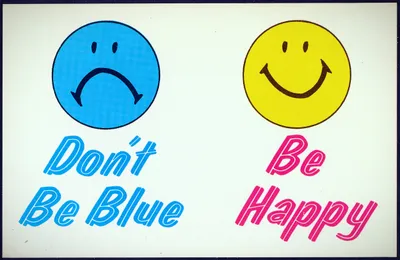
'Don't Be Blue, Be Happy.' The Tichnor Brothers Collection ca. 1960–1979. | The Digital Commonwealth (edited by the Author)
issue #255 of brennan.day
Suspect Happiness in Pursuit: An Anti-Interview with Unstory
brennan.day — issue #255
Publisher: Brennan Kenneth Brown
Place of publication: Calgary, Alberta, Canada
Available at: https://brennan.day
Contact: mail@brennanbrown.ca
The United States has marked 250 years since the Declaration of Independence this year, a nation in decline, which includes the infamous line of the unalienable rights given to all people:
But what does it actually mean to pursue happiness? It means to chase, to run after. You are free to try to reach, but you are not promised the destination of happiness itself.
And, sure, I could explain that the idea of the founding fathers was to have citizens living a life of civic virtue, moral self-improvement, and personal freedom to work (or own property) without unfair government blocks, rather than just seeking short-term personal pleasure.
But I think you'd agree with me—that sounds more like a noble contentment rather than happiness, doesn't it? Hm.
The 50/10/40 Split
All I want now is happiness for you and me
What I used to be will pass away and then you’ll see.
—Elliott Smith, "Happiness"
As you may already be aware, our capacity for happiness is already regarded as known. The most widely cited framework for happiness is from psychologist Sonja Lyubomirsky (UC Riverside) and colleagues Kennon Sheldon and David Schkade, who proposed a "sustainable happiness model" in a 2005 paper, later popularized in her 2008 book The How of Happiness.
The review of evidence by Lyubomirsky et al. (including a 1996 study by Lykken and Tellegen which compared the well-being levels of identical and non-identical twins raised together or apart) led to what's known as the 50/10/40 split.
To start, there's a 50% set point. Essentially half of a person's long-term happiness level is genetically determined. Identical twins' well-being levels correlated around 50%, versus only 2-8% for non-identical twins, suggesting a strong heritable component to baseline happiness.
And how much is due to circumstance? Things like income, health, marital status, where you live—in other words, the things external to you that you can't control?
10%.
That's it. The remaining 40% is determined by intentional activity, what Lyubomirsky calls "happiness strategies". We can't alter our genetic set points, and there are many circumstances in our life well beyond our control, but our will and choices we make can meaningfully increase and sustain happiness.
Now, it's clear that this is a radical oversimplification of many factors, and it's been decades since this research has been published. In a 2021 revisiting paper, Sheldon and Lyubomirsky write that the pie chart aspect of the model was flawed, and that they agree with many critiques while noting they were speculative and not dogmatic in the original.
But there is still something to it—I think there's a placebo aspect to will. I don't know if our belief in how much control we have actually changes how much control we have, but I do know it at least makes us, in fact, believe we have control.
If the 40% is real, it may be real only as a story—a story about intention, effort, and choice.
The Curious Case of Unstory and Brennan
In truth, I bring all this up because there's an anonymous blogger who's been on my mind, Unstory, who you may have seen on Bubbles or elsewhere.
There have been quite a few stories in the blogosphere recently about fighting against doomerism, in the realm of politics and the struggle and fight against doom. I've always thought that our capacity of imagination for a better future is one of the most vital things we can cultivate. This is what Indigenous Futurism is; the post-apocolyptic Biskaabiiyang.
And then there's Unstory.
There are many labels I would give Unstory after reading his blog posts: pessimist, cynic, misanthrope. But he rejects all labels except "peasant," which I can't help but respect. He understands a peasant as simply needing "food, sleep, maybe silence, not solidarity. [The] Peasant is not a member. Not an identity. Not a political faction." He appreciates the peasants who write online that are working class, those who are the "no-name cashier, waitress, cleaner, janitor, watchman, food delivery guy" and I completely agree that I would love to read more blogs by people like that.
In many ways, Unstory and I have similar ethos. He writes in short, unsentimental bursts, usually under a couple hundred words, blog posts that get to the point. We both appreciate the literal, the thing rather than the thing being merely talked about. We're both against tone policing, we would agree that the romance of nature is often completely detached from its reality. We would also agree that the Internet is over-engineered and bloated, and he even came up with a rather smart, simple idea for "leaf" files which I enjoy. The platonic ideal of the lazy minimal source of peasant articles.
In other ways, though, we are diametrically opposed. He has a disdain for the exact kind of writing I do. And I've found Unstory's recent posts to be hostile, and critical-yet-passive. His latest post, as of writing, is angrily complaining about the IndieWeb traditions of carnivals and other writing challenges without actually naming anybody in particular. And I can't help but wonder why? Compared to the earlier posts on the blog, these more recent ones feel hollow, aggressive for the sake of being aggressive, aimed at fellow writers rather than massive corporate entities and bullshit systems that would be justified with such ire.
Part of what makes those recent posts feel hollow is the language. I dislike ableist words (dumb, stupid, idiot, and the like) because insulting someone’s intellect has eugenic roots. Unstory certainly doesn’t need those words to be cutting, his best lines are sharper without them.
But maybe what bothers me the most is how it feels like Unstory is maintaining a label and identity, and performing a particular mood and opinion. Something predictable at this point.
Anyways, to bring this back to my original point, about happiness, Unstory wrote to me how "willpower as biological illusion, like free will. System can't be changed from inside. Too abstract for an article. Maybe it stays as smoke."
And I think that's where we differ the most, to surrender to the physical mechanics and electrochemical certainties of our material world, and to believe there is absolutely no autonomy, as a result.
I admit that these are most likely handy illusions, but I have lived such a joyous, interesting life because of these pseudo-choices I've made. Unstory replied that "handy illusions are still illusions. You can't do whatever you want. That's your illusion. You do what environment, and time demand. Organism moves or does not. The story comes after."
And what of people? Unstory says "Good people? There is no such thing ;/ Nature does not know "good". Something exists or not. You romanticized people and society."
Is this wise zen, or bleak nihilism? It's hard to tell. To be honest, despite how crude and crass Unstory often is on his blog, and despite how much I disagree with him, I can't help but find wisdom in his writing. And he tells me, "[y]ou can't learn anything from me. Your organism does not need my body for anything. And if it needs it, you will kill me and eat. It knows what to do."
Unstory’s determinism is that he writes. He replies. He maintains a blog. He "points at corpses" and refuses labels. If nobody chooses anything, then even the refusal to decorate a lie is not a choice. Yet, it is a performance, and a performance implies an audience, and an audience implies that the story matters.
Am I happier than Unstory? It's a ridiculous question, and I'm almost certain Unstory would reject it. While we have two radically different, opposing worldviews, I certainly don't think mine is better or superior. That's why I wrote "The Curious Case of Unstory and Brennan" in the header. By that, I don't think we balance each other out, or that the world needs both our worldviews, or anything like that. People are just people. I just think we're both weird, and we would make a fantastic buddy-cop film if we co-starred in it.
I am humanist, social, romantic, attached to identity, seeing people as good, treating questions as meaningful, and treating free will as a useful illusion. Unstory is anti-humanist, anti-identity, deterministic, seeing categories as traps, rejecting moral language, and refusing to offer wisdom or salvation.
Of course, by writing this I am doing exactly what he refused to do. I am turning him into a type, with particular labels. I did indeed want a clean portrait for my story of Unstory. And in his first reply, he refused, telling me that my “questions try to turn [him] into a type…” He will not wear labels, and his answers are evasive not out of dishonesty but out of a principled resistance to being pinned down or figured out.
I failed in getting a proper interview out of Unstory, and I joyously surrendered. The more we exchanged, the more the diptych developed. Cynicism vs. love, the stripped body vs. the embellished story, the impossibility of change vs. the glorious illusion of it.
You see, Unstory’s logic remains unassailable on its own terms, but Brennan’s joy remains unconquered. Two people staring at the same abyss—one seeing only the abyss, the other seeing a wonderful illusion and shouting “Hurrah!” into the void. Our exchange gains a strange beauty from the double vision—and it just keeps looking.
I'd like to share a quote from one of my favourite writers to end this on.
“In spite of everything I still believe that people are really good at heart. I simply can’t build up my hopes on a foundation consisting of confusion, misery, and death. I see the world gradually being turned into a wilderness, I hear the ever approaching thunder, which will destroy us too, I can feel the sufferings of millions and yet, if I look up into the heavens, I think that it will all come right, that this cruelty too will end, and that peace and tranquility will return again.”
― Anne Frank, The Diary of a Young Girl
Originally, it was merely going to be "life, liberty, and property" as per John Locke... and maybe we'd be a lot closer to universal housing as a right if that were the case. ↩︎


Comments
To comment, please sign in with your website:
How it works: Enter your website URL. IndieLogin checks your rel="me" links on GitHub, GitLab, Codeberg, and email. Setup instructions.
Signed in as:
No comments yet. Be the first to share your thoughts!