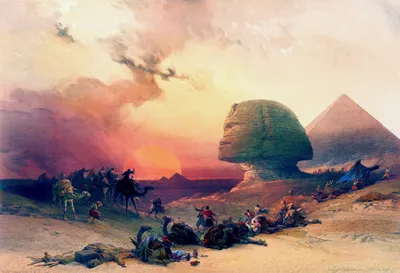
Egypt and Nubia, Volume III: Approach of the Simoon-Desert at Gizeh' by Louis Haghe. 1849. | The Cleveland Museum of Art (edited by the Author)
issue #256 of brennan.day
A Story of the Origins of Religion

brennan.day — issue #256
Publisher: Brennan Kenneth Brown
Place of publication: Calgary, Alberta, Canada
Available at: https://brennan.day
Contact: mail@brennanbrown.ca
It's been awhile since my last essay on religion, and while I've shared my personal testimony and death rituals from around the world, I haven't written about the fascinating origins of religion.
I know what you're thinking, how it's rather sacrilege to try to pinpoint and explain the beginning of spirituality—I know that it is far easier to explain things in retrospect—but it's an interesting rabbit hole nonetheless.
We begin with Friedrich Max Müller, a European comparative philologist born in 1823 who is now most well-known for pioneering and founding the academic science of religion, what we now call Religious Studies.
Müller's theory of naturism, or physical religion, posited that early religion began with humanity's direct sensory perception of the physical environment and natural forces. He argued that awe-inspiring phenomena—the sun, the sky, the weather and storms, dawn and dusk—inspired awe, terror, and an intuition of the Infinite. Early humans personified the forces as divine agents, shaping language and myth.
Lightning and thunder, for instance, are rather terrifying. And yet they also cause deep marvel, surprise, and reverence. And so, we personified the phenomenon, creating a deity who controls when it thunders as an attempt to better understand these chaotic, random forces. Surely if it happens often, then the God is angry.
"Regarding mythology, others see it in a picture of great forms and forces of nature, particularly the sun, the moon, and stars, the changes of day and night, the succession of the seasons… all these reflections by vivid imaginations."
Sacred rituals and sacrifice grew out of a desire to control the unpredictable and survive, such as giving offerings or performances for better crop harvests.
There's "Pluto's Gate", a mythical gate to hell, which was found to be a real place in Turkey. CO2 concentrations in the grotto below the temple still reach up to 91 percent, lethal vapours causing the suffocation of animals, and by some accounts, causing visions and prophecies in pilgrims who slept nearby, in what one archaeologist called an oracle-of-Delphi effect.
I would be remiss without adding that Müller carries problematic baggage, with his translations and academic frameworks serving a Western colonial and missionary agenda, often aimed at diminishing indigenous spiritual confidence, particularly with his work in India.
In Ancient Egypt
Whatever Müller got wrong—and surely he got plenty wrong—I appreciate his instinct to look for religion in the natural world. Ancient Egypt is a particular interest of mine, with the amount of environmental danger people endured and survived. For in the Nile Valley, there's the Nile Crocodile, the Nile hippopotamus, scorpions, and the Egyptian cobra. These were some of the deadliest animals in the world.
And you can see how the religion of Ancient Egypt attempted to reckon with these mortal terrors. The cobra, the Wadjet, symbolised protection of royalty. Pharaohs wore her rearing form on their crowns as the uraeus, and it was said to spit fire at any enemy who came near.
Hippos were associated with both death and fertility, the goddess Taweret was part hippo, part crocodile, part lioness, who guarded women through childbirth.
Crocodiles, born on land and living in water, protected the dead, ferrying them to the afterlife, skilled in navigating both planes. This was Sobek, and Egyptians mummified crocodile eggs and fetuses to bury alongside their dead to enlist his help crossing.
Scorpions would be prayed to for healing from illnesses. Serket was the goddess of both venom and its cure, whose name means "she who causes the throat to breathe," referring to the paralysis a sting brought on.
Livestock was associated with the fertility of the land, embodied in the cow goddess Hathor, prayed to for good farming seasons. Hathor was also love, joy, music, motherhood, and the sky, with more temples built to her than to any other Egyptian goddess.
And the Scarab Beetle was connected to the Sun, with Khepri, the aspect of Ra who rolled the morning sun into being the way a dung beetle rolls its ball across the sand. Egyptians watched young beetles emerge from those dung balls as if from nothing. A God born from what looked like dead matter, over and over.
The black lands of Egypt were fertile, and tombs were built on this precious land alongside crops, with the Sekhet-Hetep, the Field of Peace being one of the Egyptian heavens. The farmers imagined the afterlife similar to their own lives, meaning they would, tragically, continue their labour forever. Egyptians buried shabti figures with their dead, small magical servants meant to answer the call to work in their place.
Meanwhile, the Netherworld is the red lands—a place where you can get easily lost, suffering from drought, thirst, and the scorching heat of the Sun.
The Evolution
There was a process to this—a gradual evolution of understanding the animal's role, sacredness, and identity.
For example, jackals[1] in Ancient Egypt were grave robbers and scavengers, and the earliest Egyptian civilization struggled to block them from entering tombs—this was an existential threat, as preserved bodies were vehicles to the afterlife.
So, to start, there was Zoolatry, Anubis in full animal form originally, and there were attempts to placate the power of the animal, bribing the power of the Jackal by satisfying the God, making the animal less threatening.
Over time, technology advanced and made protecting tombs easier, and the anthropomorphic, humanlike Anubis that we know now developed as the Egyptians conquered and controlled the jackals (and, in turn, their fears), understanding the God as now being cooperative. Anubis predates Osiris as lord of the dead, and got demoted to embalmer and gatekeeper once Osiris rose in prominence.
Some would argue the evolution didn't stop there—as nowadays Anubis is known to some as being an adorable anime girl now protecting their website from DDoS attacks. The wheel of time continues to turn.
I'm aware that, in writing something like this, I'm playing the role of the anthropologist which I've criticized in the past. Which is to say, I'm compartmentalizing and acting as though the beliefs and thoughts of others can be easily understood, simply because they're geographically and temporally distant.
The wheel of time doesn't change the gods—it changes the people telling their stories. My evolutionary arc is another layer of interpretation, surely.
2011 genetic analysis reclassified the "Egyptian jackal" as the African golden wolf, a distinct wolf species, not a jackal subspecies. ↩︎
Comments
To comment, please sign in with your website:
How it works: Enter your website URL. IndieLogin checks your rel="me" links on GitHub, GitLab, Codeberg, and email. Setup instructions.
Signed in as:
No comments yet. Be the first to share your thoughts!