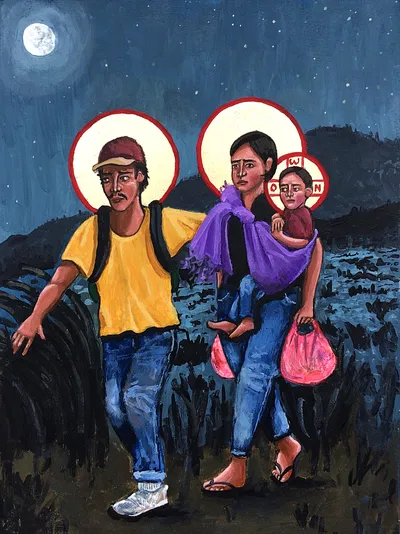
La Sagrada Familia, Kelly Latimore, 2016. Acrylic and gold leaf on basswood. © Kelly Latimore Icons. kellylatimoreicons.com
issue #165 of brennan.day
How and Why I Believe in God: The Ballad of Tragic Theism
brennan.day — issue #165
Publisher: Brennan Kenneth Brown
Place of publication: Calgary, Alberta, Canada
Available at: https://brennan.day
Contact: mail@brennanbrown.ca
I've come to realize that I mention God in passing, but I've never actually explained the specifics of what I believe. When I get asked what I believe in, or what my religion is, I never have a simple answer, or even any vocabulary to explain myself at all. An atheist would call me a believer, and a believer would call me an atheist, or at the very least, blasphemous. There is no specific label for what I am, no church I can attend and feel fully understood. My answer is four-dimensional, requiring an impossibly lengthy explanation of my life beginning all the way in childhood.
Let's begin.
I. The iPod Shuffle
My small Payless sneakers made a rhythmic crunch as I walked home down the back alley after elementary school was over. We lived close enough that I could walk home alone, no problem. I was in fifth or sixth grade when I was introduced to atheism by Liam on MSN Messenger. He was several years older than me and urged me to read The God Delusion by Richard Dawkins. I was twelve, so I didn't really have a source of income, and instead I went on Pirate Bay and grabbed a torrent of the audiobook and loaded it up onto my second-generation blue iPod Shuffle, screenless and clipped to my backpack strap. And so, there I was down that back alley, listening to Dawkins narrate his own book, explaining in logical detail why belief in God was so absurdly incorrect—why a supernatural creator was not only improbable but actively harmful, a delusion in the clinical sense of the word.
I think, tragically, for a lot of people the buck stops there. You take the time to logically think through religion and faith, come to terms with the fact that it's all bullshit, or at the very least you are disinterested enough to remain a distant, ambiguous atheist. This was not the case for me.
It was around this time I started loaning out books about Buddhism from the library, specifically Mahayana Buddhism. I learned about Prince Siddhartha Gautama leaving his comfortable, lofty life only to witness the horrors the world has to offer — and found the understanding that life contains suffering for all sentient beings a revelation. So it wasn't just me, a younger Brennan muttered to himself. I learned the Four Noble Truths and the Eightfold Path, watched a documentary narrated by Richard Gere whose name I forget. I found myself getting into the modern, western idea of secular Buddhism specifically. This was something I was able to reconcile with my newfound atheism, maintaining the philosophy while discarding the traditional elements deemed incompatible with western scientific rationalism and egalitarian humanistic values.
This is where I remained for my teen years. I read the works of western spiritual communicators like Jack Kornfield and Alan Watts, as well as popular Buddhist monks like Pema Chödrön, Thich Nhat Hanh, and Henepola Gunaratana. I am so grateful for this middle path I began to walk. I learned that attachment to earthly desires was honey on a razor blade, a metaphor rooted in Shantideva's Bodhicharyavatara and alive throughout the Tibetan tradition. The sweetness is real, but the deeper you lick, the deeper you bleed. I learned to sit with discomfort rather than flee. I learned impermanence is the source of beauty. A flower is precious because it will not last.
And yet. There was something the secular path could not hold. An invisible thumb pressing into my chest when I wasn't paying attention.
II. The Hospice
My dad got me a job cooking at the Rotary Flames House, a children's hospice next door to the Alberta Children's Hospital, one of only six pediatric hospices in all of Canada. The building is designed to feel like a home. Two storeys. Warm lighting, soft floors, a beautiful kitchen I got to work in. I was young, and I thought I knew what grief was. I didn't.
What I discovered there was different suffering. Unresolving, enormous and structural the way a mountain is. Children who would not grow up. Parents learning to hold that knowledge while they still held their child. A mother who thanked me once for the warm soup, her voice completely steady.
That steadiness, that will. I kept watching it and thinking where does that come from? Because it wasn't from nowhere. The steadfastness wasn't from making peace with the math. It came from below the math, beneath the level at which equations and the calculus of continuing are even possible.
I was not going to get there with secular Buddhism, which had given me equanimity and compassion, but not this. This required otherworldly survival that survives the worst possible news and remains standing.
One afternoon, after the lunch rush, I found myself in the building's small study during my break. I was tired. I sat in the chair. And there was a copy of the Holy Bible, the New American Standard Bible, the translation produced by the Lockman Foundation and committed above all else to formal equivalence: word-for-word, as close as possible to the original Hebrew, Aramaic, and Greek. I read the foreword and was impressed by how honest the translation attempted to be about its own limits, its own faithfulness. I could trust that. Something in the acknowledgment that translation is always imperfect, always an act of reaching toward something you cannot entirely touch.
I opened to the New Testament.
III. Reading Matthew
I began with the Book of Matthew, and found myself profoundly moved.
Here was Christ. Not the Christ of the prosperity gospel, not the Christ of colonial missionaries handing out Bibles with one hand and taking land with the other.
A dark-skinned Palestinian man, less than 5'5" tall, two thousand years ago, who spent time with sex workers and tax collectors, who declared that it was easier for a camel to pass through the eye of a needle than for a rich man to enter the Kingdom of Heaven, who said the poor in spirit were blessed, who announced the meek shall inherit the earth.
Christ who flipped tables in the temple courts when the money changers turned a house of prayer into a market, He looked at that scene and felt, within his human body, the fury of a person who loves what being desecrated. How human His anger was.
I read about Peter—Jesus' most faithful, most present disciple, a man so full of doubt that he sank the moment he stopped looking at Christ and looked at the waves. I read about the Transfiguration, where Jesus's face shone like the sun on a mountaintop and Moses and Elijah appeared beside him, and Peter—totally overwhelmed and not knowing what he was saying—suggested building three tabernacles, one for each: Jesus, Moses, Elijah.
As if you could contain the divine in a tent. As if holiness could be organized into equal shelters. The cloud overshadowed and a voice came from the cloud. And Peter fell on his face.
I found Peter's failure more moving than his faith. His failure was human, his attempt to build a house around something that cannot be housed, trying to name and structure a moment of pure, blinding encounter. I recognized that impulse. With atheism, then with Buddhism, I've always been trying to build a clean philosophical shelter around something that kept burning through the walls.
I began to dive deep into apologetics, listening to the debate podcast Unbelievable? with Justin Brierley while washing the dishes or taking the bus home. I found myself becoming a syncretist, a progressive Christian, teetering on the edge of being a religious fictionalist, a philosophical position to affirm religious sentences and participate in religious practice without necessarily believing the content of those sentences to be literally true. The fictionalist says that even if we are atheists, we should carry on talking, thinking, and acting as if religion were real, because the fiction is valuable, because the story does something no mere argument can do.
I hovered there, but I kept returning to the hospice. I kept returning to that mother's steady voice. And I could not make the fictionalist account add up. A fiction, however valuable, does not get you through that. Something had to be real.
IV. The People Who Actually Wrote the Book
The Bible is beautiful literature. The range—law and prophecy and poetry and apocalypse, genealogy and elegy and erotic verse and epistolary fury—is staggering. Job screaming at the sky alongside Ruth's quiet loyalty, the Song of Solomon's unashamed sensuality alongside Lamentations' inconsolable grief. It is literally a book of books. It is several centuries of a people trying to understand what it means that the universe exists and that they are in it.
And the Bible was not written by who most people think it was written by, and it was not written when most people think it was written.
Mark was the first Gospel to be written, sometime around 70 CE, forty years after the Crucifixion. Matthew and Luke arrived roughly a decade or two after that, drawing on Mark and on a now-lost source scholars call Q. John came last, somewhere between 90 and 100 CE. The names we attach to them, Matthew, Mark, Luke, John, were all assigned later, in the second century, when early Christians were working urgently to establish which texts carried apostolic authority.
No surviving manuscript is anonymous; every complete manuscript has the title we now recognize. But the texts themselves never claim their authors' names.
The Acts of the Apostles, at 4:13, records that when the religious authorities saw the boldness of Peter and John, they recognized them as agrámmatoi, literally "without letters," unschooled, common men. They had no formal rabbinical training; Jewish boys in first-century Galilee learned to read Torah. To write sustained, theologically sophisticated Greek prose across thousands of words—the kind you find in the Gospel of John, or in Paul's letter to the Romans—required a level of education that most of Jesus's fishermen, tax collectors, and working poor simply did not have. Paul is an exception, a Pharisee trained in Jerusalem, literate in both Greek and Hebrew, and he tells us himself that he never met Jesus during His earthly ministry.
The scholar Bart Ehrman spent decades as a committed evangelical Christian before the weight of the historical evidence shifted him, and documented all of this carefully in books like Misquoting Jesus, arguing the New Testament manuscripts we have are copies of copies of copies, altered by scribes over centuries, sometimes accidentally, sometimes deliberately, to clarify theological positions or smooth over contradictions. The manuscripts differ from each other in 400,000 places.
The historical messiness of the Bible does not make the Gospels false, it makes them human. The Word became flesh and dwelt among us, transmitted through oral tradition for decades, carried in the memories of Aramaic-speaking peasants, before anyone wrote it down in Greek.
The fact that this transmission was imperfect, that it was shaped by community, that it bears the fingerprints of the people who carried it, deepens it. What survived was not perfectly preserved, but fervently preserved. A real miracle.
The Bible is written by frightened, fallible, brilliant people thousands of years ago, filtered through oral tradition and scribal copy, shaped by communities with their own anxieties and their own arguments. The Word and the word, the divine and the human, tangled together like everything else that matters.
The Corrupt
What I cannot forgive, and what I will not soften, is the use made of this imperfectly-transmitted, humanly-authored, historically-contextual document by American evangelical Christianity.
Contemporary American Christian evangelicalism, particularly in its political expressions, is poison.
The prosperity gospel, which is the theology that God rewards faith with financial success, that wealth is a sign of divine favor and poverty a sign of spiritual deficiency is a direct inversion of what Jesus actually taught. Jesus said the meek would inherit the earth. He said to sell everything you have and give to the poor. He said it was easier for a camel to pass through the eye of a needle than for a rich man to enter the Kingdom of Heaven. You cannot serve both God and money.
Preachers fly on private jets worth tens of millions of dollars and tell their congregations that God wants them wealthy too, as long as they keep tithing. Predatory behaviour.
Similarly, according to research by PRRI, roughly two-thirds of white evangelical Protestants hold Christian nationalist views.
The Jesus of the Gospels was not a nationalist. He was executed by the imperial state as a threat to its order. He told His followers to render unto Caesar what is Caesar's—establishing the irreducibility of God's claims against imperial ones, not a blessing of empire. He healed the servant of a Roman centurion without making him renounce his citizenship. He talked to Samaritans and Syrophoenicians and people His own culture had designated untouchable.
Christian nationalism has deep American roots, tangled in the theology of Manifest Destiny and the preaching of a Gospel reimagined as permission for conquest.
Both movements mistake American values for Christian virtues. The prosperity gospel baptizes the American dream of upward mobility. Christian nationalism baptizes the American ethos of supremacy.
I am a Christian of the Christ who got into trouble. The one who touched lepers when touching lepers was forbidden. The one whose first miracle was making sure a wedding didn't run out of wine. The one who told the story of the Good Samaritan and made the moral hero the ethnic group His audience despised. The one who said "love thy enemies" knowing full well that it was the most difficult thing He could ask. That Christ. Not the false, white Christ who has been franchised and branded and deployed in service of political power.
V. On Treaty 7 Territory
I am writing this in Mohkínstsis, in the lee of the Rockies, in a city that was not supposed to exist on land that was never supposed to be sold. The Bow River runs through it like a vein the earth hasn't closed. I am Red River Métis with a thunderbird medallion at my collarbone. I carry, in my own body, the contradiction that is colonial life. The church and the sweetgrass, the French and the Cree, the faith of my grandmothers bending toward each other across a fault line that was never fully healed.
In Blackfoot cosmology, the Creator—Apistotoke, the Sun, the Great Spirit—works alongside a figure called Napi, Old Man. Napi is a culture hero, a transformer, a maker-of-worlds. He shaped the land, gave the people their laws, taught them how to live.
He is also a trickster. He is foolish. He makes mistakes—sometimes venal, sometimes catastrophic, sometimes darkly funny. He steals. He overreaches. He falls for his own tricks. There is even a story called The Mistakes of Old-Man, in which Napi makes the bighorn sheep wrong before making them right. He is not evil, but he is flawed, and the flaws are inseparable from the making.
The Blackfoot tradition doesn't treat this as a problem requiring a solution. The trickster-creator doesn't get resolved into a more theologically tidy figure. Old Man's mistakes are part of the cosmology explaining why the world has its jagged edges, why death came into it, why things are broken and unhealed.
But the world is still good. Still made with love. Still worth inhabiting. The mistakes don't undo the creation; they're the teachings.
I'm not going to appropriate a tradition I'm adjacent to but not inside. Napi belongs to the Siksika, the Kainai, the Pikuni, not to me. But this cosmology made my own faith legible to me. The idea that a maker could be powerful and imperfect simultaneously, that creation could be both beautiful and broken.
VI. The Artist
Imagine the Creator. A painter, not a professional with a steady hand and an infinite budget of time, but a real painter. An artist working by instinct, who makes marks and steps back and winces, who sometimes gets it so deeply right that it frightens them.
This painter has no model to copy. There is no reference image, no prior draft, no teacher standing at the shoulder. They are inventing colour itself. Inventing the concept of the canvas while simultaneously trying to stretch it.
That is my God.
The painter is not weak. To be first, to be the inventor of invention, requires a power so vast it breaks language trying to say it. But power is not the same as infallibility. To be creative is, by definition, to risk. You cannot make something new without the possibility of making something wrong.
A God who could not fail would not be creating—they would be printing, stamp after stamp after stamp, each copy identical, none of them alive.
My God creates. My God risks. My God makes mistakes.
And when the mistake is grave—when the rapist exists, when the child dies, when the thing that comes out of the painter's hand is monstrous and real—my God winces. Deeply, at the weight of what has been made. And my God does not succumb to it. Does not let the mistake become the painting's definition. Continues to work. Continues to love. Continues to grow.
A God who cannot grow is not a God who creates. A God who cannot be wounded by what they have made is not a God who loves.
VII. Where I Diverge
I came to understand my beliefs as process theology. Alfred North Whitehead's dipolar God—one foot in eternity, one foot in time, shaped by everything that happens in the world—felt closer to my God than the Thomas Aquinas God. The idea that God is not above the process but inside it, the "fellow-sufferer who understands," as Whitehead put it.
But process theology insists that God does not make moral mistakes. God's aim is always the best possible response. Evil emerges from creaturely freedom, not from divine error. God persuades; creatures distort; God suffers the distortion. In this schema, God is finite in power but not in goodness—perfectly loving, always reaching toward the best possible outcome, always the poet of the world leading with, as Whitehead said, tender patience.
If God is in everything—and I believe God is in everything—then God was in the hands of everyone who ever hurt me. God was present at the worst moments I have witnessed. God did not prevent them. And I cannot construct a clean separation between God's persuasive lure toward good and the creature's choice of evil that lets God off the hook entirely. If you are the painter and you paint the rapist into the scen —not someone else, you, with your own brush—then the rapist is yours.
In Wendy Farley's Tragic Vision and Divine Compassion, she argues that traditional theodicy and the attempt to justify God in the face of evil, is not only intellectually insufficient but morally dangerous. It risks asking victims to make peace with what was done to them in order to protect the coherence of God's goodness. Her alternative is a theology of compassion rather than justification: God is not innocent, but God suffers with us.
Jürgen Moltmann's The Crucified God argues that God and suffering aren't contradictions. His central claim is that suffering is not a problem to be solved but an aspect of God's very being. God is love, and love invariably involves suffering. A God who cannot suffer is a God incapable of love, and therefore cannot be God.
Richard Rubenstein's After Auschwitz remains one of the most honest theological books ever written because it does not try to make a comfortable argument. It asks the one question everyone was avoiding: If God chose Israel, what does Auschwitz mean? And it refuses every answer that softens the question. I am not Rubenstein. I did not conclude that God is dead. But I think he was asking the right question with the right amount of honesty.
What I am is a tragic theist. Someone who believes God is real. God is love. God made this, and God grieves this. God has not finished.
Jack Miles, in his Pulitzer Prize-winning God: A Biography, reads the Hebrew Bible and sees God as a character with depths and contradictions and an inner life changing across the narrative. The God of Genesis is not the God of Job. Something happened. Grown, or broken, or learned. Miles doesn't say God is fictional; he says that the character of God, read closely, is more complex, more surprising, more human than centuries of systematic theology have allowed.
VIII. The Hardest, Most Difficult
Innocent children are killed every day. People are abused and tortured every day. The suffering is specific, named, bodied, unbearable. And I believe God is in all of it. Not above it, but inside it, present to it. Author of the conditions that made it possible.
God created the murderer. God is within the murderer. God witnesses and does not stop him.
My cognitive dissonance is the only honest position I can hold as I commit to both divine immanence and the actual existence of will.
I cannot have it both ways. I cannot say God is in everything and then say God wasn't there. God was there. God winced. God did not stop it. God is not finished with that.
The artist who has made something terrible is not absolved by grieving it. But they are also not simply evil. I cannot hold everything and arrive at a simple verdict. A verdict would require one of them not to be true.
And I refuse to let the worst moments become the definition of the canvas.
IX. The Good Is Infinite
Here is what else is true.
I am thirty years old and I live in a city ringed by mountains that turn pink in the evening like they are embarrassed by how beautiful they are. I have friends who would drive through snow for me. I have read Tolstoy and Morrison and Borges and Emerson. I have held a beaded thunderbird against my chest and felt continuous with the very old. I have eaten bannock hot from the pan. I have been in love. I have stood in the break room of a children's hospice and watched a father hold himself together with both hands, and then go back through the door.
All of this is also God. All of it came from the same painter's hand as the suffering. I cannot look at the balance sheet and conclude that existence was a mistake. The good is not louder than the bad. But it is deeper. It goes further down. And I believe that the depth of the good is not an accident.
I believe that God, who makes mistakes, also makes the Bow River at dusk. Light hitting the water in September, gold and then copper and then gone, and you are standing there on the bank thinking: I did not deserve to see this and here I am seeing it.
I am the luckiest person on Earth. I say this knowing what I know about the world. Not from ignorance, but from weight-bearing gratitude that only comes from a person who has known the deep, nerve-shattering canals of suffering. My suffering is because of God. My joy is because of God. The good is infinite. He made everything. I exist because of Him. The painter continues to work.
X. I Contain Multitudes
I know what the classical theist wants me to say: God is omnipotent, and your "mistakes" are just a creature's limited perspective on a plan too large to comprehend.
I know what the atheist wants me to say: You've just described a very large naturalistic process and called it God.
I know what the process theologian wants me to say: The evil isn't God's doing, it is creaturely freedom operating beyond divine persuasion.
I am not fully any of those. I live in the gaps between. Raised between the church and the sweetgrass, baptized Protestant and then self-baptized in that back alley with Dawkins in my ear, then in the library with the Four Noble Truths, then in a break room chair with a Bible that wanted to be taken seriously, then at a mountaintop called the Transfiguration where even Peter didn't know what he was saying.
The universe should not exist. Physics and chemistry operate on margins so precise that the existence of anything at all is an ongoing miracle. A number so close to zero that it might as well be zero.
Except it isn't. We are here. I am here. The probability of me being here, at this desk, in Mohkínstsis, on Treaty 7 territory, typing this specific faith and this specific doubt is functionally zero. And yet.
Do I contradict myself? Very well then I contradict myself. I am large. I contain multitudes. Walt Whitman wrote that in 1855 and I am still not done being grateful for it. The only way to hold faith intact—to hold anything intact—is to stop demanding consistency, agreement, harmony, and coherence. This is the mystery.
The universe is a contradiction that exists. God is an artist who makes mistakes and is also infinite love.
You are here. You were made. The making cost something. The cost was real. The maker grieves it. The Creator continues. Go, then. Be grateful. Be honest. Hold the contradiction. Call it prayer.
XI. My Own Prayer
There is a large purple-blue abalone shell on my desk. I have written about it before. Iridescent, shifting green to blue to violet depending on the light.
Inside the shell I keep the materials. Sometimes the materials are good. Sometimes, in the right season, I walk up to Nose Hill Park. 11 square kilometres of native rough fescue grassland sitting in the middle of northwest Calgary, an endangered ecosystem surrounded on all sides by residential subdivisions, one of the last of its kind in North America. The park has over 40 pre-contact archaeological sites. Tipi rings pressed into the earth, lithic scatters, a medicine wheel built by Blackfoot Elders.
In the spring the prairie crocuses come up violet-white through soil that is still half-frozen, pushing through snow. In summer, the grasshoppers leap out of the fescue like sparks. There are coyotes. There are Swainson's hawks riding thermals above the coulees. On a clear day you can see the full spine of the Rockies, white and enormous and indifferent and astonishing, from the plateau at the top.
I go up the hill and I look for sweetgrass growing in the draws and swales where the moisture collects. When I find it, I take a small amount and before I leave, I press tobacco into the soil where the plant was. You do not take without giving. The tobacco is an offering.
There are tobacco seeds in my apartment right now, gifted to me by my Honours Advisor, Dr. Sarah Banting, who gave them as a sacred present carefully. I intend to grow them properly this season. I hope I do not kill them.
More often than not, I'm buying rosemary and sage from the grocery store. Or from one of the crystal shops in Kensington or Inglewood, where the incense burns thick in the doorway and there are geodes in the window and people sell you healing.
Natural materials become profane through the commodity relation, through the cash register, through the supply chain. Sage grown somewhere in California in a monoculture, cut, dried, bundled, labeled, sold at a markup to a white-presenting Métis man in Calgary who burns it in an abalone shell. This is not sacred. But the profane container is still a container, and what I put inside it matters even when the outside doesn't cooperate.
I bundle what I have and I hold a flame to the bundle until it catches. I blow it out. The smoke rises gray-white and curling, fragrant with the resinous and green and ancient. I bring my cupped hands through the smoke and draw it toward my face, my chest, the crown of my head. I close my eyes.
This is smudging. Purification, cleansing, a clearing of what has accumulated. The scent bypasses the part of the brain that argues about theology and goes straight to the part that has always already believed.
Sometimes, with the smoke in front of me, I do tonglen, the Tibetan Buddhist meditation practice of taking and giving, gtong len, whose origins trace back over a thousand years to the Indian master Atisha Dipankara (982–1054 CE), who brought this practice to Tibet as part of the lojong mind-training lineage.
In the West it was popularized most widely by Pema Chödrön, whose books I read as a teenager in that public library. Breathe in the world's suffering, visualized as thick black smoke—dense, hot, heavy—and you breathe out relief, light, whatever good you have to offer. You are reversing the instinct of the self-preserving ego, which is to take in comfort and exhale pain. You do the opposite. Pull the suffering of others into your own chest, let it break on your heart, and send back something clean.
With actual smoke in front of me, the practice becomes physical. I witness the smoke. I inhale and the sage comes with it. Real smoke into real lungs. I think of Gaza. I think of Sudan. I think of the children at the hospice whose names I never knew and will never know. I think of every person dying tonight in a place where no one who loves them can reach. The black smoke is not a metaphor. I breathe it in. I try to hold it. I breathe out what I have.
On different nights, or sometimes the same night after the smudging, I pray the rosary.
I am not Catholic, but I have collected dozens of rosaries over the years. Wooden, metal, glass, colourful makeshift beads knotted on cord, cheap plastic ones, an olive-wood one from a man who'd been to Jerusalem. I began collecting them after my stepsister died by suicide. I found one in her room. I did not know what to do with it. I kept it. And then I kept going back to the practice, to the physical thing in my hands, to the rhythm of it.
I have memorized the Apostles' Creed. I have memorized the Hail Mary and the Lord's Prayer and the Glory Be. I know the mysteries by day. Monday is Joyful, the Annunciation, the Visitation, the Nativity, the Presentation, the Finding in the Temple. Tuesday is Sorrowful, the Agony in the Garden, the Scourging at the Pillar, the Crowning with Thorns, the Carrying of the Cross, the Crucifixion. Wednesday is Glorious, the Resurrection, the Ascension, the Descent of the Holy Spirit, the Assumption, the Coronation. Thursday is Luminous, the Baptism of Christ, the Wedding at Cana, the Proclamation of the Kingdom, the Transfiguration, the Last Supper. The Luminous Mysteries were the last to be added, proposed by Pope John Paul II in 2002, as if the tradition missed the light mysteries, about manifestation and presence and water-into-wine.
The rosary gives my hands something to hold while my mind works. Tactile beads, the weight of the cross at the end, an interval between decades, a rhythm like walking, one foot in front of the other, one bead at a time, the same words over and over until the words become breathing.
I am not asking for things when I pray the rosary. I am marking time. I am keeping a count of the world's beauty and grief.
Talking to God is more of a wrestle than a conversation. For instance, I circle questions, approached from different angles like a problem in chess: like the difference between creating the conditions for something and intending it. I pray to the God who is a parent with a child, creating conditions for everything the child will ever do, including the terrible things, but not intending the terrible things. The parent risks the child's freedom. The risk is real. When the child does harm, the parent bears some responsibility—they made this person, they released this person into the world—but not the same full responsibility as the child.
I go outside. In the early morning, before the dog walkers arrive in numbers, when the frost is still white on the rooftops and branches. I stand in it. The wind carries the cold-and-green smell of prairie grassland before the day warms, the smell of lichen and old stone and distance. I have felt this feeling since I was a child, standing in open spaces and being struck, without warning, being small and held simultaneously. This is what the Romantics called the Sublime, and I have my own relationship with that tradition through the poets I love. But it predates the Romantics. It predates everything. The oldest available form of faith.
I have no congregation. No church where I feel understood. No tradition capable of holding all the pieces of what I believe without something vital leaking out. I do not know how my ancestors wrestled with these questions, or what God they prayed to in the moments when they were most afraid, or what their celebrations looked like, or what grief rituals they had. But they would call me blasphemous, the way anyone from any tradition would.
This is my testimony. The abalone shell sits on my desk. That is my practice. It has no better name than that.


Comments
To comment, please sign in with your website:
How it works: Enter your website URL. IndieLogin signs you in through your site's IndieAuth server if it has one (e.g. indieauth.com), or checks your rel="me" links on GitHub, GitLab, Codeberg, and email. Setup instructions.
Signed in as: