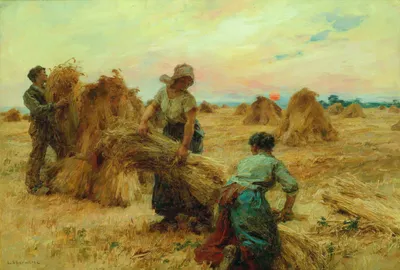
'The Harvesters' by Léon Augustin Lhermitte, ca. 1888–89. | The Art Institute of Chicago (edited by the Author)
issue #213 of brennan.day
Farming is Why Humanity is Fucked
brennan.day — issue #213
Publisher: Brennan Kenneth Brown
Place of publication: Calgary, Alberta, Canada
Available at: https://brennan.day
Contact: mail@brennanbrown.ca
Lightning can strike the same spot many times. Goldfish can remember things for months. Bulls are colourblind. Vikings didn't wear horned helmets. Napoleon wasn't short.
This month's IndieWeb Carnival run by Alex Hsu, has a theme titled "No Way!" where bloggers are asked to write about something that was a plot-twist level revelation.
The first few ideas that popped into my head were the most obvious. The well-known facts that weren't facts at all, but really, the truth about these facts is usually already well-known. Anti-facts, if you will.
It's a fantastic topic, because it makes you pause and recollect on when you've had a real epiphany. An actual paradigm shift.
And I suppose I could write about something like how the scrip system was designed to fail and speculators bought scrip from Métis families for pennies on the dollar before they'd even received their land, which is why so many ended up landless and pushed west. Or that the "barter came before money" story taught in every intro economics class has no anthropological evidence behind it and there's no documented case of a society running primarily on direct bilateral barter; proto-money and credit brokers show up first, with barter as the rare exception, not the rule. (The textbook origin story of money is basically fan fiction economists tell each other.)
But instead, I have something a lot... weirder. I want to share the most mind-shattering concept I've ever learned. A concept that was nonchalantly taught in a first-year general education class I took in the spring of 2022 which completely upended how I thought about humanity as a whole.
Setting the Stage
To begin, the university I attended, Mount Royal University, has far more general education class requirements for its undergraduate degree than most schools do. Three classes need to be taken in four clusters, in other words, twelve entire courses dedicated to the liberal arts outside your degree, and this isn't counting electives. And there are four foundational courses every student needs to take, with ambiguous, vague titles like "GNED 1103 - Innovation" and "GNED 1404 - Writing about Images" and "GNED 1202 - Texts and Ideas."
Professors often take advantage of how loosely defined these foundation classes are, and teach whatever the hell they want to. It is a total gamble of what you're going to be learning and if the class is going to be a bird course. Your best bet is to look up the professor's RateMyProf more than looking at the syllabus.
This class I took seemed popular at first, with class at full-capacity of 30 students (yes, MRU has grade-school class sizes, which is amazing). The professor was charming and funny, but it quickly became apparent that the topics he was going to teach made many of the Oil-and-Gas Business-major archetypes who enrolled uncomfortable.
Our professor did several lectures on the perils and inevitable exploitation of neoliberalism and late-stage capitalism, and an assigned reading was Karl Marx's The Communist Manifesto. Truly, this class was what the anti-woke conservatives are warning the populace about in regards of the brainwashing happening on campuses across the nation. That's sarcasm, mostly because another GNED I took had a professor deny human-made global warming and glaze the economics of Adam Smith for the entire semester.
But no, learning about the horrors of the zero-sum slave labour occurring around the world was not the most eye-opening experience of this course, not even close. And I apologize for burying the lede here and reminiscing about my undergrad days, but I really need to ease you into this and soften the blow here, you'll see.
Enter Daniel Quinn and Totalitarian Agriculture
Daniel Quinn was an American author, cultural critic, and publisher of several educational texts. He's best known for his novel trilogy Ishmael, which is what I'm going to be discussing now. What do these three novels explain?
Farming and agriculture are why all civilization is in peril.
This seems absurd at first glance, and why it takes multiple books for Quinn to lay out and explain the idea in a way that makes it comprehensible. But I'll try my best to explain it in a single blog post.
The idea is rather simple: Farming allows a surplus of food not otherwise found in nature, which means there is an increase of population likewise not found in nature. This unnatural, rapid population increase results in unnatural increased density, resulting in disease, vulnerability to natural disasters, and more.
Quinn's argument runs on what he calls the Law of Life: for any species, population size is a function of food supply, full stop. More food doesn't follow population growth, it causes it.
Quinn's own vocabulary for this, across the trilogy, splits humanity into two groups. The Takers—the global, agricultural, "civilized" culture you and I were both born into—and the Leavers, his word for the world's remaining hunter-gatherer and small-scale tribal societies. The Takers, in Quinn's telling, are the only culture in the planet's history to break the Law of Limited Competition: every other species, and every Leaver culture, may compete for food as hard as it wants, but it doesn't:
- exterminate its competitors
- destroy their food supply
- or cut off their access to food.
Our global civilization, built on what Quinn later named totalitarian agriculture, does exactly those three things as a matter of course, and has for ten thousand years.
Quinn likes to point to a simple experiment with lab mice: give a population of mice enough food to sustain a hundred mice, and the population settles around a hundred. Double the food, and the population doubles too, no mood music or moral reasoning required. Humans are not exempt from this math no matter how badly Mother Culture wants us to believe otherwise. In his later book Beyond Civilization, Quinn names the resulting feedback loop the Food Race: a culture that ties its own survival to ever-expanding agricultural output has to keep expanding food production forever just to keep up with the population growth that the last round of expansion caused, with no terminal point in sight.
Higher population density simply means more chances for a pathogen to find its next host, and the agricultural package didn't just pack humans closer together, it also packed us in next to penned, domesticated animals and our own concentrated waste for the first time in our species' history. So-called "crowd diseases" like measles and smallpox either jumped to humans from livestock, or simply couldn't sustain themselves as ongoing epidemics until human settlements got dense enough to keep a steady supply of new, non-immune hosts (read: infants) being born into the population. Bioarchaeologists who've spent careers digging up skeletons from the agricultural transition have found exactly what this would predict: people getting shorter, more anemic, and carrying a heavier infectious disease load the moment a population settled down to farm, compared to the hunter-gatherers who came before them.
Surplus and storage make a population dependent on a small handful of staple crops instead of the broad diversity a forager's diet draws from. The anthropologist James C. Scott wrote Against the Grain, decades after Quinn, how early agrarian states leaned almost entirely on one or two annual grain harvests, and that dependency made them fragile. A bad harvest, a granary infestation, a drought, could tip a hungry society into a starving one in a single season, in a way that simply wasn't possible for people who weren't relying on one or two crops to keep an entire settled population alive. A community's diversity is what keeps it resilient, as Ishmael puts it to the narrator in the novel itself; losing every species but one on a given rung of the food chain is what makes a community fragile, and agriculture, by design, does exactly that to our food supply. On purpose, again and again.
The biologist Jared Diamond made the same argument independently in his own widely-reprinted 1987 essay, calling agriculture the worst mistake in the history of the human race, as it bought our species a temporary population boom at the cost of disease, inequality, and a permanently worse standard of living for nearly everyone who wasn't at the very top of the new hierarchy agriculture made possible. Farming also meant land became important, became estate that particular people owned and other people didn't, creating a power imbalance and hierarchy that wasn't there before either.
Now, you might be thinking that the agricultural revolution was in fact the start of civilization, so how could it possibly be the cause of its fall? Quinn argues that what we consider "precivilization" is a total misnomer. As I've written about before, humanity has existed for over 12,000 generations. Only around 500 generations have had farming.
Humanity existed in equilibrium with nature for hundreds of thousands of years before we began planting seeds in the ground and storing unprecedented masses of foodstuff. We weren't causing sea levels to rise or hundreds of species to go extinct or had exorbitant, inconceivable wealth inequality where a trillionaire can exist while others starve to death.
And, too, you cannot fault a particular group for this: Agriculture occurred independently in both the East and the West, the Old World and the New World, and agriculture is an inherent foundation for both capitalism and communism economic systems.
Now, let me tell you I've never really come across somebody that subscribes to this idea, including the professor teaching the class. Most scoff when I bring it up. And Quinn doesn't have anything close to an answer or solution for the problem he's proposing, though he does try to reckon with finding one in his later book, "Beyond Civilization: Humanity's Next Great Adventure."
Quinn's formula there, offered in deliberate contrast to Timothy Leary's "tune in, turn on, drop out," is "walk away, go tribal, think incremental." He points to Mesoamerican civilizations like the Maya and the Olmec, who built pyramids and hierarchies and then, by his reading, simply walked away from them back into tribal life rather than collapsing or being conquered, which is its own kind of "no way!" anti-fact, frankly, since most of us were taught Maya civilization "collapsed," past tense, rather than that its people opted out.
Quinn's bigger claim is that there's no single correct way to organize a human society, and that the planet can sustain a lot of different small-scale, low-hierarchy ways of making a living, it just can't sustain all eight billion of us living at Western consumption levels under one totalitarian-agricultural roof.
At the end of the day, despite how mind-blowing this idea is, despite how much it made me scream "No Way!" learning about it doesn't really change anything, does it? Maybe if you're somebody willing to be a Preagrarian Anarchist and leave all of civilization behind to become a hunter-gatherer again, maybe. But there is such a large sacrifice to such a notion: all the technology, culture, art, medicine, and life that we've had the privilege and luxury to experience. It is clear you cannot have one without the other. How unsettling.


Comments
To comment, please sign in with your website:
How it works: Enter your website URL. IndieLogin checks your rel="me" links on GitHub, GitLab, Codeberg, and email. Setup instructions.
Signed in as: