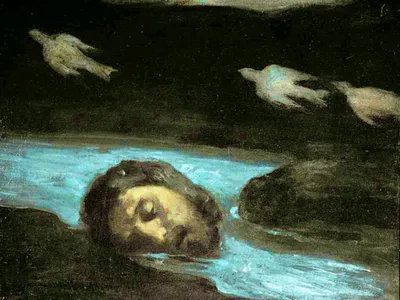
'The Head of Orpheus Floating Down the River Hebrus to the Sea' by Kahlil Gibran, c. 1908-1914. | Telfair Museums (edited by the Author)
issue #184 of brennan.day
On Being a River
brennan.day — issue #184
Publisher: Brennan Kenneth Brown
Place of publication: Calgary, Alberta, Canada
Available at: https://brennan.day
Contact: mail@brennanbrown.ca
Humanity has always existed by the river. The Nile gave Egyptian civilization life, annual flooding depositing rich black silt across the delta as a calendar of abundance. Mesopotamia translates to the land between rivers in Greek, rising from the Tigris and Euphrates, two bodies of water running parallel through the heart of what would become Iraq and Syria and Turkey, feeding the civilization that gave us writing and the wheel and the city.
The Indus River Valley nourished people in what is now modern-day Pakistan and India. Grid-planned cities with sewer systems and running water thousands of years ago, more sophisticated than anything in Europe for millennia. The Yellow River, the Huang He, turned the plains of northern China gold.
Humanity has always been something the river built around us.
Fresh, running water gives us life. Drinking, fishing, irrigation, the turning of grain mills, hydroelectric power, trade routes before roads. It gives us borders and it gives us bridges. Running water gives us the spiritual cleansing of mikveh, baptism, the sacred bath. I have written much about the Red River and the Assiniboine River, converging at my birthplace in the heart of the continent—the Forks where Winnipeg now stands—and of the Bow River in Mohkínstsis where I lived for twenty years, running clear and cold off the Rockies through the centre of the prairie city.
Perhaps we are drawn to rivers because we, too, are rivers. Think of all the veins and arteries and capillaries within you right now. If you pulled every blood vessel from your body and laid them end to end, they would stretch approximately 60,000 miles, more than twice around the circumference of the Earth. Sixty thousand miles of river inside you, always running, never in the same spot twice.
There's recirculation, of course—five litres of blood making the full circuit every minute, the heart a fist-sized pump never once resting. But recirculation is no different than water vapourizing into clouds and returning to the Earth as rain. The river goes and returns. It is never truly the same.
This is what I was getting at with my English thesis on bloodwriting. The blood is us, mixed with the ochre in the first cave paintings of humanity, but it is also finite, temporary, streaming and coursing. I cannot think of a calmer, more relaxing sound than the soft noise of running waters. I have held my hand in glacial streams until my fingers went white and numb, reluctant to pull my hand out. To feel the cold is to be real, to be here in the now.
Our own anatomy has a precipitation system. A living body has an entire ecology, for we are far less singular than we imagine. We are 38 trillion bacteria cells, and 30 trillion human cells. 1.3:1. We are more other than human. We are the safe harbour and cradle for a civilization naked to the human eye. You are not one. You are a watershed.
We are always in a state of ebbing and flowing. Always turning into something new, transforming. Every cell within your body has an expiry date, and nearly every second, millions of new ones are born. The human body replaces 330 billion cells per day. 3.8 million new cells every single second. 86% of those are blood cells—river cells. You shed yourself daily.
Colon cells die after three to five days. Skin cells have a life of two to four weeks. The lining of the small intestine replaces itself every few days. Skeletal muscle cells take up to fifteen years. And neuron cells are never replaced at all in the cerebral cortex. Memory, language, and consciousness all live exactly as long as you do. Likewise, the cells behind your eyes, in the lens, are embryonic, they formed before you were born and will be there when you die.
In your skull are cells that have been with you from your beginning. Carrying, inside itself, the shape of every river you will ever be.
After enough time, the same man cannot step into the same river twice, for he is a new man. But not entirely. Something of the first man remains.
Good health of the system depends on the shedding, the moulting, the old making way for the new. We are baptized in the waters. Our ashes are spread in the waters.
I remember stumbling onto a Twitter bio years ago that said constantly recalibrating and that's deeply stuck with me. I cannot think of a better self-descriptor. Life is far too long to not reinvent yourself, to not question and realign the base principles of operation. Life is far too short and fragile for this as well. The tension between holding on and letting the current take you, between the cells that live forever and the cells that die in days.
And I wonder to myself what my new phase will be. What direction is the river of my blood oriented towards? Is this true animal magnetism? The way the Canada Geese know which way to fly, spending countless hours in formation across the sky, crossing provinces, finding refuge in the warmth of the Floridian peninsula. Ancestral instinct running through the body. Something older than thought, older than memory, older than the cells that carry it.
The river, though, is impossible. The fresh, current now is always just a moment. All we ever experience will, inherently, be a memory for 99% of our life. There is peace and solace in this—for this too shall pass. But there is also a bittersweet yearning. For as soon as the river is witnessed, is felt, that water is stale and elsewhere, no longer the current cold river we’re pressing our fingertips into.
The past and the future are handy constructs—intricate illusions to help us not live a life constantly disoriented and impulsive and without focus. But the now is now is now.
A man cannot step into the same river twice. The river cannot be stepped into by the same man twice.
I sit at my desk and I want to list out all of my future plans, all of the big projects I was to thrust myself into ambitiously. I want to retire the old, abandon the past, and only look into the future.
The Dark River
The Greeks understood the river. Their underworld—the realm of the dead, the place beyond—was navigated entirely by a dark river. To die was to arrive at the water.
The underworld held five rivers: Styx, the river of hate, which formed the boundary between the living world and the dead. Charon ferried you across for the price of a coin. Acheron, the river of woe. Phlegethon, the river of fire. Cocytus, the river of lamentation. And Lethe. The river of forgetting. The river whose water washed every memory clean when you drank.
When a soul was ready to be reincarnated—to return to the river of the living—they drank from the Lethe, and forgot. Everything. Who they had been. Who they had loved. The shape of their hands, the sound of their mother's voice, the cold of every river they had ever crossed. To drink oblivion and become new again.
To shed what was and arrive again at the source, unencumbered, as pure water. The question is never whether you will change. The river never asks. The question is whether you will drink willingly—or whether you will be the man who keeps looking back.
Orpheus, a legendary musician in Greek mythology, traveled to the underworld to bring back his wife, Eurydice, who died from a snake bite on their wedding day. He crossed the Styx. He charmed Cerberus to sleep with the sound of his lyre. He stood before Hades and Persephone and played music so beautiful that gods, who do not weep for nothing, wept. Hades allowed her to return on one condition: Orpheus must walk ahead of her and not turn to look back at her until they were completely out of the darkness.
With so much to look forward to, Orpheus looked back.
What do we call the pull that is stronger than survival, stronger than reason, stronger than the thing you want most? The Lethe flows through the underworld for a reason. You cannot bring back what was without losing what is. Orpheus wanted both. He wanted the past and the future and no present. No darkness, no uncertainty, no walk through the cave where you cannot see who is behind you. He wanted to look, just once, just to be sure.
What Remained
I want to end with this, another well-known tale from Greek mythology: When Pandora lifted the lid and out poured everything that had no name before. Plague, grief, envy, war, the slow rot of time. The world, which had known only warmth, learned frigid cold. Loss. What it meant to witness the beautiful end.
Gods did not give her curiosity by accident.
Every evil scattered to the four winds, finding the cracks in every heart, the fault lines in every kingdom. Humanity bent, then bent further. Invisible fractures running through trust, joy, the ability to believe in tomorrow.
And then the jar went quiet.
She must have felt the sudden stillness after. She pressed the lid back down from instinct, the way you cover your mouth after saying the wrong thing, too late, knowing it already.
One thing remained at the bottom. The only thing that could live after everything else had already won.
Her name was Elpis. She had been sealed in with the rest of them, felt the weight of the lid, breathed the same dark air as plague and war and grief. She was hope. She was not separate from suffering. She was its unlikely survivor. While everything else tore itself into the world with hunger, she stayed. She waited at the bottom of the ruined thing like someone who has decided, for no good reason, not to leave.
Hope does not arrive before suffering, it is what suffering leaves behind. Not a promise. Not a cure. Stubborn, unreasonable insistence. The story is not yet finished.
Pandora opened the jar, and the world fell until there was nothing left but hope.


Comments
To comment, please sign in with your website:
How it works: Enter your website URL. IndieLogin checks your rel="me" links on GitHub, GitLab, Codeberg, and email. Setup instructions.
Signed in as:
No comments yet. Be the first to share your thoughts!