Posts tagged "identity"

4 posts with this tag.

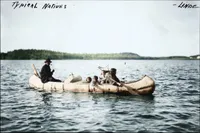
  • Colourized historical photograph of an Indigenous family traveling in a birchbark canoe on a calm lake. A man in a dark hat sits in the stern smoking a pipe, while a woman paddles at the other end. Three young children sit between them near a bundle of belongings, and one child reaches a hand toward the water. A forested shoreline lies in the distance under a pale sky. Handwritten at the top of the photo: ‘Typical Natives’ and ‘Linde’.

    RIVYAYR PIMICÎWAN: We Are Always Somewhere

    On October 11, 1869, nineteen unarmed Métis stopped a Canadian survey crew by standing on its chain, refusing to let a square grid be laid over our river lots. On the Whanganui River, declared a legal person in 2017 after 140 years of Māori struggle; Te Urewera, which owns itself; the Atrato, the Magpie, the Klamath, and wild rice suing the state of Minnesota. On Two-Spirit, a word that arrived in a dream in Winnipeg in 1990, Balboa's dogs, We'wha shaking the president's hand, and a province named for the sound water makes. Liquid has no shape of its own, and bodies can refuse the container. On Shoal Lake 40, acknowledgement, and rewilding ourselves. Both us, in whole, and our land must be sovereign.
  • Close-up photograph of numerous padlocks attached to a chain-link fence, with a red lock in sharp focus bearing the handwritten message 'FUCK LOVE!' in white paint. The surrounding locks are blurred by a shallow depth of field, while warm orange and yellow tones in the background create a soft, out-of-focus glow. The featured lock shows signs of rust and wear, contrasting with the romantic 'love lock' tradition typically associated with such fences.

    A Ship in Harbour is Safe

    Nassim Nicholas Taleb's concept of 'skin in the game' is the idea that true learning only happens when you have something to lose. And I look at IndieWeb principles of using what you make to publishing under your real name. Having risk and real stakes is essential for creative work. A ship in harbour is safe, but that's not what ships are built for.

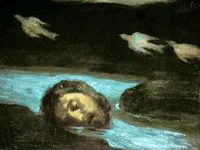
  • A dark oil painting depicting a man's head lying at the edge of a luminous turquoise river, his eyes half-open and expression serene or unconscious. The surrounding landscape is rendered in deep blacks and earth tones, with the vivid blue-green water serving as the primary light source. Three pale birds fly through the dark sky above him. The brushwork is loose and expressive, evoking a Romantic or Symbolist style. The overall mood is ethereal and elegiac.

    On Being a River

    Sixty thousand miles of blood vessels run inside each of us, more than twice around the Earth. 330 billion cells are replaced every single day. Humanity has always built civilization beside rivers because we are rivers. Always in motion, never stepping into the same current twice, carrying cells that live only days alongside neurons that will last precisely as long as we do.

  • Two arms, one with darker skin, one with lighter skin, clasp together against a near-black background, bound by a single red thread that wraps around both. Dramatic low-key lighting isolates the hands at the centre, the red yarn the only point of vivid colour.

    What We Lose with Cultural Extinction: The Red Thread Cut

    In 1995, China abducted six-year-old Gedhun Choekyi Nyima—the recognized 11th Panchen Lama—severing the chain of mutual recognition at the heart of Tibetan Buddhist succession. Meanwhile, Michif, a language born from Cree verbs and French nouns that belonged to no one but the Métis People, has nearly vanished within living memory. Both losses are the same act: colonialism's weaponization of continuity. On the extinction of languages, the cutting of red threads, and what it means to inherit a chain with links already missing.

← View all tags

↑ TOP