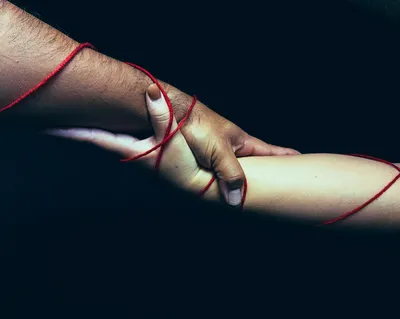
Photo by Kevin Reyes taken in Guadalajara, Jal., México | Pexels (edited by the Author)
issue #183 of brennan.day
What We Lose with Cultural Extinction: The Red Thread Cut
brennan.day — issue #183
Publisher: Brennan Kenneth Brown
Place of publication: Calgary, Alberta, Canada
Available at: https://brennan.day
Contact: mail@brennanbrown.ca
On May 14, 1995, the 14th Dalai Lama recognized six-year-old Gedhun Choekyi Nyima as the 11th Panchen Lama, the reincarnation of the second-highest authority in Tibetan Buddhism. Three days later, Chinese authorities abducted the boy Nyima and his family, replacing him with their own appointee, Gyaincain Norbu.
The Dalai Lama and Panchen Lama have historically identified each other's reincarnations since the 1300's. A mutual legitimation relationship, where each was the witness to the other's continuation. Two hands needed to pass a single flame. The Panchen Lama is meant to recognize the next Dalai Lama after he passes. With Nyima disappeared, the chain of mutual recognition is forever broken.
China knows spiritual authority is political sovereignty. The Gelug school of Tibetan Buddhism works with the practice of reincarnation recognition; the system is predicated on continuity and the unbroken thread of one realized soul finding the next. Break the thread and you kill the succession, yes, but you also inherit the loom. Beijing's state-selected Panchen Lama, Gyaincain Norbu, has spent thirty years being positioned to recognize China's version of the 15th Dalai Lama when the current Tenzin Gyatso passes away. The 14th Dalai Lama has already warned that no candidate chosen for political ends should be recognized or accepted. But warning isn't prevention.
Gedhun Choekyi Nyima would have turned thirty-six this April. If the legitimate Panchen Lama is alive—and we don't know if he is—he's spent his adult life invisible. His birthday is marked by exile, with children in Dharamsala holding portraits of a face that hasn't been seen in public for three decades. The Tibetan Centre for Human Rights and Democracy marked the 30th anniversary of his disappearance in May 2025. His whereabouts remain unknown, as does the fate of Tibetan Buddhism. The government of the People's Republic of China continues to deny access to him. His enforced disappearance constitutes a serious violation of the Convention on the Rights of the Child, to which China is a signatory. China insists he is living as a private citizen, contentedly. Hm.
These are the extinctions I think about, the permanent severance of culture.
My Own Cultural Extinction
I spoke to my Dad the other day about how I want to learn Michif but the resources to do so are so few and far between. For I am of the Michif People, a distinct Métis nation in Canada and the United States, originating from 18th-century unions between Cree, Nakota, and Ojibwe women and French-Canadian fur trade workers.
He told me how his Mémère—my great-grandmother—spoke the language all the time. He understood Michif as "low" French compared to "high" Quebecois French. He recounted, too, how his Uncle would try to fill his childhood head with important lessons and histories of our People, and the atrocities committed at Residential Schools, being a survivor himself. But my Dad was so young at the time, and had no idea how important that knowledge and storytelling and storykeeping would be as time passed.
There's grief in retrospect, in understanding only after too much time has passed. My Dad heard Michif as a child. He didn't know he was witnessing the language of his people, an entire epistemology, really. The way of naming the world existing nowhere else on earth. Michif is Plains Cree verbs married to French nouns, the grammar of the fur trade, a linguistic record and a new tongue. Linguist Peter Bakker, in A Language of Our Own, wrote that the bilingual Métis were no longer accepted as Indians or French, and so they formulated their own ethnic identity, and a mixed language was part of that. Something that belonged to nobody else. Something that was entirely and irreducibly ours.
It's thought there were never more than a thousand speakers of Michif. By the 2011 census, 640 Métis reported it as a mother tongue; 940 said they could hold a conversation. A fragile language that perhaps never numbered more than a thousand, and now scraped down to the hundreds, concentrated in Elders, scattered across the Prairies and North Dakota.
Nobody in the family speaks Michif as their mother tongue anymore. That is what was lost, what was taken through the systemic erasure of our culture and history. Through the wreckage of settler-colonialism.
This is language attrition at the individual level, the gradual erosion of a first language due to the cultural pressures of the dominant one. At the community level, this is "intergenerational language shift." The language stops being transmitted between parents and children. Not with violence, necessarily, but with silence. The quiet decision to not pass something on, a decision that isn't even fully a decision. More like a capitulation to a world that has made speaking your mother tongue expensive.
In early twentieth-century Manitoba, instruction in public schools was required to be in English only. The law didn't relax for Francophones until 1967. But for Michif speakers, the accommodation never came.
By the time the laws changed, there was a generation of children who grew up in kitchens where Noohkooms and Mémères switched to something foreign and low when nobody was listening. The language wasn't passed on. Why would it be? The world had made very clear what the cost of being visibly Indigenous looked like.
I can try my best to learn Michif mechanically, through the scant resources available to me. The Gabriel Dumont Institute's Michif Tools has been banking the language for decades. There's also the Rupertsland Institute's language program here in Alberta, the BC Métis Federation's Michif Language Project, and a Michif studies guide at the University of Calgary library. Dictionaries, lesson plans, and oral histories are compiled.
These are all resources that didn't exist when my Dad was young, or if they did, nobody thought to tell him.
But I cannot learn it through my own family anymore.
The name "Winnipeg" originates from the Western Cree words winipīhk (or win-nipi), meaning "muddy water" or "murky water." It was adopted from the local Indigenous name for nearby Lake Winnipeg, 65 kilometres north of the city.
For years living in Alberta, I felt so disconnected from my culture and people of Winnipeg and Treaty One. There was a certitude in reconnection, in repairing the loss I've accumulated. But in truth, some loss is permanently excavated. The water stays murky.
The Many Others
Michif is not alone in this, of course. The world is so impossibly full of languages dying within living memory. You cannot even attempt to hold them all at once.
In 2008, Chief Marie Smith Jones of Alaska died, and with her died the language of Eyak, unique to the Pacific Northwest coast that had already outlasted most predictions. Chief Smith Jones spent years documenting Eyak, trying to find others who still held pieces. She said
"It's horrible to be alone. I have a lot of friends. I have all kinds of children—yet I have no one to speak to."
Not in Eyak. Not in the language that made her who she was. The Eyak language isn't gone from the archive, as the linguists recorded it. French linguist Guillaume Leduey has dedicated himself to its study, but its natural transmission, the kind that happens across a kitchen table, is finished.
There is Manchu. Once the ruling language of China's Qing dynasty, spoken by the people who governed a fifth of the world's population for nearly three centuries, Manchu is now down to fewer than a hundred native speakers, mostly elders in Sanjiazi village in Manchuria. A young Manchu man who had started learning his ancestors' tongue told a reporter: "If Manchu dies out, so much will be lost. Language is the soul of a culture. People would never truly understand Manchu culture and history." The same state that disappeared the Panchen Lama is the same regime now tightening instruction in minority languages across its "autonomous" regions, where Manchu is dying but yet its speakers are told their language is officially protected. Protection and extinction are not opposites. Often they're the same policy wearing different names.
There are also, thankfully, counterexamples. Welsh, Hawaiian, Māori—the languages that returned from the edge through sustained, community-driven effort. Cornish, once declared extinct, is now being taught to children in Cornwall. Hebrew was resurrected from a purely liturgical language into a living mother tongue.
Revival requires continuous community, resources, political will, and above all, the uninterrupted chain of people who remember and share. All of which colonialism violently targeted. Once enough links in that chain are missing, revitalization becomes archaeology. You can dig up the bones. You cannot make them walk.
My Relations
There is, though, at least a silver lining. I've done the genealogy research as best I could independently on my own, and cross-referenced it with the family tree my father and half-brother have created—and luckily I was accurate. These names are the links in the chain that survived. Let me tell you who I am, and what my relations are.
I am Red River Métis, a member of the Manitoba Métis Federation. My ancestry traces directly to the Red River Settlement through several documented family lines. On my father's side, I descend from Alexis Lamirande (b. 1839, St. Norbert, Manitoba) and his mother Marguerite Danis (b. 1805, Red River), whose father Louis Lamirande (b. 1793) made the journey from St-François-du-Lac, Québec to the Red River Settlement, where he died in 1873. Further back, the line reaches Jacques Lamirande (b. 1755, Louiseville, Québec), among the earliest documented ancestors in this branch. Parallel lines include the Charron dit Ducharme family, rooted in St. Boniface and St. Vital across multiple generations, and the Pilon family — Antoine William Pilon (b. 1785, Pointe-Claire, QC, d. 1869, St. Norbert) and his daughter Marie Pilon (b. 1840, St. Norbert). All of which were central to the francophone Métis parishes of the Red River. These are the families who built the community that became Manitoba.
Marguerite La Montagnaise (described as Chippewa/Ojibwe, b. 1776, St. Norbert, Red River Settlement; d. 1853, Winnipeg, Manitoba) is among the most directly named Indigenous ancestors. Philomène Larivière (Cree, b. 1750, Red River) and Joséphte Maskégonne (b. 1765, Red River Settlement) are further documented. These ancestors reflect the historical reality of Métis identity: the children and grandchildren of French-Canadian and Scottish fur trade men who formed families with Cree, Ojibwe, and other First Nations women in the Red River basin.
When I say these names, I am practicing both genealogy and ceremony. The record survived. The chain of transmission was not fully severed. My ancestors lived in the St. Norbert corridor, in the parishes along the Red and the Assiniboine, in a world smelling of pemmican, woodsmoke, and river mud. They witnessed Louis Riel be called a traitor by the same government that called their children's French "low." They spoke Michif.
What the Panchen Lama's disappearance and the death of Michif as a mother tongue share is colonialism. The weaponization of continuity. When you break the chain of succession, recognition, and transmission, you get to steal and recreate culture at your will and peril.
You get to name what comes next. You get to appoint the boy who will identify the next God-king. You get to call the children's English fluency progress, not loss.
The water stays murky, yes. But murky does not mean gone. Murky is not invisible. Murky water is still water. Murky means something happened upstream, and the river remembers it. The river always remembers, even when we've forgotten the name.


Comments
To comment, please sign in with your website:
How it works: Enter your website URL. IndieLogin checks your rel="me" links on GitHub, GitLab, Codeberg, and email. Setup instructions.
Signed in as:
No comments yet. Be the first to share your thoughts!