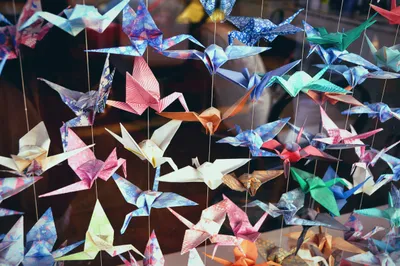
Colorful paper cranes in the window of Evolve, a salon in the Georgetown section of Washington, DC., taken by Kevin Harber, 2009 | Flickr
issue #164 of brennan.day
A THOUSAND CRANES: Why I Write Every Day

brennan.day — issue #164
Publisher: Brennan Kenneth Brown
Place of publication: Calgary, Alberta, Canada
Available at: https://brennan.day
Contact: mail@brennanbrown.ca
I recently came across this post by Axxuy referencing me and my workflow titled "I Don't Blog Every Day." They wrote that the practice of blogging every day "quickly felt like a chore. It felt exhausting."
If writing like this felt like a chore to me, I certainly wouldn't be doing it. I am an incredibly lazy loaf! For me, there is a precise, never-ending compulsion. An itch. Maybe a supernatural drive? I write to think, to learn, to process, but mostly to empty my ballooning head.
And I will say right now that, while I do think it is a good and healthy habit to write privately each day, it is unwise to post and blog each day! Writing is my job, but it would be wise to space my posts out. This isn't shortform video content—I post at a rate that causes my work to autocannibalize itself from a metrics and marketing point-of-view, and I'm sure a lot of first-time readers would already find my backlog overbearing. If I were to post every other day, my metrics would probably improve, I'd have a growing backlog to schedule posts, and I could relax a lot more!
And yet here I am, continuing the practice regardless. Why?
The Essayists
At 38 (a little older than me), Michel de Montaigne retired from a career in law and politics, retreated to a tower in his château in the Périgord, and didn't let anybody in. Even his wife. Inside, he had roughly 1,500 books. He had Greek, Latin, and Biblical epigrams painted directly onto the ceiling joists. Philosophy was carved into the wood above his head, so that wherever his eyes wandered, a sentence was waiting. He wrote there for twenty years.
He called his work Essais. The French verb essayer means to attempt, to try. That is all he claimed to be doing. Attempting. The chapter titles read like human life detonated into component parts: "On Smells," "On Drunkenness," "On Cruelty," "To Philosophize Is to Learn How to Die," "On Thumbs." Nothing was too vain to examine. Nothing too abstruse, either. He apologized constantly and falsely for writing so much about himself. He wrote, I study myself more than any other subject. It is my metaphysics; it is my physics. He had invented a new medium by accident, by refusing to stop.
Voltaire wrote more than fifty plays, dozens of treatises, several books of history, and more than 20,000 letters to friends, enemies, and heads of state. He spent up to eighteen hours a day writing or dictating to secretaries, often still in bed—propped against pillows, a secretary at his side, words flowing before he had even stood up. He was fueled, allegedly, by forty to fifty cups of coffee per day, a chocolate-coffee mixture that his doctor warned would kill him. Voltaire said it was a remarkably slow poison, as he had been drinking it every day for seventy-five years. His reckless, joyful industry is offensive in the scale. He is not relatable. But I recognize something in the not-stopping, the refusal to treat rest as default.
Closer to my sensibility, there's Samuel Johnson. In 1750, Johnson was broke and already deep in the exhausting labour of compiling his Dictionary—a decade-long project he was doing largely alone. Into this, he agreed to write a new essay twice a week for two years. The result was The Rambler, 208 essays, almost all written by Johnson himself, published every Tuesday and Saturday "whether Johnson was well or ill, idle or busy." Many were sent to the printer the same day they were written, unrevised. He was paid two guineas per piece, which was just enough to keep the wolf from the door—a phrase he actually used. "A man may write at any time if he will set himself doggedly to it." The essays were not widely read when they first appeared. They became a classic only later, reprinted in volumes, recognized as essential. The periodical was a slow burn. Writing for a future that hadn't found him yet.
What unites Montaigne in his forbidden tower, Voltaire dictating from bed, and Johnson at his desk in poverty? None stopped because conditions were wrong. Montaigne was writing through the French Wars of Religion; the sounds of his country tearing itself apart drifted across his vineyard. Voltaire wrote from exile, a letter a day to Catherine the Great. Johnson wrote through debt and grief and the accretion of failure.
Writing was not their reward for circumstances being good. It was what they did instead of waiting for circumstances to improve. You write because you can't not write. You write into the circumstance. Water finding a crack in stone.
1,000 Voyagers
I want to take a step back and return to Sagan's Voyager, which I wrote about a week ago. I'm frustrated, angry even, that there are only ever going to be two Voyagers. These were costly projects, and required gravity assists—"slingshot" maneuvers—to send the probes outside of our solar system. They needed a rare, once-in-175-years alignment of Jupiter, Saturn, Uranus, and Neptune.
But I can't help but imagine if humanity allocated all of its time and resources to sending out Voyager after Voyager, in all different directions across the Milky Way. This would likely not raise the likelihood of an alien civilization encountering one, even if we were to make hundreds of probes. We certainly have enough actual, tangible issues here on Earth to worry about instead of shooting out a thousand shots in the dark that would only ever be found millions of years after we're all dead.
In a way, I think that is what I'm doing though. My writing isn't interstellar, but I am finding myself writing and sending out hundreds of messages in bottles. I am writing a thousand paper cranes.
The Bottles
The message in a bottle is older than romance. Around 310 BCE, Aristotle's protégé and one of the earliest systematic botanists, Theophrastus, sealed papyrus into clay vessels and dropped them into the Mediterranean, trying to determine whether the sea was fed by the Atlantic. The world's oldest known recovered message in a bottle was cast overboard in 1886 from a German sailing barque called the Paula, crossing the Indian Ocean as part of a 69-year oceanographic experiment—one of thousands of identical bottles released to trace global currents. It was found in Australia in 2018. One hundred and thirty-two years in the sea, stopped by a woman walking a beach north of Perth looking for something to put on her bookshelf. She didn't know what she was holding, just that it was old and beautiful.
The origin of the message in a bottle is science. The earliest practitioners were not heartbroken sailors confessing their love to the open Atlantic. They were researchers trying to understand the world. They released thousands of notes and got back a few dozen. The rest sank, smashed, decomposed. But the ones that returned taught us where the Gulf Stream runs, how Antarctic ice flushes north, and where Labrador's oil spills eventually wash up on Norwegian shores. You don't control the current. You scatter something and listen for the echo.
The Cranes
The 千羽鶴, Senbazuru translates literally to "one thousand cranes." A Japanese practice rooted in the belief that the crane bird lives a thousand years, and whoever folds one thousand paper cranes in origami will have their wish granted. The practice is ancient, but most of us came to it through a girl.
Sadako Sasaki was two years old when the bomb fell on Hiroshima in August of 1945. She was healthy. She was fast—a runner, popular with her classmates. She was luminous. At twelve, the leukemia arrived. The radiation had been circling in her blood for a decade, patient as a tide. In the hospital, a friend told her the legend of the cranes. Sadako began folding. She used medicine wrappers, candy wrappers, scraps of foil—anything with a flat surface and a crease willing to hold. Her room filled with cranes of all colours and sizes, hundreds of them, suspended from strings, drifting in the air currents of the ward.
She wrote on their wings: I will write peace on your wings, and you will fly all over the world.
The story is that she folded 644 and then died, that's what's in the children's book. But her brother Masahiro said she actually exceeded her goal. She made around 1,450 cranes before she died. She didn't fold a thousand and wait for the wish to come true. She folded past the thousand and then kept going. Believing in the wish became the folding itself. The act. The precise work of her small hands in the hospital room while October moved past the window.
Today, children from around the world travel to the Children's Peace Monument at Hiroshima Peace Park every August 6th to drape wreaths of paper cranes over her statue. The inscription at its base reads, This is our cry. This is our prayer. Peace to the world.
Sadako was making magic. She was making evidence—of a life, of a wish, of a refusal to stop despite every reason to. The cranes were proof that she had been here and that she had wanted something.
The Whole Math
So, why am I writing myself, then? To increase the likelihood of what, exactly? Higher chances of leaving a legacy? Of far-future anthropological discovery? Of getting a wish granted through my makeshift Senbazuru? No, I don't think so. I think I'm trying to increase the likelihood of the right person finding my words when they need to hear them. Whether for solace, comfort, or inspiration.
As I've said, this is not a chore for me. Words flow out like a broken faucet. Many would tell you my pace is a one-way ticket to burn-out, but I have been burnt out. I have been ash. This is enjoyable. In truth, I think I have my Mom to thank for this. I could spend hours talking to her every day. She always has something interesting to say—a colourful story to share, an anecdote that's somehow new to me after all these years. I am so grateful for her in every way imaginable.
I write about whatever captures my attention and interest in the current moment, and then I write my message in the bottle and it flows down the running river. A lot of the time, I don't really think about the topic again. I've said what I have to say.
Some bottles drift into strange geography. There was the one I sent out in the small grey hours of an anxiety attack—a morning I woke into dread and couldn't locate its borders, couldn't tell where my body ended and North Darfur began, where Kansas arrived and Haiti receded. I wrote about whose suffering counts, whose death gets reported, what it means to witness catastrophe from behind glass. I fold the paper and let it go.
There was the bottle containing fifteen hours of Saskatchewan prairie seen from a passenger window—grain elevators sliding past like punctuation, my brother driving. The small towns with beautiful, desolate architecture of goodwill. I wrote that one down, folded it, and it went into the river before I could think too hard about whether it was good.
There was the crane about poetry—sneaking off school grounds to write in a back alley, shoplifting Ginsberg and Neruda from Chapters because I needed them more than I needed to be honest about my poverty. The back of my jacket was my library. I'm alive today because of those stolen books.
There was the Moon, written into a sky I would spend thirty years tilting my head at—full of lunacy and the first human poems and the face of every civilization that has ever stood outside at night and needed something to look at.
Every one of these is a crane I've folded from whatever scrap paper I have. The medicine wrapper, the Dollarama receipt, the plastic wrapper of a chocolate bar. Each one paper stuffed into a bottle during an afternoon with the faucet open and the river running. I don't know where the current takes the bottles, for all I hear is the silence of the sea.
For Theophrastus released his bottles in 310 BC and they helped us understand the Mediterranean, and the Paula's bottle crossed 132 years of ocean before it reached the right beach, and Sadako folded 1,450 cranes and her wings are flying over this world, and Johnson's Rambler sat unread in its penny sheets until someone gathered it into volumes and gave it to the future.
I write a post a day. Maybe one in a hundred lands on the right shore. That's enough. By the logic of drift bottles, by the logic of cranes, by the logic of the essai itself, the attempt is entirely sufficient.
That's the whole math of it. You don't fold a thousand cranes to receive a wish. You fold them because your hands know what they're doing. Somewhere in the world, the right person is walking a beach, looking for something to put on her shelf, not yet knowing what she's about to find.


Comments
To comment, please sign in with your website:
How it works: Enter your website URL. IndieLogin signs you in through your site's IndieAuth server if it has one (e.g. indieauth.com), or checks your rel="me" links on GitHub, GitLab, Codeberg, and email. Setup instructions.
Signed in as:
No comments yet. Be the first to share your thoughts!