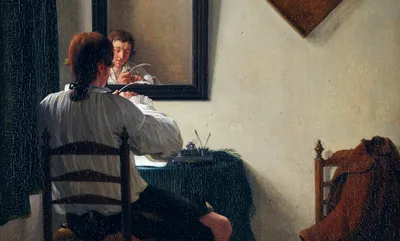
'A Writer Trimming his Pen' by Jan Ekels (II), 1784.| Source (edited by the Author)
issue #159 of brennan.day
Poetry Saved My Life
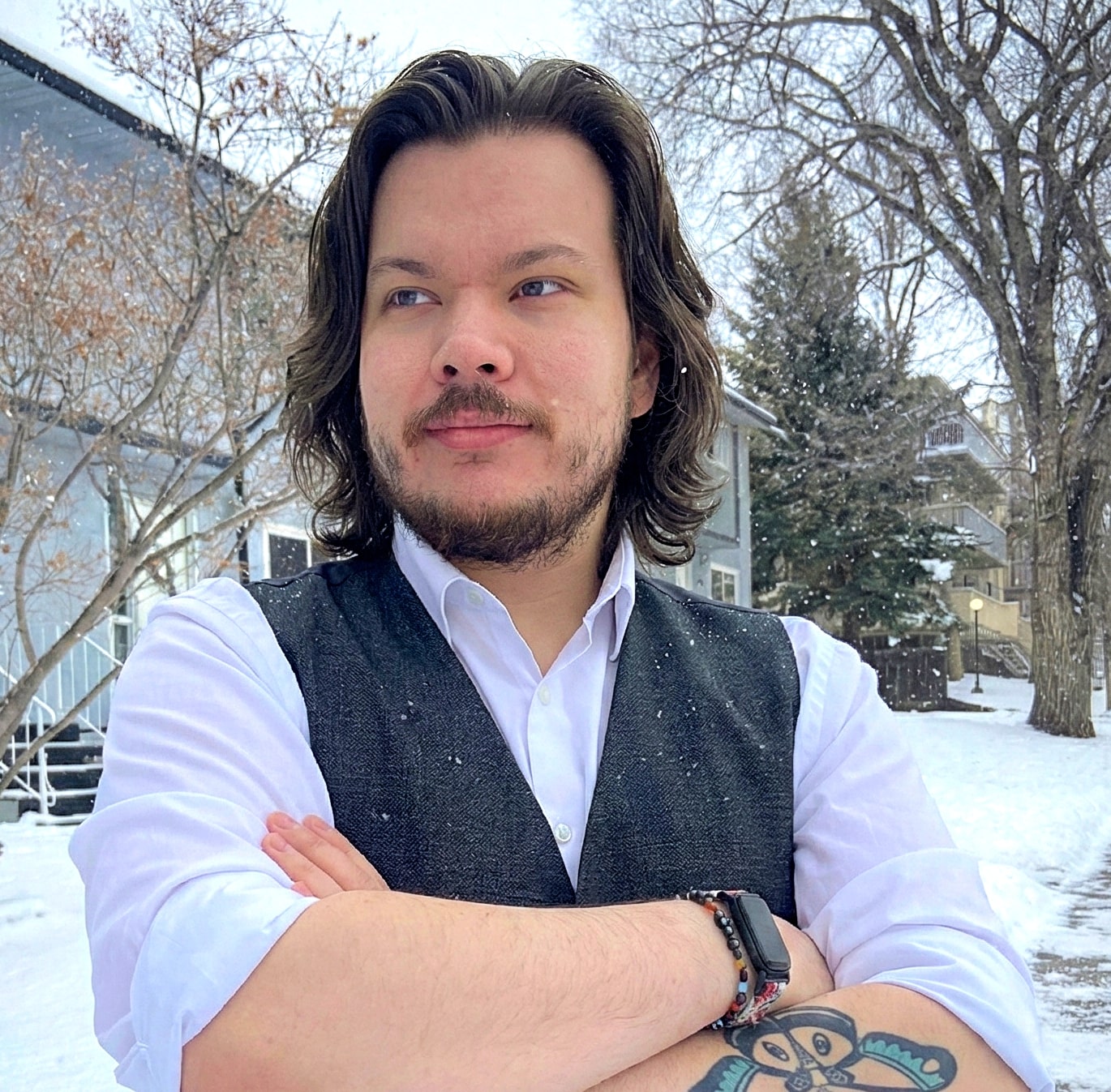
brennan.day — issue #159
Publisher: Brennan Kenneth Brown
Place of publication: Calgary, Alberta, Canada
Available at: https://brennan.day
Contact: mail@brennanbrown.ca
What if he was rabid? What if I just hadn't yet noticed he was foaming at the mouth?
These were the questions I was asking myself as I eyed the large black dog wandering closer towards me. I clutched my spiral-ring Hilroy notebook tightly, the chalky dust filling the air as I stood up from the suburban gravel of the back alley as quickly as possible. I can barely recollect anything from ninth grade, but the confused gaze from those beady eyes in retrospect was, quite obviously, not harmful.
It was lunch break during a typical school day, my awkward pubescent mind urging me to find a place to write that required me to sneak off of middle school grounds. The school was close enough to a residential neighborhood that the journey took less than five minutes—past the chain-link fence, across a strip of dead grass and into the narrow lane between two rows of houses smelling of garbage bins and dandelion. I would sit there on the gravel, notebook balanced on my knee, writing until the bell rang. I never ate.
My journey into poetics began in 8th grade. I stumbled upon a spoken word piece that I found profoundly moving, titled "Death Decay and Windy Days" by Cody Weber, now only existing as a re-upload. There was something in the way Weber so bluntly articulated the corruption and violence of our world—a pace and rhyme burying permanent tendrils into my adolescent mind. Perhaps looking back I would find the work edgy, but it is responsible for the fact I'm writing here right now.
My first-ever poem was an imitation of Weber's work. I am fairly certain I even plagiarized a few lines. I submitted it as an assignment for my Literature Arts class. Mrs. Moore, my teacher at the time, told me that my words moved her. She was a sweet woman, pale with red hair—her profile photo on Facebook is of her holding her newborn. I didn't quite understand what she meant with her praise, but it was the first time I can remember being sincerely praised for anything I had done. Just another example of how important good teachers are.
What I did not know, sitting in that back alley with my notebook, was that a few years later, Wassiliwizky and colleagues in Social Cognitive and Affective Neuroscience would demonstrate in 2017 that recited poetry activates the brain's primary reward circuitry. The dopaminergic pathways involved in pleasure, motivation, and survival illuminate in imaging. The nucleus accumbens, a primary component of the reward system and interface between motivation, emotion, and motor behaviour, shows bilateral activation in the moments before a poem's emotional peak. The "prechill" state, as researchers call it. The anticipation of being moved. Poetry triggers the body's wanting system before the words had even arrived. The mind leaning forward. A 2024 synthesis published in Cognitive, Affective, & Behavioral Neuroscience wrote the "aesthetic chills" poetry produces—the goosebumps, the shiver down the spine—correspond to these peaks in dopaminergic release, and perhaps can serve as a non-pharmacological intervention for anhedonia, the inability to feel pleasure that is a hallmark of clinical depression.
In other words, the poetry is far closer to SSRIs than I would have ever expected. I knew none of this when I began. The research did not yet exist.
What I did know was that poetry pushed me, offering a way to see for the first time. I kept writing—and I wrote voraciously. Sneaking away each lunch hour to that back alley to scribble in my spiral-ring notebook, sitting on dirt and pavement instead of eating. After school, I would visit Chapters and sneak into hidden corners of the bookstore to sheepishly rip the ISBN barcodes off the back of heavy titles like Collected Poems 1947–1997 by Allen Ginsberg and The Poetry of Pablo Neruda, shoplifting them until I was caught. The most influential book I ever picked up was Harold Bloom's The Best Poems of the English Language: From Chaucer Through Frost. This is where I fell in love with 19th and 20th century American poets—Walt Whitman, T.S. Eliot, Emily Dickinson, e.e. cummings, William Carlos Williams, Robert Frost, Anne Sexton.
What I was doing, instinctively, was building an identity. The Journal of Youth and Adolescence found adolescents who wrote poetry were significantly more likely to have resolved identity crises compared to those who did not write. More likely to be in what psychologists call the "identity achiever" status. Students who never wrote poetry were more likely to be in states of identity diffusion and foreclosure. Unable to articulate a self. Poetry demands precision, the right words within the right place, and the writer is forced to circumnavigate and locate themselves in that process, and say I am the one who notices this. I am the one who feels it this way.
When I returned home from the bookstore, I would boot up my family's monstrously beige PC tower and open a window to the still-budding, still-Wild-West Web 2.0, sharing my angst-overflowing poetry on the now-esoteric LiveJournal and deviantArt and Tumblr—finding a community, and more importantly, an identity. I'd manically post dozens of poems over several weeks before impulsively deleting everything without saving any copies.
Thankfully, despite this, a large amount of my poetry is still available online. I began on Wordpress, as the Hyacinth Boy, which contains transcriptions of those first poems I wrote in those scribblers between 2011 and 2012. After that, I moved to deviantART with the pseudonym b.k. Blayze. After that, during my first years of high school, I moved to Tumblr again with the name Hyacinth Boy, though this blog and all of its writings are gone, losing about a year's worth of my work. I eventually created a new account, called the Pine Draft where I wrote between the years 2017 to 2020. I also ended up deleting this blog but thankfully the entire collection of poetry was saved. After that, I began Warsaw Mountain, which is still online, and where I wrote from 2020 to 2025.
The compulsive deletion is its own kind of essay, isn't it? In the same breath poetry was building me, I was dismantling the evidence. The poet-as-teenager online has also been analyzed. When looking at original content created with the hashtag #poetry, it was found that, rather than conforming to stereotypes of superficial content, poetry posts prompted nuanced critical discussions and therapeutic applications—young writers using language to unite the mind and heart. The teenagers in those forums, sharing clumsily enjambed stanzas about heartbreak and futility, were practicing something meaningful—making themselves legible to each other.
For many years I did not have a therapist, I had a notebook. For many people, especially young ones, it is the only available alternative. Writing and reading poetry is associated with positive short and long-term mood changes, as well as behavioral improvements in school and academic performance. Poetry increases working memory capacity, strengthening an individual's ability to cope proactively with stressful events.
At twenty-five, before enrolling in university, I decided to compile a decade of work into a single volume. The result was The Dogwood Verses—a 600-page tome (tomb, really) of over 300 poems written from when I was fifteen to twenty-five. My early poems are embarrassing in the way that all early work is embarrassing: raw, derivative, and too loud. Evidence of a person trying to locate themselves through language. The current home for my poetry is bkpoetry.com, where I maintain newer works alongside the full archive of the past fifteen years.
A 2023 systematic review and meta-analysis published in Psychiatry Research examined fifteen studies on poetry-based interventions across psychiatric outcomes and found significant reductions in PTSD, depressive, and anxiety symptoms. The neurobiological evidence supports these effects—engagement with poetry activates key brain regions associated with emotional regulation, language processing, and autobiographical memory, including the medial prefrontal cortex, the amygdala, and again, the nucleus accumbens. The poem is not just metaphor. It is, in measurable ways, medicine.
The argument I want to make is not that poetry will save you in the way that a hospital saves you, or a fire escape, or a correct diagnosis. Even professional poet Darius V. Daughtry admits the difficult truth: no matter how much you enjoy it, a poem can't save your life. Words don't bulletproof your skin, nor reverse a diagnosis. Poetry cannot stop a car at an intersection or pay rent. But I think there is another kind of saving, which happens slowly in accumulation. To put shapes to feelings, and having the shape make the feeling bearable.
There were nights I wanted to die. The weighing of options, the cataloguing of methods the way you'd scan a menu. I was fifteen, sixteen, and the world narrowed into a hallway with no doors. But I had the notebook. And the notebook demanded a next line, and the next line demanded a next word, and the next word was a foothold, and the foothold was enough to climb out of the hour, hour after hour passed, and that was enough to survive the night.
Poetry did not argue me out of anything, but it required me to keep looking—at the exact slant of light through a window, at the word that rhymed with wound, at the way a stanza could hold two contradictory truths without breaking. You cannot kill yourself in the middle of a line. The poem insists on being finished. And by the time you finish, the worst of it has passed through you and onto the page. The notebook was a ledge I grabbed with both hands, and I held on, and I held on, and I am still holding on.
A 2023 study by the University of Plymouth and Nottingham Trent University surveying 400 people found that more than half of respondents reported that reading and writing poetry helped them deal with loneliness and isolation, while half said it helped with anxiety and depression. Johns Hopkins researchers write that "in writing poetry, the mind is forced to slow down and to revisit memories, often bringing to life past emotions and experiences. The process itself is a dynamic one in which writers often learn many new things about themselves that they did not previously think about." This is what I was doing in that alley. This is what I have been doing, compulsively, for fifteen years.
Poetry is cognition. A 2017 study found that the aesthetic chills produced by poetry—the full-body, involuntary shiver—are not simply emotional but represent the brain activating its reward and learning systems simultaneously. The chills are most likely to occur at the ends of lines, stanzas, or poems. They are more likely to occur during lines that involve direct social address—when a poem says you. The poem reaches out and touches the nervous system at the point where language and feeling become indistinguishable.
The Johns Hopkins Arts + Mind Lab summarizes it: the use of metaphor activates the right hemisphere of the brain, the hemisphere more involved in integrating seemingly unrelated concepts into something comprehensible and new. The poem does not simply describe, it reorganizes the world.
Poetry is a glowstick exploding underneath a blacklight. First kiss tasting like restaurant food. When I write poetry, I am alive. I am pouring something down the drain, I am unclogging, I am the sinus relief. The act promises me all is going to work out.
Recent science and research has discovered, over and over, what Indigenous and oral cultures have always known: poetry is medicine. Poetry is dopaminergic release. Balm and salve for our anhedonia. A way to form our identity, for with the act of writing poetry you will have your own hagiography built out over time. The poem is attempting, over and over, to be honest with yourself. The poem is a way to escape loneliness and feel connected with others the way watercolours bleed into one another. And there is so much poetry left to write.
And to write poetry, all you have to do is start. Just write. The blood-letting, religious practice is mandatory for writing well. There is no other advice I could offer you, reader. No shortcuts or strategic tactics or miracles exist, even in the peripheral. I look over one of the poems written in that back alley:
You must write today—and tomorrow, too. Ink-stained palms on shaking hands, paper the colour of honeydew. The young writer must begin to create a bulk of work, awful, before creating one they can be proud of. To write the way flowers dance—the way orchids and foxgloves bloom. Understanding the nature within each beating pulse. Understanding the movement, feathered in life by default.
The dog in the alley turned out to be friendly, wandering past me and disappearing into a garage after a pet. I sat back down on the concrete and kept writing. It was lunch. I wasn't hungry. I had the notebook. That was enough. That was, looking back, everything.


Comments
To comment, please sign in with your website:
How it works: Enter your website URL. IndieLogin signs you in through your site's IndieAuth server if it has one (e.g. indieauth.com), or checks your rel="me" links on GitHub, GitLab, Codeberg, and email. Setup instructions.
Signed in as:
No comments yet. Be the first to share your thoughts!