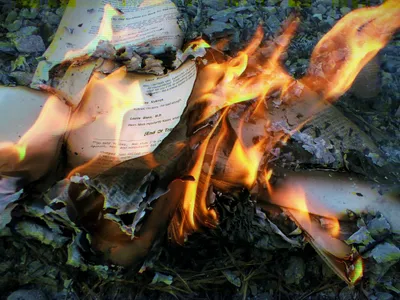
'The House of Leaves - Burning 4' photographed by LearningLark, November 19, 2009. | Flickr (edited by the Author)
issue #176 of brennan.day
Writers Who Burned All Their Words feat. Bix Frankonis

brennan.day — issue #176
Publisher: Brennan Kenneth Brown
Place of publication: Calgary, Alberta, Canada
Available at: https://brennan.day
Contact: mail@brennanbrown.ca
There are two obvious things about me—I write a compulsive amount and I keep and archive every jotting and scrap I write just as compulsively. I believe this began when, as a child, my computers and their software would fail. I'd read "bad sectors" trying to recover files from begrudgingly slow 4,200 RPM HDDs, and I'd lose dozens of songs and poems I wrote in a clunky, niche application called MasterSongwriter.
To give you some examples, my first independently-published book was called The Dogwood Verses which is 580-pages long and contains every poem I wrote from the start of my childhood up until 2021.
Another independently-published book I wrote was called The Reaper and Her Sickle: Rough Cuts, Spares, Afterthoughts, B-Sides and Experiments, which contains every scrap of writing I did during my university undergraduate career between 2021 and 2024 that didn't make it into a finished poem or essay. It's only 250 pages long.
As of right now, I have over a million words and fifteen years of private journal entries, over a thousand poems, and nearly 300 blog posts. More than half of the blog posts are on brennan.day and written only in the past half year. All hosted on multiple sites and mirrors, with redundant backups on physical storage and the elusive cloud.
And so, I can't help but think about how much writing matters to me—both the process but also the final product, on display for the public.
I say I write for the sake of writing, and I certainly do. The verb and process of freewriting is my therapy, prayer, and meditation. Writing is how I think outloud, how I study, and how I channel my emotions.
But I would be lying if I said I didn't also care about the product, the end-result, the container in which I present and share my writing publicly to you. The reader, right now.
My writing has become an extension of my identity—really, I want it to be wholly my identity. I want my ideas and prose and poetry to outlive me. I want to contribute well to the commons, and to build a meaningful legacy, to create and share ideas that will do good for the world.
So, then, how would things be for me if all my writing was gone? Publicly and privately. I try to conceptualize if it would be a blow to my ego, or a crisis I would be grieving. I wonder if I would I give up entirely, or just continue the next day from zero, like reaching for a wall in a dark room and finding none. No boundary. Just open space where something used to be. In truth, I hope to never have to find out.
But throughout history, there have been many writers, authors, and poets who felt the inverse of how I feel. Those who requested all of their work be destroyed.
Those Who Asked
The most famous case is probably Franz Kafka, who asked his friend Max Brod to burn all his manuscripts upon his death, including The Trial, The Castle, and Amerika. Brod ignored the request and published them instead.
Kafka burned things himself, before he died—his companion Dora Diamant recalled him wanting to "free his soul from these ghosts," and she burned things before his eyes while he lay ill. He left not one but two written instructions for Brod: everything—notebooks, manuscripts, letters, sketches—was to be burned unread, to the last page. It wasn't ambiguous. He meant it.
And yet there is a knot that literary scholars can't untangle, Kafka chose Brod as his executor knowing, with certainty, that Brod would not comply. He had told him so directly, years before. Some read this as a gesture of ambivalence—a Kafkaesque act of asking the impossible from someone incapable of it. Others read it as literary self-sabotage disguised as sincerity. Kafka had published very little in his lifetime, and what he did publish received scant acclaim. Metamorphosis, released in a literary magazine in 1915, caused barely a ripple. He called his published works "miscarried," asking a friend, "Why resuscitate old labours? Only because I haven't burnt them yet?" He respected only the moments in which he wrote them. The finished thing was already a kind of corpse.
Funnily enough, Brod himself asked that his diaries be destroyed after his death. They weren't either.
Emily Dickinson's case more private and heartbreaking. She asked her sister Lavinia to burn her papers after her death. Burning personal correspondence was customary for the time but Dickinson went further, leaving instructions to destroy everything. Lavinia burned her letters, thousands of them, which were the primary form of communication for a woman who rarely left her home in Amherst, and who experienced the social world through paper and ink. Those letters are gone now. Ash and white space where the words were.
What Lavinia found instead was a wooden chest and a bureau drawer. Inside: sixty hand-sewn packets—fascicles—containing approximately 1,800 poems accumulated over a lifetime in the dim privacy of her bedroom. The chest had been filling like an hourglass. Dickinson must have known how much of her life was in it and still asked for fire.
The historical record isn't clear on whether she didn't want her personal letters to become public property, and the poems were a casualty or a secret kept even from herself. What's clear is that Lavinia, not a poet herself, not a deep thinker by any contemporary account, opened a locked box and felt the weight of genius in her hands and chose not to burn it. She worked for years to get those poems into print, even when she had to hand them to someone she despised to do it.
Plath's case is different. It was Hughes who did the burning. He said it was her wishes, but there's evidence he was abusing her. In the foreword to the 1982 edition of her journals, Ted Hughes admitted to destroying the final volume—the one covering the last months of her life. His stated that he did not want her children to have to read it, and in those days he regarded forgetfulness as an essential part of survival. A second journal, he added casually, had simply "disappeared."
The implications of this have never stopped reverberating. Critics have never stopped asking what else he didn't want anyone to read. The destroyed journal covered the period for which the archival record is thinnest, the disintegration of her marriage and the long winter before her death. We are left with Hughes's version of her.
And then Virgil—which is almost comic in its grandeur. In 19 BCE, having spent eleven years on The Aeneid, Virgil fell ill while traveling in Greece and died before he could complete his revisions. He had wanted three more years. He instructed that the manuscript be burned. The reasons were at least two: he considered the poem unfinished, and some scholars believe he had come to dislike at least one sequence for its moral nonconformity. Virgil had also possibly come to see The Aeneid as a text that could be used to justify autocracy, and he didn't want to be the poet of empire.
Augustus overruled him and instructed Virgil's literary executors to publish the poem with as few editorial changes as possible. The greatest Latin epic exists because a Roman emperor decided an artist's wishes didn't matter.
The perfectionist's horror of the unfinished thing. The political discomfort of having served power. A poet who spent his whole life on one poem and couldn't release it into the world imperfect.
...Why?
What was the cause of this drive towards self-erasure? Kafka's was self-loathing and ambivalence, a man who felt he had failed his own impossible standard, who saw his published work as miscarried things—respecting only the moment of composition, not the composed artifact. Dickinson's was privacy, the radical act of a woman who had already made herself nearly invisible to the living world, who published almost nothing in her lifetime and wanted to keep it that way. Plath's was possibly not her wish at all—her wish is the absence, the silence, the journal reduced to ash by someone else's hand. Virgil's was perfectionism, and maybe a conscience about what his art was being used to do.
It is so difficult for me to fathom dedicating your life to an act only to want it vanish with you. What, then, was the point? Of course, that is a silly question. The real question is, who were you?* But maybe the point was always the writing, not the written thing. The moment and not its preservation. Kafka said he respected only the moments in which he wrote. The rest was miscarriage.
That said, just because I do not understand the feeling that would lead to authorship annihilation, that doesn't mean I'm happy their wishes weren't respected. On the contrary.
Kafka is the ur-example because Brod's betrayal was so deliberate and the stakes so high—without Brod, arguably the most important novelist of the twentieth century vanishes entirely.
And that's how it should have been. I don't care how talented or important Kafka was. I don't care how much I love Dickinson's poetry. I do not believe any work of art is "good" enough to violate the autonomy of the artist, for the sake of culture or the masses or whatever else. It is, frankly, a disgusting and perverse violation of someone's rights and privacy, and so often a betrayal done by someone close to them—a friend, a sister, a husband, an emperor. Someone who loved you and decided that love entitled them to keep what you wanted gone.
A Real-life, Living Example
Now, I could talk about famous dead authors all day, but I recently came across a contemporary example of this—an ex-blogger named Bix Frankonis. Bix, who I met on omg.lol's IRC channel, once had a rather massive blog archive, which he then decided to eliminate entirely.
From March 2000 to the present, across more than thirty domains—some running concurrently, some lasting years while others lasted weeks—Bix wrote.
He began with a personal page hosted at geekforce.org, then moved to bix.portland.or.us. By late 2001 he had cycled through voteordie.org, whatplanetisthis.com, and a first attempt at theonetruebix.com—a domain he would return to repeatedly throughout the decade—before settling into the longer projects: portlandstories.org, from 2002 to 2006; almostboston.com, from 2004 to 2006; whatismiamadeof.com, from 2006 all the way to 2017. He also contributed regularly to blueoregon.com, a Portland group blog, from 2004 to 2007.
The domain names themselves are autobiography. There's a civic period—portlandstories.org, portlandhistories.org, portlandsfuturecharter.com. And then there are the strange titles that mark a certain era of early blogging: riverismadeofchocolate.com, bigdamncommentaries.com, furiousnads.com, omgwtfehwr.com, piespoilers.com, itsownsubgenre.com, breakingatmo.com, twitchyunreliablelooking.com. Each an act of naming that now reads like folk art, and each now mostly unreachable.
In the 2010s he migrated toward platforms—Tumblr, then Medium under three separate handles, then WordPress—before a stretch of self-hosted experiments under variations on a theme: some.mediocre.work, this.mediocre.life, bix.today, write.as/bix, write.house. He arrived at bix.blog in 2019, where he spent years assembling what he called a restoration project: every word he could still get his hands on, back online in one place. By the time he was done, there were something like 4,600 posts.
And then he deleted all of it. Why?
I decided the best way to understand the "why" was not to read papers by stuffy academics, but rather to just email him and ask. He agreed to answer my questions. What follows is that interview. I previously included a lightly edited version. He wrote back and told me, correctly, that the whole point was to share what he actually wrote.
Interview with Bix
BKB: Just from a pure stats perspective, do you know how many sites you have written on, or how many posts you've created, or words written?
The closest I ever came to figuring this out was the guide page I had at one point published after a lot of research. It doesn't give any sense of posts or words, just an overview of the sites. Some of these sites were microblogging, some were longer, titled-posts blogging. Obviously the microblogging ones had a relatively enormous post count. There was a microblogging era in my modern blogging period, which is why at the time I shut everything down there were something like 4,600 posts—and that hadn't even yet reached into my pre-Twitter microblogging periods.
BKB: I remember you saying in IRC that one day a flip sort of just switched for you. Could you explain your thinking beforehand when you were trying to archive and share everything, and where it stands now?
The thinking beforehand in many ways is connected to when I managed to get the bix.blog domain, which sparked the idea of putting everything I'd ever blogged—that I could still get my hands on—back online in one place. Unconsciously, this ultimately stems from both a long-running feeling of inadequacy and a long-running sense that I deserved more attention. All of which of course in the end is related to being a late-diagnosed autistic who remains entirely dependent financially upon his sole remaining parent, who once they, too, are gone, my life will rapidly deteriorate.
So, somewhere in all of this was the idea of trying to force the world to see the person it had almost completely failed to support, who was staring at his midlife with difficult questions about what came next.
There also was just some very specific stuff I wrote in the past that I really wanted to see back online, because it was good. That, too, though, is a thing that ultimately winds its way back to Franny Glass.
So, what happened.
The initial trigger for the sort of cognitive cascade that led to the decision was the side blog I'd started to discuss the upcoming 25th anniversary of Firefly, a fandom I'd spent a decade in—meant to be a sort of critical look at a problematic fave. But a couple of weeks into it, I started to wonder what was the point, and why was I performing these thoughts publicly, especially given the hazardous environment of how the show is discussed.
Once I deleted that blog, this issue of why I am publicly performing my thinking rattled around in my head, both consciously and unconsciously. The first to fall was the blog restoration project, because I suddenly didn't see why I was going through all the headaches of it, and that decision itself quickly became one, specific thought.
I need to be smaller online, not bigger.
At that point, it was a done deal, and I began taking the blog offline and eradicating every piece of software on my laptop that I used to create and maintain it. I did import all the posts into the Bear notes app, in the event there is something I need to know, since the blog also functioned as a sort of external memory for certain things, given the aphantasia and SDAM.
In addition, I started working up a custom stylesheet for Bluesky that hides the "new post" buttons, as well as various other parts of the site I do not use—and also hides things such as the "like" button and repost counts, so not only am I not seeing my own numbers, I'm not seeing or caring about anyone else's either. I've also upped my periodic post purge from "older than 14 days" to "older than 7 days."
In the end, it wasn't just about being smaller online but being calmer, too.
BKB: Is there anything about your life you want to share that would add context for this decision?
Something I brought up in therapy was that I wondered how this decision would impact my self-regulation, since writing—and writing in public—was a self-regulatory behavior, especially going back to 2018, when after two years I finally started overtly writing about my autism diagnosis. What I've come to realize, in part through talking this out in therapy, is that whatever self-regulatory benefits I'd gained from all that outward-facing introspection—and flailing at the unsupportive systems and structures around me—had basically run its course, and a lot of how I was writing about things was just so much wheel-spinning.
Nothing about the world around me as an autistic was going to change, and what was going on inside me as an autistic I'd in large part figured out. While I obviously blogged about other things too, a lot of those things easily could be put in a box labeled "ego."
In the time since I started writing-as-self-regulation, certainly with the help of those weekly therapy sessions—which are structured around my private, bullet-point weeknotes—I've established enough of my own habits, routines, and structures that support my self-regulation, and have come to understand how to advocate for myself in circumstances and environments where it actually matters to do so, without having to publicly perform it all in such exhaustive, archived detail.
BKB: How do you see your current site slow.dog being different from bix.blog?
The site now known as BIX not BLOG is locked and will remain as it is until the domain expires in a few years, unless I renew it and continue to keep it as-is. Its former incarnation was exhaustive to the point of exasperation, while Sluggish Canine Enterprises is a kind of stable snapshot—if in its own kind of exhaustive way. It's a way to be known, should anyone care, without having to perform myself online day after day after day.
It's basically "me" as I present online now. The associated statuslog only shows the past seven days, because ephemerality is also a way of being smaller—so there's still a small, uneventful way to narrate random parts of my life, but it doesn't "matter" to me as much, and so I don't really have to think about it, and don't have to care if anyone else thinks about it, either.
(I'm basically pretending to ignore that it has an RSS feed, and so technically there's an archive of it in people's feed readers. I mean, I'm also not having things deleted from the Wayback Machine, either.)
BKB: Is there anything else you'd like to add? Further readings for me or my audience?
No.
Getting an Answer
In place of his archive, Bix placed a passage from Franny and Zooey by J.D. Salinger:
"So woozy and funny. I don't know what's the matter with me."
"You think you're a genius?"
Franny took her hand down from her head. "Aw, Lane. Please. Don't do that to me."
"I'm not doing any—"
"All I know is I'm losing my mind," Franny said. "I'm just sick of ego, ego, ego. My own and everybody else's. I'm sick of everybody that wants to get somewhere, do something distinguished and all, be somebody interesting. It's disgusting—it is, it is. I don't care what anybody says."
Lane raised his eyebrows at that, and sat back, the better to make his point. "You sure you're just not afraid of competing?" he asked with studied quietness. "I don't know too much about it, but I'd lay odds a good psychoanalyst—I mean a really competent one—would probably take that statement—"
"I'm not afraid to compete. It's just the opposite. Don't you see that? I'm afraid I will compete—that's what scares me. That's why I quit the Theatre Department. Just because I'm so horribly conditioned to accept everybody else's values, and just because I like applause and people to rave about me, doesn't make it right. I'm ashamed of it. I'm sick of it. I'm sick of not having the courage to be an absolute nobody. I'm sick of myself and everybody else that wants to make some kind of a splash." She paused, and suddenly picked up—
Bix deleted all of his writing. Not to protect it from someone else. Not because he was dying. Just because one day something changed, and he wanted to be smaller. The blog restoration project, it turns out, wasn't really about the writing. It was about the world having a record of someone it had largely failed to show up for, while there was still time for the record to matter.
What connects Bix to Kafka and Dickinson and Virgil—the thing that makes him feel like a contemporary case of an ancient impulse—is this: the decision was not made from nihilism. It was not indifference. Bix didn't think his writing was worthless. The problem, he said, is that it was starting to feel like performing. And performing for whom? For a self that wanted to be known, that wanted to matter, that was keeping score without realizing it.
"I need to be smaller online, not bigger."
I am a compulsive archivist because I'm terrified of losing the words—the pale blue screen, the progress bar, the bad sectors. But the writers who asked for fire weren't terrified of loss. They were terrified, perhaps, of the opposite. Of a self being held still, pinned like a moth to a board, preserved past the point at which they'd grown. A corpus is a corpse. A poem is never finished, only abandoned.
To ask for your writing to be destroyed is not to say it was worthless. It is to say: this is not who I am anymore. Or: this was private. Or: this was for the making, not the keeping. Or, like Bix, I need to be smaller.
My compulsion runs deep, my fear of loss too present, my desire for legacy too bright. I want the words to outlive me. I want to contribute well.
The writers who burned their words were not less serious about writing than I am. They were all better writers than me, certainly. And they were, in their own way, more serious—serious enough to insist that the work was theirs, finally, completely, even in death. No reader gets to hold you still. The self is not an archive.
Comments
To comment, please sign in with your website:
How it works: Enter your website URL. IndieLogin checks your rel="me" links on GitHub, GitLab, Codeberg, and email. Setup instructions.
Signed in as:
No comments yet. Be the first to share your thoughts!