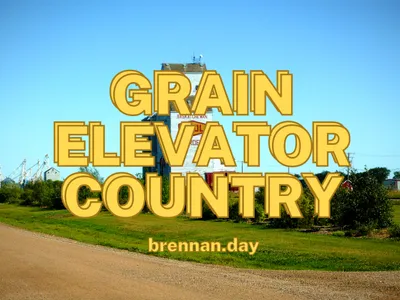
Grain elevator, Aberdeen, Saskatchewan, Canada. September, 2009. | Source (edited by the Author)
issue #160 of brennan.day
GRAIN ELEVATOR COUNTRY
brennan.day — issue #160
Publisher: Brennan Kenneth Brown
Place of publication: Calgary, Alberta, Canada
Available at: https://brennan.day
Contact: mail@brennanbrown.ca
The building looks like a religious monument from another era, the silos remind me of the Monolith from 2001: A Space Odyssey. The grain elevator. Stark against the endless horizons we've been looking at for hours. In Saskatchewan, the elevators are compass points. Mountainless markers dotting flatland, pins in a map. Every small town seems to claim one, names emblazoned on weathered wood, an identity forged in storage capacity.
I watch it all from the passenger window. My brother Byron only watches the road. This is the whole of our arrangement. He's driving because I don't. Six years older and still without a license. There's no metaphor here that I've earned the right to explain away. He doesn't ask questions about it. He just gets in and drives. His car is a late 2000's Mitsubishi Eclipse Spyder, a sunset orange paint and V6 engine. Curvy, aggressive styling. He bought it during the middle of the COVID-19 lockdowns with the help of CERB money. A year later, we're taking this road trip.
Fifteen hours, Calgary to Winnipeg, east across a country that gets flatter and flatter until the sky takes up more room than the land. I'm in the passenger seat with my notebook and my window and all my useless education. He has the road.
What does it mean to be carried?
10:30AM
The province sprawls, seemingly forever. 1.2 million souls scattered across endless prairie, though most are huddled in the urban safety of Saskatoon or Regina. Here in the south, though? Spaces between dwellings grow wider, settlements more tenuous. Even the Farm Road that marks the border feels uncertain. Paved but hemmed in by high weeds, as if nature is always one season away from reclaiming it.
When we travel through Orne, I notice the elevator has been smacked relentlessly by wind, each gust a chisel slowly carving decay.
The abandoned speak louder than where there's still life in prairie country. Towns are ghosts where paint peels in slow motion, and tall weeds grow around doorframes. Leaning buildings west of Claydon hold decades in warped boards. Vintage cars in Wood Mountain rust in formation—GMCs, Fords, Chevys lined up like a drive-in movie frozen in time. Chassis after chassis slowly returning to prairie dust. Cemeteries of wheel wonders.
Byron says nothing. He's been awake since four in the morning. I've been awake since Byron started driving.
Noon
The roads stretch emptier than eastern Montana. Farm and ranch houses scattered miles apart, each an island in a sea of wheat. When we pull over, a hawk watches, unperturbed by human presence. The birds don't seem to mind the solitude. Ground squirrels emerge as punctuation marks in the landscape's empty pages.
I want to tell him about this. The prairie silence—how it presses back against you like something with weight and intent. I read once in Leanne Betasamosake Simpson's As We Have Always Done that land is pedagogy, generating and animating knowledge. I think: yes, exactly! And then I look at Byron's one-handed grip on the wheel. He already knows this.
Objects remain exactly where they were left in these forgotten pockets. A radio still plugged into an outlet, someone simply stood up one day and walked away. Old metal coffee cans. Heating stove brunette with rust. Bottles marked strychnine. Archeology of agricultural life frozen in final positions, an abandoned chess board. Inside one homestead, green paint still clings to upper walls. Better days. What gets left behind. What gets carried forward.
After the Red River Resistance, after the provisional government Louis Riel built was dismantled by incoming troops, our ancestors moved westward and northward in search of peace—dispersed across the homeland in search of somewhere that wouldn't burn. The history of our people is a history of things left in houses, of routes memorized and abandoned. Names carved and scratched into wood that slowly returns to earth. Every ghost town in Saskatchewan is haunted by more than settlers.
Cemeteries hide in tall grass, headstones tilting as bad teeth. Churches stand hollow, steps crusted with lichens, paint bubbling under relentless sun. You can see where the last service ended through broken windows. Hymnals still open to unsung songs. Is God here?
9:30PM
The flax fields offer me a reprieve, the blue blossoms nodding in wind unceasingly. Canola glows yellow as far as the eye can see. The land begins to undulate, subtle hills breaking the hypnotic flatness. Even in this emptiness, beauty persists. At sunset, smoke from distant fires in British Columbia turns the sky surreal, the sun a blood orange hanging low over rippling wheat that moves like ocean waves.
Byron glances at the sky. "Nice," he says. The whole curriculum of prairie manhood in a single syllable. This country raises sons on silence and endurance, doesn't it? Masculinity as rigid as the rows of wheat that organize its horizon. I see it in his jaw, his grip on the wheel, his quiet refusal to admit fatigue. The ideology was here before either of us—hammered into fence posts and long distances between anything soft.
11:30PM
After hours and hours, the motel appears near midnight, a low-slung building with a vacancy sign that flickers. The parking lot is mostly empty. One truck. One flickering overhead lamp drawing moths in frantic circles. The office is small—a counter, a key rack, a man who looks like he hasn't been surprised in thirty years. We are two Métis brothers, one exhausted, one with too many words and not enough sleep. I reach for my wallet. Credit card. Except.
I didn't bring it. I thought it would help me spend less on this trip. I was inexperienced enough to not know you needed it to book a room. I stand at the counter explaining this to a man who has heard every version of this story. Byron is behind me, leaning against the wall with the particular stillness of someone who has been awake for sixteen hours and is running on the last fumes of will.
The man looks at us. Looks at Byron. Makes a calculation I will never fully understand and takes my debit card.
I have thought about this moment many times since. The mercy of strangers. The architecture of goodwill extended in small motels in small Saskatchewan towns at midnight.
Byron doesn't even make it to the bed. He sits on the edge of it, shoes still on, and is asleep in under a minute. I lie in the dark and listen to his breathing slow. Outside, the moths keep circling.
1:30AM
Our ancestors knew how to read pressed grass, interpret broken twigs, follow paths invisible to eyes that hadn't learned to look. Tracking deer through morning dew, reading stories in muddy riverbanks. The knowledge was precise and patient. A language for understanding where something had been and where it was going.
I have been trying to track my brother for years. He's twenty-four, now. Knows more about real life than I do. He worked as a bartender at a Mexican bar and became an expert in tequila—the worms are rare, he says. I pretend he mixes cocktails with the same precision I use to parse semicolons. When he started coming to Write Club, I thought: here. Here is the place where our vocabularies might finally meet.
He came for a while. Then he left. And the commute between his world and mine got longer again. I tried to joke that he should enroll, take over as president after I graduated. He just keeps wiping down the counter. A growing and gaping maw of distance. Slang ages like milk. His nightly tips worth more than my poetry.
I want to tell him about Billy-Ray Belcourt—a Cree kid from Driftpile Nation in northern Alberta who became the youngest ever winner of the Griffin Poetry Prize, his poems love songs to the land, my analysis of This Wound Is a World. I want to tell him about Joshua Whitehead, Oji-Cree and Two-Spirit from Peguis First Nation, who wrote full-metal indigiqueer out of Winnipeg's spoken word scene—the same city we're from and driving toward—who said: I craft mirrors for myself ... Taking my body out of the 'was' and placing it into the 'is.'
I want to explain, years later, why I decided to spend so much time in a brutalist university building reading dead people's mail for my degree. Instead, I send him reaction emojis hoping some wisdom transfers through cultural osmosis.
How do you be the kind of older brother who makes the path easier without smoothing away all the important rough edges? Every day I practice dying. Practice leaving him. My legacy needs to be more substantial than a good YouTube playlist and annotated poetry.
The stoic, patriarchal inheritance running through this landscape has already done its work on you. I've read the theory, traced the system, named the hegemony in seminar rooms. But knowing the architecture of a cage doesn't mean you can open it for someone who doesn't see the bars. My quiet failure as an older brother is not that I couldn't find the words—it's that the words I found are the wrong language entirely.
3:30AM
The nights belong to coyotes, howling songs replacing daytime birds. The grain elevators become black monoliths against star-scattered sky. By morning, the wind ripples wheat fields into ocean waves, an inland sea of agriculture stretching beyond horizon.
I dream of Torquay, where a man opens a convenience store stocked with homemade pickles and Saskatchewan-grown vegetables. His wife bakes. Trying to bring their little community back together, he says. The town's residents no longer have to drive 40 minutes to Estevan for milk or bread.
8:00AM
We leave early, continental breakfast cancelled due to social distancing. Instead, we're given saran-wrapped breakfast burritos. I'm grateful.
By the lake near Coronach—a town named for a 1926's champion winning racehorse—cattle stand in water like hippopotamuses seeking relief from 40-degree heat. White pelicans drift. Fish surface in massive schools, close enough to touch with a paddle. Through the culvert, spiders have weaved kingdoms. Nature reclaims what humans abandon.
Every small town has an ice rink—hope frozen in place. The next great Canadian hockey player could emerge from any of these dots on the map. They often do. Municipal swimming pools offer community baptism in summer heat. Library buildings, once schools, hold stories of what was and what could be. In Lake Alma, the school persisted until 1998, its windows now dark but still reflecting sky.
10:30AM
Houses wear weather like old suits in Frobisher, too big now for their shrunken circumstances. Bright yellow fields of canola surround towns like Oxbow, refusing to slip into oblivion, maintaining a defiant tidiness. Some towns offer electrical hookups and small parks for travelers, fifteen dollars a night to share their diminishment.
Signs fade into illegibility. At Gainsboro—proudly proclaimed as Saskatchewan's oldest incorporated village—a garage sits for sale, waiting for a buyer who might never come. In Estevan, the "big city" of 13,000 souls, oil and agriculture still provide life. The downtown streets are under repair.
The wind never stops. It shapes the lean of abandoned houses, the slope of scattered trees, the ripple of prairie grass. Even buildings bow, as if in prayer. This is a place where distance is measured in absence, where silence grows louder than sound, where empty spaces tell fuller stories than filled ones.
2:30PM
Winnipeg finally arrives gradually, more a thickening than a destination. More cars. More signs. The Red River running cold and wide beneath bridge after bridge. The city at the forks of the Red and Assiniboine, the birthplace of the Métis Nation and the heart of the Métis homeland—a fact I know academically and feel in my body. Our family is here. Our father. All the things that require fifteen hours of highway to reach.
Our people are people of the Red River Cart—the great vehicle of trade and travel, a symbol of movement and return. We have always been people of the road. People who moved west when they had to and came back when they could. Byron drives east. Our ancestors navigated by stars and pressed grass, I navigate by grain elevator.
Byron is exhausted for nearly our entire visit. He sleeps in every morning we're there, recovery sleep, deep and necessary. I feel guilty and grateful. He gave his body to this trip so I could sit in the passenger seat and watch the prairie go by and think about grain elevators and tracking and brotherhood.
It's different than Alberta. April has cracked earth, white salt crusting the riverbed. May has mud to the axles, water pooling where wheat ought to root. Dust devils in empty fields. Half the rain that should’ve fallen, reservoirs showing their stone ribs. A storm crosses the Rockies made of angels, angels, then the mercury drops & stays dropped. Fields cracking open.
1:30AM, Again
I'm sleeping on an air mattress on the wooden floor of my dad's apartment. I dream about my brother's future. In the dream, I've finally figured out how to be wise without preaching—how to give advice without triggering the reflex of eye-rolling as the older sibling begins a sermon on being a better person that wasn't asked for. I've learned how to share the important things, the real stuff about how to be a person in this world with hope and love and optimism despite everything. In the dream, I die peacefully, knowing I've done this one thing right.
But then I wake up. To a world where I'm still alive and failing. It’s just like the fields of wheat that encompass every direction outside. Endless. Blonde. Growing despite the drought. Swaying in the wind, without much care or control. Silently praying to God.


Comments
To comment, please sign in with your website:
How it works: Enter your website URL. IndieLogin signs you in through your site's IndieAuth server if it has one (e.g. indieauth.com), or checks your rel="me" links on GitHub, GitLab, Codeberg, and email. Setup instructions.
Signed in as:
No comments yet. Be the first to share your thoughts!