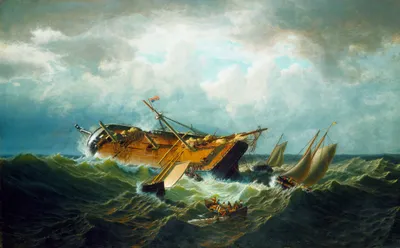
'Shipwreck off Nantucket (Wreck off Nantucket after a Storm)' by William Bradford. ca. 1860–61 The Metropolitan Museum of Art (edited by the Author)
issue #199 of brennan.day
A Ship in Harbour is Safe

brennan.day — issue #199
Publisher: Brennan Kenneth Brown
Place of publication: Calgary, Alberta, Canada
Available at: https://brennan.day
Contact: mail@brennanbrown.ca
In 2018, Nassim Nicholas Taleb released the fifth book in his Incerto series, Skin in the Game. The main idea is rather simple: it's actually good to have something to lose.
True learning occurs only when you have something to lose from your mistakes, what Taleb calls pathemata mathemata. Learning through pain. You have a fire lit under your ass. It burns but you get things done because you don't really have any other option.
Taleb was mostly writing about the professional class of advisors, consultants, and intellectuals who profit from appearing to know things without bearing any consequences for being wrong. But I think this applies greatly to creativity.
Tucked into the same book is a concept he calls "soul in the game," reserved for a category he calls artisans. Writers, makers, craftspeople, anyone who does things for existential reasons first and financial ones second. The artisan would not sell something defective or even of compromised quality because it hurts. They have sacred taboos, things they would not do even if it markedly increased profitability. The artist, in Taleb's framing, is the most committed form of skin-in-the-game practitioner. Sacrificing not money or reputation, but something harder to name. The songwriting self. The written record of what they actually believe.
In poetics for example, you have the confessionals. Robert Lowell, Sylvia Plath, Anne Sexton, and their contemporaries. Poets making art out of personal history and autobiography, with direct expression as method. At the time, private experiences were considered taboo as primary subject matter. Yet, Plath published Ariel under her own name. Yet, Sexton read her poems about psychiatric wards and suicide attempts at universities and in living rooms. In the public sphere they wrestled with patriarchal expectations, motherhood, womanhood, and mental illness. The wager was real. The stakes were real.
One of the principles in the IndieWeb is to both use what you make and make what you use. You might know this as "dogfooding," where a business uses the product they're selling. It's also known as "drinking your own champagne" to put a more positive spin on it, but it shouldn't have a positive spin. While you may eventually get to the point where you create something enjoyable to use, it won't start off that way.
This is skin in the game—you develop an immediate empathy from the impact of poor design choices or errors. You are no longer building hypothetical features for a fictional audience. You are building a real thing for you. And if you aren't going to use what you build, why would anybody else want to? This is a bodily thing, you feel the drag of a slow page load in your own impatience. The broken navigation. It's the potter who only makes pots she'd use, the carpenter who sleeps in the bed he built.
My blog certainly passes that test. I created it from scratch and use it every day, and I even have dipped my toes in Developer Experience (DX) to improve how much I enjoy the workflow of writing each day here.
But that's not the only way I put skin in the game. Another example is that everything I do online is connected directly to my real-life identity. My legal name is Brennan Kenneth Brown. Is there risk to this? Yes, and the risk is entirely the point. You know who I am, and so I have to live up to a real standard I set for myself—I'm held accountable, and it's inherently transparent. If I seriously fuck up, those fuck-ups are tied to who I am. Learning through pain.
There's a weight to being named. When I posted about my diagnosis, when I wrote critically about what others in my field depend on financially, there was the moment before I said something publicly that I knew I couldn't take back. That weight is proof that what you're doing matters. An anonymous post about mental illness is a contribution to discourse. A post with your name on it is a reckoning. Both might say the same words but only one costs you something.
Similarly, I follow the Show Your Work philosophy of Austin Kleon. Along with my essays meandering about spicy foods and Groundhog Day are plenty about how I write and how I code. All of my technical work (and now creative writing work as well) is publicly available in open source repositories on GitHub and GitLab and Source.tube.
If people fuck up on the Internet under an alias, and they practice good infosec, then they can go and move on with their life as though nothing has happened. No skin in the game.
I've deeply enjoyed having my identity tied to what I do. I'm proud of my work and I think my track record shows somebody working in good faith. Taleb's idea, like many others he's written about that I've been influenced by, has been proven to be correct through my action.
The title of this article comes from a quote coined by John A. Shedd in his 1928 book Salt from My Attic. The full quote goes "a ship in harbour is safe, but that is not what ships are built for." I think about it often, and I think it lends itself to how existential the importance of having skin in the game is.
I've written before about my distaste for how we've become a culture of convenience and taking the path of least resistance, but we've also become a culture of taking the safest path forward as well. There is so much less to forage in the garden if we avoid anywhere weeds and thorns have sprouted up. Safety is so much smaller than risk.
To make something safe is to sand down the edges. You soften the claim. You write the essay and then spend twenty minutes asking yourself: could this be misread? could this hurt someone? could this embarrass me in a year? And then you chisel off the parts that answer yes, until what's left is smooth and inoffensive and inert, a thing that will neither wound nor illuminate. A ship in harbour, tied to its cleats, paint still fresh. Impressive, maybe. Inert, certainly. Safe as a ship can be, yes. Permanently, uselessly safe.
I'm sure you've heard all of these empty platitudes already in self-help, business organization contexts, but it really is about the art for me. I do not think we are capable of creating great art unless there is a chance it will ruin us. Anytime I have an uneasy gut in my stomach about something I've posted, I know that means that it is something I need to share.
I'll bring another one of these trite sayings up; Tennyson taught us 'tis better to have loved and lost than never to have loved at all. I know the ocean in the storm, I know the feeling of shipwreck, to be capsized and to lose near everything. But then you just build another ship. You set sail again.
The harbour has people who love you in it, and dry land, the smell of woodsmoke from somewhere warm. When you leave, you leave that too. The water is dark and deep, the swells are indifferent and there is no one out there who will save you from a mistake in the rigging. You knew this going in. You went in anyway. You are a sailor.
You have to be willing to not come back. That is what the art requires. That is what skin in the game means. It will cost you something you can't recover with a pseudonym and a new account. Your name is on the hull. Your name is on the work. You are in the water.


Comments
To comment, please sign in with your website:
How it works: Enter your website URL. IndieLogin signs you in through your site's IndieAuth server if it has one (e.g. indieauth.com), or checks your rel="me" links on GitHub, GitLab, Codeberg, and email. Setup instructions.
Signed in as:
No comments yet. Be the first to share your thoughts!