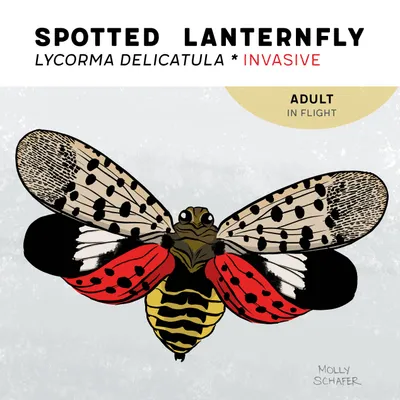
Illustration of the Spotted Lanternfly in Adult Stage by Molly Schafer | Mt. Cuba Center
issue #200 of brennan.day
THE LANTERNFLY.

brennan.day — issue #200
Publisher: Brennan Kenneth Brown
Place of publication: Calgary, Alberta, Canada
Available at: https://brennan.day
Contact: mail@brennanbrown.ca
My legs tremble when I wake up now, I'm not sure why. I probably need to eat something—a garden salad the colours of sunset and bruises. I need caffeine and to stop making a list of things.
The nothing is always waiting and welcoming. Just for a minute, sit in the not-yet. But the monkey clatter bubbles up all the same, no different than well-taken care of sourdough. There's a name I keep turning over in my head.
Before The Light
The spotted lanternfly is beautiful. The forewings like grey calligraphy paper, polka-dotted. Underwings a shock of red and black and white. Colouring belonging to a naturalist's illustration from the 19th century.
Lycorma delicatula. Delicate. There's that word.
The lanternfly is also a terrible, invasive planthopper, arriving as egg masses on imported stone in Berks County, Pennsylvania in 2014. Spreading across North America ever since.
The lanternfly feeds on over 70 plant species, shitting a sticky honeydew promoting unhealthy, sooty mould growth. Don't worry, though, it lacks the capacity to bite. Causing enormous harm with innocence.
The lanternfly's favourite food is Ailanthus altissima. The tree of heaven. This tree, too, is terrible and invasive. First brought from China to Europe in the 1740s as an ornamental garden specimen. The tree initially hailed as beautiful, and now grows out of cement, out of cellar gratings, suppressing competition with allelopathic chemicals it shits into the soil.
Two invasive species locked in an ecological codependency. The lanternfly, spreading toward a tree that was never supposed to be here. The tree named for heaven, and it smells so foul when you crush its leaves.
The lanternfly is a lightbearer. A lantern-shaped body, underwings lit like a match. Beautiful things arrive uninvited. Creatures that don't belong somewhere can still illuminate that place.
The Flood
Well over half of new online articles are now AI-generated. Mostly formulaic content—news updates, how-to guides, SEO filler. Not lyric essays about invasive insects, I presume. Not yet.
The pressure is not only in the volume, but the indoctrination. Constant suggestions nested in every product announcement, every LinkedIn post, every breathless tech newsletter. The droves of people who do not discern a meaningful difference between generated text and original writing. The droves of people who believe acceleration is the same as expression. That a writer who uses AI to "enhance their workflow" is simply being practical. A carpenter using a nailgun instead of a hammer.
In real life, have you noticed all the restaurants becoming boring grey boxes? When you go to the movie theatre, (if that's something you still do) do you notice the recycled content?. As though we have entered an age of monotony-as-safety.
Every major platform on the Internet in 2026, along with shoving an unnecessary genAI interface into their products because their aging shareholders believe it will mysteriously conjure profit, converge onto the same aesthetic as well. Frictionless, sterile, flat, spacious, white. Calm? Calm is what you design when you worry the user will leave if anything asks too much of them.
There is a lack of trust in all of this. The genAI autocompletes don't trust you have the capacity to write, yourself. The product designer and the Hollywood scriptwriter don't trust that creative expression will alienate (and cause a loss in profits, of course). In this lack of trust, there is a lack of love. A lack of understanding. We are all exhausted, guarded, and simply throwing anything at the wall to see if it sticks.
Authenticity is becoming a premium commodity, how contradictory. Humanity becoming a market differentiator. Mess and error and personality the brand itself. The baseline is automated, and so everything that was once just "all writing" becomes "human writing." A subcategory, a niche, a premium tier.
I refuse the premise. Original writing is not premium. The earnest and considered and risky and human is the point. You cannot suddenly have the term encompass something else because it is so widespread and mainstream.
It's easy to think that we are the ones being invaded—that the trends towards the artificial and sterile are encroaching on us. But in reality, this is the system working as intended. All systems functional and online.
Those who dare to object, to expose their vulnerable soft flesh, to centre love instead of comfort—we have always been the misfits. The rebels. We are the invasive species.
The tree of heaven, that foul-smelling invasive, was the last tree to come out of dormancy each spring. The locals along the lower Yellow River called it chunshu—the spring tree. The sign that winter was actually, finally over.
A tree that shouldn't be here, that causes real harm, that grows out of concrete—also the harbinger of warmth. Both things true at once.
I need to begin. I need to eat something. The lanternfly hasn't lit yet. But I can already see where it wants to go.


Comments
To comment, please sign in with your website:
How it works: Enter your website URL. IndieLogin signs you in through your site's IndieAuth server if it has one (e.g. indieauth.com), or checks your rel="me" links on GitHub, GitLab, Codeberg, and email. Setup instructions.
Signed in as:
No comments yet. Be the first to share your thoughts!