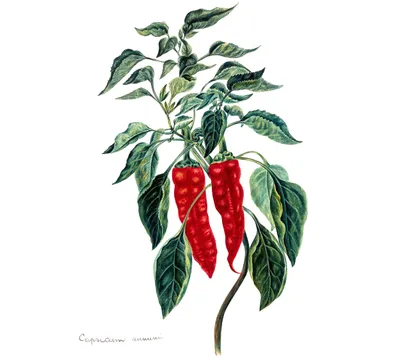
'Chilli or pepper plant (Capsicum annuum): fruiting stem'. Watercolour. | Wellcome Collection (edited by the Author)
issue #189 of brennan.day
SPICE: Our Antifragile Biology

brennan.day — issue #189
Publisher: Brennan Kenneth Brown
Place of publication: Calgary, Alberta, Canada
Available at: https://brennan.day
Contact: mail@brennanbrown.ca
It's come to my attention that, even though I was a cook for years, I've never actually written a post here yet about food. How absurd!
Over the past few months, I've been adding more spice to my meals. Learning the recipes has been so enjoyable—cracking Sichuan peppercorns into a dry, hot wok, filling the air with scents of citrus peel and electricity. Then, sizzling the doubanjiang (fermented broad bean paste) in toasted sesame oil. Silken tofu slides in as pale moons, poaching as the oil starts to blush red. You finish with hand-crinkled chili threads and a glug of chili oil infused with star anise and cinnamon.
The heat of Mapo Tofu hits twice. The upfront hit of fried chiles, and then the numbing buzz-buzz tingle dancing on your lips long after the bowl is empty. A kiss you can't stop remembering.
There are a lot of recipes I could describe like this I've been trying out. Like Jalapeño & Habanero Corn Chowder, Misir Wot (Berbere-Spiced Red Lentil Stew), or Volcán al Pastor.
But no, this isn't going to be a blog post about recipes or cooking. What I actually want to write about is the aftermath. The red-faced sniffles and unquenchable fire that stays well after the meal. The science of the pain that cultures around the world have celebrated, ritualized, and passed down.
The Accident
What exactly is spicy food? The answer is capsaicin, a chemical which binds to the TRPV1 receptors in our mouths. Those receptors evolved to detect actual physical burning, to stop us from eating things hot enough to damage tissue, and so capsaicin tricks us into thinking there's pain.
Plants evolved high concentrations of capsaicin to stop mammals from eating them, so their seeds could instead be carried by birds, since birds lack the relevant receptor entirely and feel nothing at all. The chili pepper is bird-delivery with mammal-proof packaging.
Didn't really work out that way.
The Chase
What's the response our body has to being on fire? Blood vessels dilate; we flush, sweat, drool. The trigeminal nerve in both mouth and nasal cavity sets off mucus production even when nothing has gone near your nose. We hiccup. We vomit if it's severe enough.
Every symptom is a purge response. Cry, sweat, drool, flush, expel.
Endorphins then rush in to provide relief, creating euphoria; dopamine adds pleasure and reward; adrenaline surges, heightening senses. These endorphins reduce stress and sedate us.
Leigh Cowart, in her book Hurts So Good, writes how people who seek out deliberate pain, like spice, always talk about what comes after. The dominion over self, the endorphin rush, the homebrew morphine. This is what we're drawn to, not the pain itself.
Psychologist Paul Rozin calls this "benign masochism," the enjoyment of negative sensations which are harmless. When eating spicy food, you know the discomfort is short-lived and not a real threat; a thrill rather than something to flee.
Capsaicin is also a neurotoxin; it causes selective degeneration of a particular population of pain-sensing neurons in mammals, producing irreversible functional impairments. But the amount you'd need to consume for that to happen is kilograms of the hottest peppers that exist, don't worry.
After the Fire
After the initial excitation, capsaicin produces a lasting refractory state where neurons become unresponsive, not just to capsaicin, but to a variety of other stimuli including noxious heat.
This is why high-concentration capsaicin patches are used to treat chronic nerve pain. Our body is a forest, the controlled burn repairs and heals.
The calcium influx through the TRPV1 channel desensitizes the channel. The stressor triggers its own antidote.
Interestingly, the same logic extends to the gut. IBS involves TRPV1 receptors that are overactive and hypersensitive. Repeated, controlled exposure to capsaicin causes those nerves to become less reactive, improving visceral pain thresholds, calming overactive gut signals. In clinical trials, patients initially reported more discomfort in the first two weeks, and then the symptoms faded. You endure the flame, you become fire resistant.
The Bacteria Were Always There
It used to be thought that drinking large quantities of milk to treat or cure lactose intolerance was folk wisdom—wrong. Like nearly all folk wisdom, though, there was truth here as well. It works.
Consuming lactose does not cause your body to produce more lactase. The enzyme needed is absent, regardless. However, repeated daily consumption of lactose alters the gut microbiome and improves lactose tolerance. Lactic acid bacteria eat the lactose but produce lactic acid instead of gas. You still can't digest lactose yourself, but the bacteria kindly digest it for you before any symptoms begin.
Bifidobacterium multiply in response to a signal you sent by eating something that hurt you. The microbiome reorganizes and the gut homes a different ecology. You are changed by choosing discomfort consistently over time.
Weight-lifting, Allergies, Fasting, and Childhood Dirt
When you lift weights, microscopic tears occur in your muscle fibers. The pain you feel a day later is your body's inflammatory response to the structural injury. After a rigorous workout, the nuclei of muscle cells migrate toward the tears to help patch them up, issuing commands for new proteins to be built. The muscle that heals is denser than the one that tore.
Allergen immunotherapy works by introducing small, gradually increasing doses of the thing that makes you sick. Pollen, peanut, bee venom. The immune system, which is confused and overreactive, is healed through controlled exposure. The short-term phase involves mast cell desensitization; the long-term phase produces regulatory T-cells that suppress the allergic response entirely.
When you fast, your cells experience mild metabolic stress, activating autophagy. Damaged proteins and worn-out organelles are broken down and recycled in this state. The cell eats its own debris. There's increased long-term stress resistance as a result.
The hygiene hypothesis states that early childhood exposure to particular microorganisms—gut flora, environmental bacteria, even parasites—protects against allergies by properly tuning the immune system. Children who grow up on farms, who play in the mud, who are exposed to animals, consistently show lower rates of asthma, allergic disease, and autoimmune conditions. Raise children in sterile environments and the system turns its aggression inward, attacking pollen, peanuts, and the body's own tissue instead.
There's A Word For It
This is the biological concept hormesis. The phenomenon in which a low or moderate dose of a stressor produces a beneficial response, though high dose remains harmful.
Intermittent fasting, exercise, cold exposure, and plant compounds like capsaicin all operate through hormetic mechanisms. The poison makes the medicine.
It's "an adaptive response of cells and organisms to a moderate, usually intermittent stress". Cells increase production of cytoprotective proteins, antioxidant enzymes, and growth factors.
What Needs the Storm
In 2012, Nassim Nicholas Taleb published Antifragile: Things That Gain from Disorder. Encountering this concept significantly shifted things for me. Antifragility is not resilience or robustness. Antifragile systems don't merely withstand shocks, the antifragile thrive and grow stronger in response. The Hydra grows two heads if you cut one off. The system needs to be attacked to become more than it was.
Taleb built this argument through finance and systems theory. But life and our biology have been antifragile for millions of years before finance existed.
Our receptors react less after exposure, muscle fibers heal thicker than the tears, and immunity cells learn from invasions. The TRPV1 channel closes. The Bifidobacterium multiply. The nuclei migrate toward the wound.
You Must Continue
Of course, there's a catch to all of this: None of it is permanent.
TRPV1 receptors resensitize if capsaicin exposure stops. The Bifidobacterium population in the gut reverts when lactose consumption ends, as continuous exposure is a prerequisite to maintain tolerance. Allergen tolerance after immunotherapy, while longer-lasting, also fades without maintenance. What stops being challenged stops being strong.
Antifragility is a dynamic equilibrium sustained by ongoing exposure. The gains are rented, not owned. Stop applying the stressor and the system softens back to baseline.
There's no endpoint, no achievement of toughness. You are trying to maintain a practice. The exposure is not a treatment you complete, it is a relationship you sustain.
Every generation of children playing in the mud, every culture eating fermented foods, everyone choosing discomfort in small doses? None are banking gains for later. We are keeping something alive that will die without us. The antibody, the receptor, the microbiome. None of these persist without the stressor. We are not the beneficiaries of our ancestors' hardships, no, we have to do our own.
The Hard Part
Which brings me to BoJack Horseman. The scene near the end of the first season where BoJack asks a runner how he does it:
It gets easier. Every day it gets a little easier. But you gotta do it every day, that's the hard part. But it does get easier.
Honestly, the hard part isn't the pain. It's the consistency. Like everything else important, you have to show up and do the work. In order to stay adapted, you need to keep showing up to the thing that hurt you in the first place.
Every time you sit with the burn instead of reaching for the water, you are telling your nervous system something about what kind of person you are becoming.
I think this partially answers why I find it easier to write every day now, half a year in, than I did when I started in November. Spiritual traditions around the world have held that endurance, when chosen, transforms those who endure. This is hormesis. This is antifragility.


Comments
To comment, please sign in with your website:
How it works: Enter your website URL. IndieLogin signs you in through your site's IndieAuth server if it has one (e.g. IndieKey), or checks your rel="me" links on GitHub, GitLab, Codeberg, and email. Setup instructions.
Signed in as:
No comments yet. Be the first to share your thoughts!