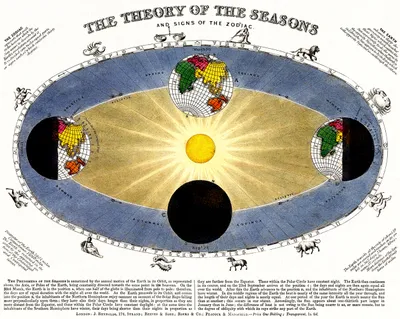
'A diagram of the Earth's orbit around the Sun in a solar year showing the changing seasons.' by John Emslie. 1851. | Wellcome Collection (edited by the Author)
issue #309 of brennan.day
The Pendulum Cycles
brennan.day — issue #309
Publisher: Brennan Kenneth Brown
Place of publication: Calgary, Alberta, Canada
Available at: https://brennan.day
Contact: mail@brennanbrown.ca
Overnight, the political landscape of the United States changed. Democrats won control of both the US Senate and House in Tuesday’s midterms, and it’s only the fifth time since World War II that a party has flipped both chambers in a midterm.
And the markets reacted with a $2 trillion loss, as a result. For there are fears that a Democratic Congress and the blue states will now crack down on genAI and data centres. A delicate balance has shifted.
But still, the United States' and Israel’s war on Iran began Feb. 28 and is still unresolved, with oil hovering around $100 a barrel.
And in Canada, Thursday’s budget adds $142.1 billion in new measures over five years, with a $62.3 billion deficit, written under a US trade war.
Salon, a pioneer of digital publishing, announced it will shut down after being online for over thirty years.
People make plans, they invest in retirement accounts, they have AI-dependent jobs. People expect to know their energy prices, trade, the outlets they read.
People want to hear that their side was right, or that it will all be fine.
Power and Safety
A lot of people misunderstand life and think that the currencies of power matter—whether that's wealth, recognition, or fear. People who prioritize wealth, fame, and image over close relationships, personal growth, and community have lower well-being across cultures.
In reality, we just want security. We want safety and trust. To be able to lower our shoulders and to stop white-knuckling with held breath. Wanting stable, close relationships is among the most basic and widespread human motivations. And close relationships predict a long, happy life better than social class, so-called IQ, or genes.
We want the security to be able to take risks. We want adventure and ambition in a well-manicured container. A child who trusts their caregiver will explore freely. Psychological safety means believing it is safe to take interpersonal risks, where people speak up with ideas, questions, and mistakes.
We want to be loved, and to be able to love. And we obscure our vulnerable nature, and pretend we are creatures of aggression, with the blood-streaked hands and teeth inherent rather than constructed. In 1986, a group of scientists signed the Seville Statement on Violence writing that war is not caused by our instinct. Natural selection favored friendliness in humans, where people less prone to aggression became preferred partners. We underestimate how much we're willing to work together, as a Science study of more than 100,000 people in 125 countries found 69% of people would give up their personal benefit for the common good, while the average person guessed that only 47% would.
Who Will Survive in America?
Does the great American experiment survive to continue onward? Will the shelter of our liberty and democracy hold against the increasingly brutal winds of tyranny and change?
I am thankful I don't have the arrogance to pretend I have any answers. I am another mundane witness, rubbernecking at the beauty of humanity's progress, as well as the horror of what that costs.
I have built an independent publication here to give the world my thoughts, to connect with you, reader, in any way I can. I have tried my best to point people towards the fact that anybody can begin an online publication of their own, and that we all have a voice worth hearing, and that we are all deserving of love.
But this privilege comes with the weight of responsibility, and the burden of integrity. Anything built can stop. Google search traffic to publishers fell by a third worldwide in November 2025. GameStop abruptly shut down Game Informer, and G/O Media sold Deadspin and laid off its entire staff. 38% of webpages from 2013 are gone a decade later, and the Wayback Machine has recovered only 15% so far. An Egyptian court ordered Mada Masr to close on Oct. 27, one of that country's last prominent independent news outlets.
Nothing is promised or permanent. To feel secure is an act of faith, more than anything. A site like Salon, which took thirty years to build, can end with a single announcement.
That's the rub, isn't it? But there is no other option. There is no way to get the honey without the sore-red sting. I do not plan on throwing away my shot.
The Cycles
I think back to the late Supreme Court Justice Ruth Bader Ginsburg, who said:
We are not experiencing the best of times. I am optimistic in the long run. A great man once said that the true symbol of the United States is not the bald eagle. It is the pendulum. And when the pendulum swings too far in one direction it will go back.
We are always in a series of back-and-forth cycles. The world moves in circular motions. Cycles like seasons. Abundant production. Necessary dormancy. Both sacred and required. I think there are a lot of people who thought the pendulum was broken, and the American empire was to collapse with it. And there are still people who think that, and who think the pendulum and the cycles were cheated with weights from the start.
But Ginsburg was optimistic, no different than bell hooks, who said:
These days I wonder more and more why people are pessimistic when American history actually supports optimism.
I've always been an optimist myself, and know there's been regeneration gathering strength underground. The fallow field we've been experiencing hasn't been empty, no. When we walk without a destination, staring at nothing, supposedly “wasting time”? We are not idle. We are gathering. Composting. The work happens below the surface, in soil and thought.
We're a Single Cycle
People forget we're cyclical just as anything else—but we typically only live long enough to experience one measure, a single to-and-fro. Shakespeare wrote, in As You Like It:
All the world's a stage, and all the men and women merely players; They have their exits and their entrances, and one man in his time plays many parts, his acts being seven ages.
What are the seven ages? We find ourselves born into a cold world, crying and whining, hopefully held in warm arms. We spend our first decade complaining and walking slowly, creeping like snail, to our schools and newfound obligations.
Later, we're writing the woeful ballads to our beloved's eyebrows, still sighing deeply like a furnace. Only to find ourselves a soldier full of strange oaths, bearded, fiercely protective of our reputation, and seeking quick glory even in the cannon's mouth.
Eventually, we become a wise, well-fed judge—neatly trimmed beard and full of wise sayings and modern examples. We shift into the weak and thin, spectacles and loose clothes for our shrunken body, deep voice once again a childish treble, piping and whistling.
And, if we're lucky, we'll survive towards a second childishness, forgetful, without teeth, eyes, taste, and then everything.
We cannot escape the cycles. The classical narrative arcs—exposition, rising action, climax, falling action, resolution—map to seasonal progression. The hero’s journey follows the Sun’s path and Earth's tilt through solstices and equinoxes. The call to adventure arrives as spring’s awakening, the ordeal occurs at summer’s height, the return happens as autumn draws, and the ending is winter’s bare stillness.
You can find the cycle within the ancient four temperaments—sanguine, choleric, melancholic, phlegmatic. The cycle is ecological food webs—animals, like ideas, are consumed, digested, transformed, and released as new energy. Primary producers capture raw energy, primary consumers transform material, secondary consumers refine and concentrate, and decomposers break down completed work to nourish future creation. And the phosphorus cycle, the cycle of precipitation, the process of our recycling—the cycle is everywhere.
Which brings me back to Tuesday. Oil, which held between $110 and $114 since Oct. 28 slid below $100 on Wednesday. Wall Street had its best post-midterm rally in 44 years, and Thursday took it back. Every season is loud while it lasts, and each will perish and be followed by another.
Do we feel safe? Do we trust each other? Do we trust the things we've built will hold? Honestly, I think it's better to see what they leave behind. The decomposers break down finished work so that something new can grow. Some of what I've built will hold. Most of it will not. The part of the cycle that comes after the harvest, making room for what gets planted next. I will keep building. I will write what is worth reading today and easy to copy tomorrow. When the season turns—and it will—maybe what I wrote will be wormfood for someone, still worth using.
Comments
To comment, please sign in with your website:
How it works: Enter your website URL. IndieLogin signs you in through your site's IndieAuth server if it has one (e.g. indieauth.com), or checks your rel="me" links on GitHub, GitLab, Codeberg, and email. Setup instructions.
Signed in as:
No comments yet. Be the first to share your thoughts!