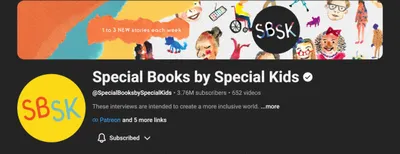
Screenshot: 'Special Books by Special Kids' YouTube channel page (youtube.com/@SpecialBooksbySpecialKids), accessed August 2, 2026.
issue #245 of brennan.day
SBSK is The Most Important Channel on YouTube
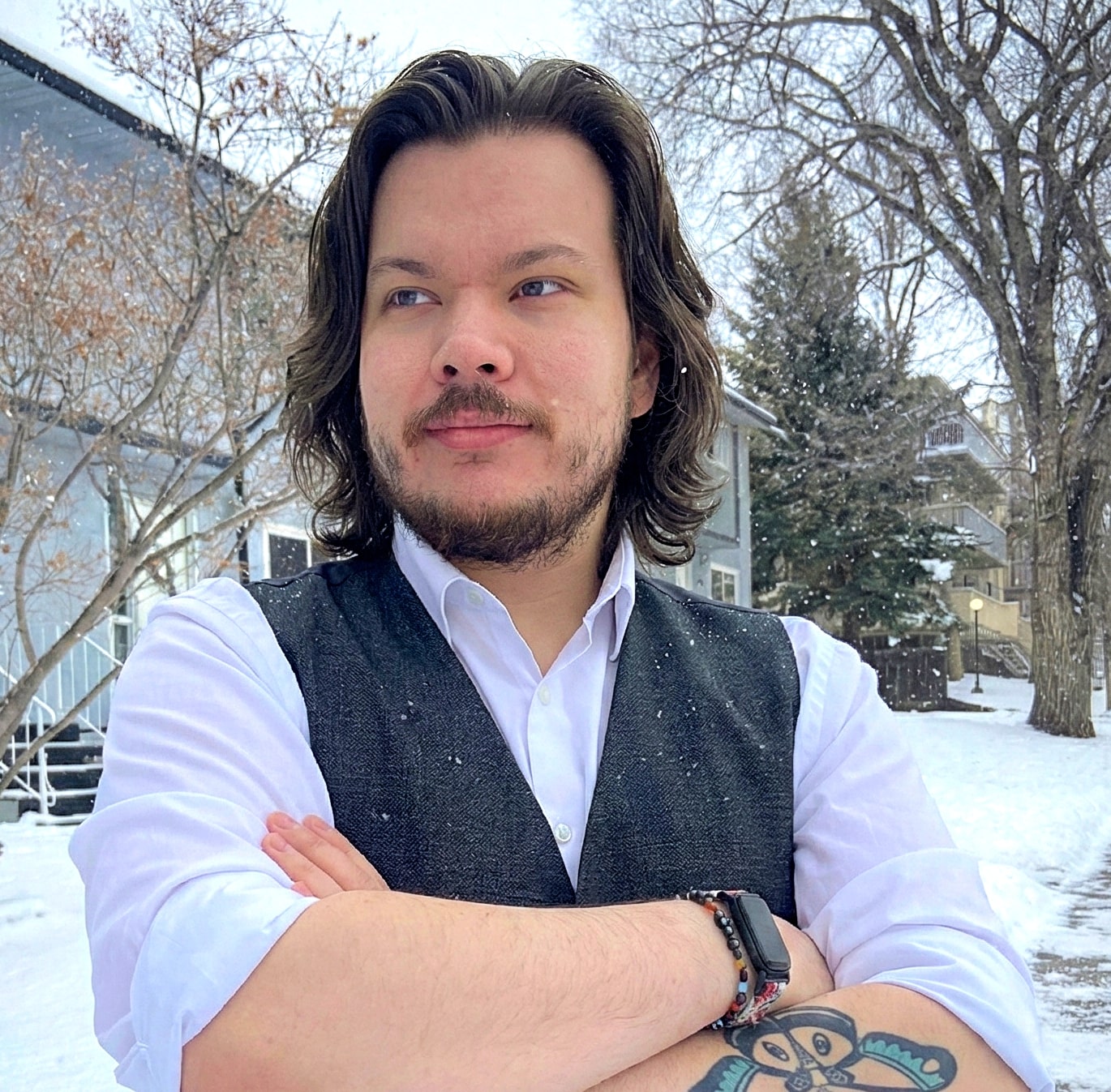
brennan.day — issue #245
Publisher: Brennan Kenneth Brown
Place of publication: Calgary, Alberta, Canada
Available at: https://brennan.day
Contact: mail@brennanbrown.ca
I love YouTube, I confess I love watching dozens, if not hundreds, of channels regularly. Despite its many flaws, and the numerous qualms and criticisms you could have with its parent company, it has been a beacon of creativity and connection for endless amounts of subcultures.
But if I had to choose a single channel that I would deem the most important and meaningful? I have an answer instantly and without hesitation: Special Books for Special Kids.
Why? Good question. If you aren't already aware, the premise of the channel is rather simple: Special Books by Special Kids (SBSK) is a non-profit dedicated to creating long-form interview videos to share the stories of neurodiverse individuals and people living with disabilities, with the mission of creating "a more inclusive world."
Chris Ulmer and his wife Alyssa Porter have devoted their lives to interviewing a wide range of diverse people with mental and physical disabilities and differences. His channel allows those who are often marginalized by society—and those who go ignored, unseen, and uncared for—to have a voice and a platform. Ulmer sits with the interviewee, and often their family as well, and listens compassionately to their story and what they want to share and offer the world.
Origins
Chris Ulmer studied media effects/communications at Penn State and earned a master's in special education from the University of the Cumberlands in Kentucky while student teaching, then moved to Jacksonville, Florida, where he'd been offered a free special-ed degree in exchange for coaching soccer. He began teaching students ages 7–10 with autism, agenesis of the corpus callosum, and traumatic brain injury.
Ulmer taught the same group of seven students for three years, and in that third year, around 2015, he and the students' families decided to collaborate on a book. Each student would get a chapter describing life from their own perspective. The goal was for the students to become self-advocates and storytellers.
The proposal was turned down 50 times. No publisher wanted it. Rather than give up, though, Ulmer started filming short interviews with his students on his phone and posting them to a new Facebook page, initially just to let the local community see the students' progress.
In December 2015, Ulmer got a call from an ABC News producer, and a segment on his classroom's morning routine aired on ABC World News, becoming one of the most-viewed videos of that year with hundreds of millions of views in a week. The SBSK Facebook page jumped from a few thousand followers to 150,000 within days.
That flood of attention brought emails from disabled people around the world asking to be interviewed too—which is how SBSK expanded beyond Ulmer's own classroom.
In the decade since, SBSK has grown to a large channel, with over 3 million subscribers. While Ulmer is in front of the camera most often, the channel is equally carried by Alyssa Porter, Ulmer's wife and SBSK's co-director/executive director, who handles the organization's business and operations side while Ulmer conducts the interviews.
In March 2019, YouTube disabled comments on dozens of SBSK videos as part of a platform-wide policy meant to reduce predatory behaviour in comment sections. This was detrimental for SBSK, whose entire model runs on two-way connection comments facilitate. Ulmer pushed back publicly, arguing that the comments are the mechanism through which strangers told an isolated kid with a rare diagnosis that they weren't alone, or told a family they weren't the only ones going through this. Thankfully, this decision was reversed, but it took two entire years.
SBSK's Impact
Lucas Hanson is a young writer with Myotubular Myopathy who keeps a personal blog, Handsome Boy Writes, and wrote a first-person post titled "What it's like to be on SBSK" shortly after his interview aired in May 2023. A teacher from his elementary school connected his family with SBSK, and he writes that "Chris and his partner stayed for a long time and the interview went really well," and that Ulmer "asked very open-ended questions."
Nathan and Bennett Falcone are brothers with mandibuloacral dysplasia (a form of progeria) from the Philadelphia area, profiled at length in The Philadelphia Citizen's feature on Ulmer. Their SBSK interview indirectly led to a meet-and-greet with the Philadelphia Eagles during the team's Super Bowl LII run, an example of how visibility from the channel has changed people's lives.
Kayne Finley, a Kentucky/Florida teen with an inoperable DIPG brain tumor, became one of the channel's best-known recurring subjects through a seven-episode arc before his passing in November 2017. His own words from his SBSK interview are preserved on his family's foundation site, Cannonballs.org, including his line "Just PRAY. I don't have anything that I want because I can do that when I'm better. I just want to get better." His obituary credits SBSK with spreading his story. Ulmer later returned to interview Kayne's family about grief two years after his passing.
If you're interested in learning about more interviewees, then I can't recommend watching the videos on SBSK's channel more. They do far more justice to the people being interviewed than I ever could in my writing here.
...But Chris Ulmer is Not a Saint
One of the most important things Ulmer has stated publicly is this: he is not a saint. He rejects the idea that the work he does is extraordinary, what he does anybody can do. And I completely agree.
Calling him a saint for treating disabled people with dignity only reinforces the idea that basic respect is unusual or heroic, rather than something every person deserves and every person is easily capable of giving.
Ulmer breaks his approach down into three simple, universal beliefs:
-
Radical equality: “Every person on earth is my equal. I am better than no one and no one is better than me.” This applies to children who deserve equal respect as people, and adults whose behaviour is often shaped by unseen trauma.
-
Unconditional positive regard: Every person deserves respect, kindness, patience, and non-judgmental communication, regardless of how they look, speak, or act—as long as they aren’t harming others.
-
All communication is valid: A nonverbal child’s smile carries the same weight as a deep verbal conversation. Meaning isn’t dependent on conventional expression.
The practical outcome, he says, is learning to be fully present. Putting down your phone, stopping the mental rehearsal of what you’ll say next, and just being there and listening.
The world doesn’t become kinder through a few extraordinary saints, it becomes kinder when ordinary people choose to treat everyone they meet with humanity.
Ulmer's work is not the work of a heroic saviour. He is not attempting to flatten and compress the lives and stories of the disabled for the nondisabled to feel good about. No, the past decade of SBSK demonstrates a sincere effort towards listening and platforming. Towards equity, accessibility, and inclusion. Ulmer and Porter are doing incredibly important work, but it is work anybody can do who is unafraid to give their compassion and love to the world unconditionally.
Comments
To comment, please sign in with your website:
How it works: Enter your website URL. IndieLogin checks your rel="me" links on GitHub, GitLab, Codeberg, and email. Setup instructions.
Signed in as:
No comments yet. Be the first to share your thoughts!