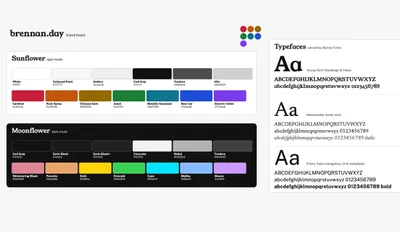
The brand board of the new design for my independent publication, Brennan.day going over the new custom colour palettes as well as the typefaces. (created by the Author)
issue #295 of brennan.day
A New Design: Tradition, Rituals, and Astrology
brennan.day — issue #295
Publisher: Brennan Kenneth Brown
Place of publication: Calgary, Alberta, Canada
Available at: https://brennan.day
Contact: mail@brennanbrown.ca
Those of you that visit my website, rather than reading my writing via RSS, will notice that I've updated the colour scheme and fonts used for the first time since I began my blog Brennan.day, last November.
I have had a deep affection for the gruvbox colour scheme I've been using—it's easy on the eyes and gives a rather cozy feeling. But something compelled me to ditch the muted browns and yellows to go with a stark greyscale of black and white, the rainbow now a custom palette I made myself called Moonflower.
Similarly, I changed from the wonderful and speedy modern font stack to three different fonts hosted by the privacy-respecting, GDPR-friendly Bunny Fonts:
- Public Sans for navigation, UI, and metadata.
- Newsreader as the serif for body text.
- Young Serif for headers and titles.
The reason for this change is the same as the update in colours—I was looking for a design for my website that, for lack of a better word, felt more serious and traditional. In fact, I wanted to wait until a specific time to make the change, like my blog's 1-year anniversary, or whenever I achieve #100DaysToOffload for the third time.
Why? Good question. Despite my progressive views and rather laissez-faire attitude, there's something I deeply appreciate about tradition. Let me be specific about what I mean by that: I mean I believe that there are certain things in life that have a serious weight and gravity that ought to be duly respected. The sacredness of ceremony and ritual. Ranging from the Indigenous practice of smudging and burning sage and sweetgrass in my abalone shell, to the joyful act of celebrating birthdays.
I think tradition is regarded as a vehicle to ensure authority is obeyed, and that an argument can be made that no particular act or day of the year is more important or meaningful than another. That it's all arbitrary and self-imposed. In The Invention of Tradition, Eric Hobsbawm and Terence Ranger wrote how many of the customs we assume are ancient, such as Welsh and Scottish national culture or the elaborate rituals of the British monarchy, were invented or elaborated only in the last couple of centuries.
But, really, I think this idea of everything being profane takes just as much faith and belief.
Émile Durkheim argued in The Elementary Forms of Religious Life that the feeling of two worlds, sacred and profane, comes from the contrast between rare, intense gatherings and long stretches of scattered everyday life. The sacred is something a community makes when it comes together, a feeling he called collective effervescence, turning ordinary objects and people into sacred symbols.
In Wittgenstein's remarks on Frazer's Golden Bough, he objected to treating ritual as bad science. People performing ritual aren't attempting to manipulate cause and effect. The ritual is closer to a grammar of gestures. Like kissing a photograph of someone you love. Ritual comes from a need to celebrate whatever we find full of value.
G.K. Chesterton, who I've written about before, wrote in The Ethics of Elfland that tradition is democracy extended through time, trusting a consensus of common human voices over the isolated, arbitrary record. "The democracy of the dead."
Thiền monk and activist Thich Nhat Hanh's meditation on interbeing asks you to look at a sheet of paper, and see the cloud in it. Without the cloud there is no rain, without rain no trees, and without trees no paper. The paper is part of our perception, so we are in it as well. Nothing is standing alone, including the one doing the perceiving.
Similarly, one of the earliest meditations I learned when I was practicing Buddhism as a teenager was to attempt to describe a flower without using any of my five senses: no sight, smell, touch, taste, or sound. No colour, no scent, no softness of petal, no shape. You quickly realize it's an impossible ask. We rely on the subjective, lossy interpretation of a reality we can never fully understand. The flower, like all else, is an illusion.
Our entire life depends on us having faith in these senses, of having faith in this reality and our interpretation of it. And so I believe we lend ourselves to surrender and reverence, at the very least as an act of humility.
I like to think about how the prisoners in Plato's Cave would be watching the shadows together—surely they'd eventually give the shadows names, they would share a misunderstanding, and maybe there would be solace there. None of us can step outside our senses to check whether anything is truly sacred or profane. We will never be able to verify the sacred from the dark. This is what unites all of us. We are all groping for something in the dark, and we are all watching the shadows dance on the cave wall. Together. To have something we agree is sacred—to have a shared language and appreciation for something beyond the materials of our senses, there is a wisdom there.
Year of the Fire Horse
I am not somebody that "believes" in Astrology, or Tarot, but I find the practice to still be incredibly interesting and helpful. Not in futures becoming known or in their fixed characteristics, but in the interpretation itself.
Let me tell you a story from the stars. In 1966, Japan's birth rate dropped by about 25% during the Year of the Fire Horse (Hinoe-uma) because of an old superstition that women born that year had fiery tempers and would bring bad fortune or death to their husbands. According to sociologist Kikkawa Tōru in Nippon.com, a malicious rumour spread in the early Edo period, through puppet theatre and popular books, that women born in a Fire Horse year were hot-tempered and would devour their husbands. It was tied to the story of Yaoya Oshichi, born in a Fire Horse year, who committed arson in hopes of seeing the man she loved. Births fell from 1.82 million in 1965 to 1.36 million in 1966, then rebounded to 1.94 million in 1967.
It has been sixty years since then, and the astrology has once again aligned. This is the year of the Fire Horse. Thankfully, people have come to their senses and the superstition hasn't caused a steep drop in births this year like it did six decades ago. Japan Research Institute's Takumi Fujinami found January 2026 births up 0.5% year over year, with no Fire Horse effect. A December 2025 survey found about 80% of mothers knew of the superstition, but 76% said they didn't care.
What comes next year? The year of the Red Goat, the Fire Sheep, or Ram. The Fire Sheep is gentle-natured, but willing to take a stand when provoked, and capable and decisive, but also somewhat careless and reckless. They're honest, upright and frank, tending to be natural storytellers. I like to imagine this as a good omen for 2027, of a being both tender and brave in the face of what is to come.
I was born in April of 1996, I am a Fire Rat. Fire Rats are bolder and more outgoing than other Rats, with big ambitions and a talent for persuading people. The downsides are impatience, impulsiveness, and a tendency to burn out and start more than they finish.
Funnily enough, the Rat is the first animal of the Chinese Zodiac, and I am also the first animal in the Western Zodiac, the Ram Aries. Not only that, but the Ram is a fire sign too, ruled by Mars and cardinal. By chance, both signs describe bold, quick-moving ambition. Both warn about impulsiveness and burning out.
Beyond that, the Rat sits directly opposite the Horse in the Chinese Zodiac, so Rats "clash" with the Fire Horse year we're in now. The diametric opposition is thought to bring on a turbulent year for us rats, with advice to be careful about big changes and to look after your health.
And yet, this has easily been the best year of my life.
What the year gave me was the opportunity to look closely, to learn where the story came from, and—at this very moment—to sit down and write this. That is what ritual and tradition do. They give us a story and frame around spans of time, reminding us of what matters, and to pay attention.
Which brings me back to my redesign, of transitioning to greyscale with old-style serif headers. It sounds silly, but it's a small ceremony for me. To say my space of writing deserves weight and gravity. It's arbitrary, and I choose it despite that. That's all tradition is. I named my new palette after a flower I can't describe without the illusions of my senses.
Next year is the Fire Sheep, the Ram in some tellings, which is my sign here in the west. Tender and brave are good things to be try to be, regardless of who (or what) is asking it of you.
Comments
To comment, please sign in with your website:
How it works: Enter your website URL. IndieLogin checks your rel="me" links on GitHub, GitLab, Codeberg, and email. Setup instructions.
Signed in as: