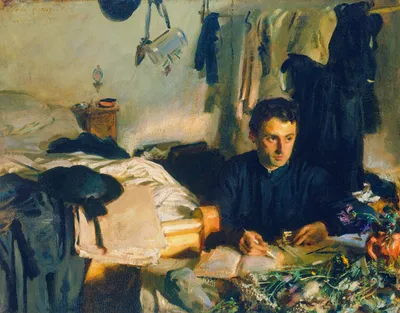
'Padre Sebastiano' by John Singer Sargent, ca. 1904–1906. Original from The MET Museum. | Rawpixel (edited by the Author)
issue #208 of brennan.day
COMPULSION: The Writers Who Wrote The Most in History

brennan.day — issue #208
Publisher: Brennan Kenneth Brown
Place of publication: Calgary, Alberta, Canada
Available at: https://brennan.day
Contact: mail@brennanbrown.ca
As regular readers of my blog know well, I enjoy navel-gazing and writing about writing. I consider myself a specimen of curiosity just as I do any other topic I write about.
Being someone who has decided to write so frequently and publicly, I've gone over the throughlines and various thesis topics I've discovered I gravitate towards, I've gone over my workflow from idea to publishing, I've gone over how each day of writing is both a wishing paper crane and message in a bottle I'm sending out.
There are mornings I sit down at this desk and mechanical keyboard and I don't know what I'm about to write. I just know that, by the time I stand up in an hour or so, there will be roughly 2,000 more words on brennan.day than there were the hour previous. And tomorrow, there's a good chance that there will be another 2,000 words, and then the day after that.
This has been going on for, give or take, seven months now. Over 430,000 words on this blog, posting nearly every day. In this process, a second skeleton has been built underneath my first. Created out of the marrow of compulsion to keep writing things down in public.
At this point, there isn't an option.
The difference between a writer and an aspiring writer is not knowledge, talent, merit, or anything like that. It is the act of writing. And so I've decided to take a look at other writers throughout history who have had it even worse than me. Writers who have an even more eyebrow-raising output.
Most of these writers history keeps as a cautionary curiosity—can you believe how much that author produced?—as though volume were a circus trick instead of the entire shape of a life.
I went looking for what shape their mornings had. Their tea and typewriters. Their guilt and how their bodies gave out underneath of them. I researched because I wanted to know what it looked like, hour by hour, to be so compelled to write.
The Dictating Giant
I'll start with G.K. Chesterton, who wrote around 80 books, hundreds of poems, 200 short stories, and roughly 4,000 newspaper essays. The American Chesterton Society points out is equivalent to writing an essay per day for eleven years straight. He did this while being a rather chaotic person—Chesterton stood at 6"4 and nearly 300 pounds, perpetually late. He once telegrammed his wife from the wrong city to ask where he was actually supposed to be. While he couldn't be trusted to find the right train platform, he certainly could be trusted to write.
His schedule was to rise late, dictate to a secretary for a couple of hours before lunch, attend to business, take a walk, dictate again in the afternoon, and then work alone late into the night, well after everyone else had stopped. The public, cigar-smoking version of Chesterton holding court in restaurants and train stations was real, sure. But so was the private Chesterton compulsively writing at his desk at midnight, fully unwilling to be done.
His secretary, Dorothy Collins, was who actually wrote out everything he dictated, and became a sort of surrogate daughter to him. Collins was present for the many hours of dictations and went on to manage his entire literary estate after he died in 1936.
Chesterton's entire body on Thomistic philosophy reportedly began with him skimming the top book of a stack Collins checked out of the library, and then he simply started to talk. No outline or second pass, just trust in the engine. The resulting book on Aquinas is regarded as one of the best, according to actual Thomistic scholars.
Sometimes the fast, undisciplined draft is the real thing. But it certainly takes thousands of attempts to get to a place where that's a possibility.
The Romance Machine
Corin Tellado published more than 4,000 novels and sold over 400 million copies, mostly under a contract with Spanish publisher Bruguera, which obligated her to deliver a 76-page novel every single week for years. Tellado did not have the luxury of waiting for inspiration, as she was running a small industrial operation out of her typewriter. She was writing while under Franco-era censorship, which made the eroticism the romance genre is known for completely forbidden. And she turned that constraint into a craft, later saying the rejected drafts taught her "to suggest more than to explicitly show". She made technique out of the limitations of what she was allowed to write. Romantic lemonade out of banned erotic lemons, if you will.
Tellado is quoted as saying that she'll only stop writing when her "head falls on the typewriter". That's a person who has fused her identity so completely with the act of writing that retirement and death have intertwined.
The Man Writing Plays Before Breakfast
Lope de Vega was a playwright-poet in Spain's Golden Age, claiming an average output of around twenty sheets per day across his entire writing life. He's credited, both by his own count and his first biographer's, with anywhere between 800 to 1,800 plays. Of which we sadly only have the texts of a few hundred.
More than a hundred of these plays, he boasted, were written and staged within a 24-hour timespan. Cervantes, author of Don Quixote and his contemporary and frequent rival, called him "the prodigy of nature."
Lope de Vega's speed wasn't separate from his innovation, it produced the innovation. He didn't have the time to honour the classical unities of exactly "one setting, one day, one plot," which the Aristotelian purists of his day were hung up on. He threw them out and invented the three-act comedia nueva, mixed comedy with tragedy, gave the women he wrote interiority and agency, and wrote in the language ordinary people actually spoke instead of the high style which the academy demanded. The deadline wasn't the enemy of the form, no, the deadline was the form. Four hundred years later, Telenovelas still run on his DNA.
The Novel Factory
Alexandre Dumas published hundreds of volumes under his own name, but it was an open secret of 19th century Paris that he didn't write most of them alone. His chief collaborator was a quiet, methodical former history teacher named Auguste Maquet, who would spend weeks in the reading rooms of the royal library, pulling memoirs, court records, and diplomatic correspondence for the historical setting Dumas had chosen, then Maquet would sketch out a full chapter outline and write the first draft of every scene.
Dumas would then take these drafts in batches of ten or fifteen chapters and rewrite them, adding the dialogue and colour and momentum that turned them from competent, historical fiction into the classic works The Three Musketeers and The Count of Monte Cristo which are immortalized today.
At his peak, Dumas is said to have run something close to 73 collaborators through this process at various points. A contemporary pamphleteer published a libelous tract in 1845 titled Fabrique de Romans: Maison Alexandre Dumas et Cie, translating to "Novel Factory: The House of Alexandre Dumas and Company." Dumas sued for libel and won. Nobody, including Maquet, disputed the facts underneath the claims.
Maquet, for his part, eventually sued Dumas in 1858 for co-authorship credit and unpaid royalties. The judge sided with the man whose name was on the contract.
The factory of Dumas produced masterpieces, and it ran on a man who did the actual archival labour and research and went home with a couple francs instead of his name on the spine. The output was real even if the proper credit wasn't there.
Fifty Cups and the Dominican's Hood
Honoré de Balzac started his day writing at 2AM dressed in the white hood of a Dominican monk, working until noon on nothing but an apparently bottomless coffee pot, fueled along the way by as many as fifty cups of thick Turkish-style coffee a day. Sometimes that wasn't even enough, and he would be eating the raw grounds straight.
This claim is repeated often, but can only be traced back to a self-published vocabulary book from 2004 rather than anything Balzac himself wrote down. What he did write down, in an essay called "The Pleasures and Pains of Coffee," is that the drug caffeine was "a great power in my life," and that it demanded a victim.
Legend or not, Balzac wrote around 90 novels, plays, and stories before dying at 51 of heart failure. He was overweight, sleepless, and still hunting down his preferred blend of Bourbon, Martinique, and Yemeni Moka beans from three different shops on three different Paris streets up until the end. Whether or not the fifty cups are real, the appetite clearly was.
The 8-Day Fevers of Georges Simenon
Georges Simenon wrote roughly 200 novels under his own name, and well over a thousand more under sixteen different pseudonyms. He prepped each novel like a ritual: character names and biographical details scrawled on a manila envelope, a checkup with his doctor to confirm his body could handle the strain, a "Do Not Disturb" sign on the office door, the same checked Abercrombie & Fitch sports shirt worn unwashed and sweat-soaked until the book was finished.
Then five hours a day, roughly 92 words a minute, no dictionary, no looking back, an eighty-page chapter finished by mid-morning, his sweat-drenched shirt handed off to be laundered only once the whole manuscript shipped to the publisher. He marked off the days on a calendar in heavy crayon. Eight to write, three to revise.
And then he'd stop, not because the muse ran dry but because the body simply refused. "I write fast because I have not the brains to write slow", is what he said. It became almost unbearable after five or six days inside a character's skin, and by the eleventh day he simply couldn't anymore, because it became physical. The vertigo and exhaustion ended his writing career for good in his 70s; he unplugged his typewriter and changed his passport occupation from homme de lettres to sans profession. Barbara Cartland solved the same friction differently, by dictating from a chaise lounge in a pink office instead of typing it herself, racking up 723 novels without physically writing most of them. Two different solutions to the same problem: the mind apparently never runs out. The hands do.
The Grind in a Dim Room, Live
The last compulsive writer I want to talk about is not a single writer, but an entire industry on the other side of the world most in the West are unaware of. Wǎngwén is the name for China's web fiction industry, which has more than 20 million full-time, part-time, and casual writers serializing daily to roughly half a billion readers. This is Tellado's industrial model running at internet speed, with the readers watching in real time.
Jin Zhao, reporting for The China Project (which I really recommend for a deeper reading on this), introduced a writer who goes by Jue: a 26-year-old in northwestern China who fell into web fiction writing after a broken leg ended his career plans, and he now earns his living on the platform Qidian writing time-travel historical fiction.
So long as he hits 10,000 words a day.
On a good day, he can do that in two and a half hours, racing against writer friends in a practice they call pīnzì, "linking words," a competitive sprint where strangers log on together just to out-pace each other into productivity.
On a bad day, the same 10,000 words eat the whole day. There's no such thing as a day off when you're serializing; the only way to rest is to write enough buffer in advance to afford it. And the devotion runs deeper than any one writer's grind. The article also mentions Tang Jia San Shao, China's highest-earning web author, who is said to have written every single day since 2008, the only exception being his first wife's terminal illness and mourning her death.
The man who wrote Against the Gods, one of the most-read xianxia novels ever translated into English, publishes under the pen name Mars Gravity, 火星引力. He has a story in the Chinese-language corners of the Internet that needs to be known by all writers, I think.
According to an interview archived on Baidu Baike, his very first novel was rejected twice by Qidian's editors, both times with the same form-letter line: thanks, but your work hasn't met our standard for a contract. Many writers quit at this point of rejection, but he decided, instead, to release the whole thing for free rather than fight for a paywall slot. He started holding himself to a quota of 6,000 words a day, treating the entire million-and-a-half word project as practice for whatever he would be writing next.
Partway through, censors blocked the novel twice for content that brushed too closely to the platform's shifting decency rules. The second time, his readers revolted on his behalf, flooding Qidian's customer service channels with complaints for two solid days and nights until Gravity gave up the platform entirely and carried the unfinished manuscript onto rival site Zongheng instead. For he didn't want to disappoint the people who had stayed with him that long. He said there were too many threads he'd planted early on that he refused to cut.
Gravity used a pirated copy of forced word-count software, one of the many apps built to lock a writer's screen until they've typed enough. Like many of us, he got distracted by browser tabs and chat windows, and promised his readers three updates a day at a typing speed that simply couldn't deliver on that with willpower alone.
One night, he accidentally set the timer to 400 minutes, and there was no way to force-quit once it started. The clock itself wouldn't advance unless he was actively typing, and copy-and-pasting didn't count. He described the next six-and-a-half hours as worse than death. He bought a properly licensed copy the next morning, mostly so that future version of himself would have an exit button.
The numbers involved in this industry are hard to hold in your head. The single longest-running novel on Qidian has passed 41 million characters and is still updating daily. For comparison: a Chinese translation of War and Peace runs about 1.25 million characters.
This output, unsurprisingly, comes at a cost. Jue's own back muscle fibres tore from years at the keyboard, and he lists off tenosynovitis, frozen shoulders, spondylosis like an occupational hazard sheet. Less than 1% of writers on these platforms earn what most of us would consider a living wage from it. The ones who do make money are called, only half-ironically, "deities." Most of the rest are described by an industry veteran, without much sentimentality, as cannon fodder.
And yet, after everything, after readers who once bullied him into abandoning a character pairing and the fucked up back and the unfair contract, Jue said simply that he "writes novels that he likes," maintaining his artistic integrity and joy in the face of the industrial machine grinding down countless others.
The Grind's Purpose?
Could you be this kind of writer? Chesterton dictating past midnight. Tellado at the typewriter until her head falls onto the keys. Jue, racing his friends through another 10,000 words with a torn back. Mars Gravity typing his way out of 400 minutes he never meant to set. Simenon, sweating through the same shirt for the eleventh straight day.
None of them, I think, would tell you they were happy during those hours. But the repetition, the loop, the showing-up, the ritual? All were non-negotiable with who they were. That's different from, say, hustle. Hustle is instrumental; you grind because of what's on the other side of it.
What I'm describing in these writers is closer to what Zen practice calls "just this." The act is the point, not a means to one. The default mode network, the wandering, undirected part of your brain firing when you're not focused on a task, does the best integrative work during repetitive, low-stakes routine. Maybe that's the secular explanation for why Simenon needed the same shirt and Tellado needed the same chair.
I am also a compulsive writer, though I'm nowhere near producing at the level of output nor merit of the writers I've collected and shared here. I am often grinding out essays I'm not entirely sure of, but that are written and published anyways because the loop demands feeding. There is no real contract here for me. On the IndieWeb, I'm writing for a small, human, accountable network instead of for a publisher or algorithm. I'm writing into a relationship instead of into a quote. Keeping the byline and the hand attached to the same person.
Chesterton dictated to a person who loved him enough to spend the rest of her life managing what he made. Simenon's wife managed his contracts from the next room while he sweated through chapters. Tang Jia San Shao wrote every day for over a decade and a half, except for the handful of weeks of his devotion to his dying wife, and then to her memory. Even Jue, grinding through his contracted quota, still found his way back to writing "novels that I like."
Underneath all of these writers of absurd output numbers is the same stubborn fact: somebody showed up daily to the same blank page, not because the page demanded it but because they did. The volume is not the point. The showing up is. The past few weeks, I've noticed my cadence slowing down a bit, and I'm not anxious or upset about that. Because I'm still consistently showing up and writing. Twenty sheets a day, or 2,000 words, or one essay every single day for eleven straight years. These are all just what devotion looks like when you measure it in a unit a publisher, or a platform, or a court, can count.
I don't know if I'll still be doing this in ten years. I don't know if any of it is good, in the way Tellado's editors meant good or the way Cervantes meant it when he called Lope a prodigy of nature. But I know the not-writing feels worse than the writing, and apparently that's been true of every obsessive scribbler since at least the Spanish Golden Age, and there's something comforting in that lineage. We're not well, certainly. But we're not alone, either.
Comments
To comment, please sign in with your website:
How it works: Enter your website URL. IndieLogin checks your rel="me" links on GitHub, GitLab, Codeberg, and email. Setup instructions.
Signed in as:
No comments yet. Be the first to share your thoughts!