All Collections

Religion

Essays on faith, spirituality, religious traditions, and the search for meaning.

8 posts
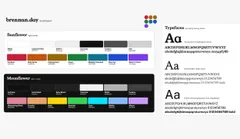
Brand board for brennan.day showing two colour palettes and three typefaces. The 'Sunflower' light-mode palette lists neutrals White, Cultured Pearl, Gallery, Cod Gray, Tundora, and Alto, plus accents Cardinal (red), Rock Spray (orange), Chelsea Gem (olive/gold), Jewel (green), Metallic Seaweed (teal), New Car (blue), and Electric Violet (purple), each with hex codes. The 'Moonflower' dark-mode palette lists neutrals Cod Gray, Eerie Black, Eerie Black+, Concrete, Nobel, and Tundora, plus accents Shimmering Blush (pink), Porsche (orange), Gold, Emerald (green), Cyan, Malibu (light blue), and Mauve (purple), each with hex codes. To the right, three typefaces show sample uppercase, lowercase, and numeral glyphs: Young Serif for headings and titles, Newsreader (with italic) for body text, and Public Sans (with bold) for navigation, UI, and metadata. All served by Bunny Fonts.

A New Design: Tradition, Rituals, and Astrology

#295

Why I redesigned the blog—trading gruvbox for greyscale and 'Moonflower' palette and Bunny-hosted serifs—as a small ceremony to give my writing weight and gravity. On tradition and ritual as a grammar of gestures and the shared shadows of Plato's Cave. Plus, the Year of the Fire Horse—Japan's 1966 birth-rate collapse, my own Fire Rat clashing with the year, and next year's Fire Sheep as a tender, brave omen.
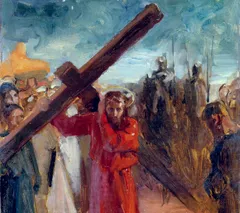
Oil painting of Christ carrying the cross, wearing a crimson robe and crown of thorns, a thin gold halo around his head. He looks directly out at the viewer while gripping the crossbeam with both raised arms. Loosely painted figures crowd around him—bystanders in white and blue robes to the left, mounted soldiers with spears silhouetted against a pale blue sky to the right. Visible, expressive brushwork throughout; no fine detail in the faces or background figures.

It's Christlike to Love Immigrants and Transfolk

#283

Responding to readers who invoke Christianity to defend exclusion, I argue that the Gospels consistently welcome lepers, foreigners, sinners, and gender-nonconforming people while reserving the strongest warnings for the wealthy and powerful. On the Christlike call to love immigrants and trans people, and why compassion cannot be rationed by politics.
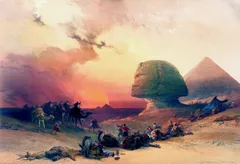
A historical-style painting of a desert landscape at sunset, with the Great Sphinx of Giza and a pyramid in the background. A group of travelers and camels crosses the desert while several people and camels lie or rest in the foreground. The sky is filled with warm pink, orange, and golden clouds, creating a dramatic atmosphere.

A Story of the Origins of Religion

#256

On Friedrich Max Müller's theory of naturism and how early religion began with humanity's direct sensory perception of natural forces. From the terrifying awe of lightning and thunder to Ancient Egypt's animal deities that protected against mortal dangers like crocodiles, scorpions, and hippos. A look at the evolutionary arc from zoolatry to anthropomorphic gods, and the problematic colonial baggage in early religious scholarship.
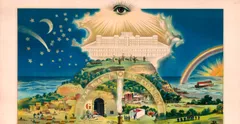
A chromolithograph Masonic certificate depicting a layered allegorical landscape. At the top, the All-Seeing Eye radiates light from within a sunburst above a celestial temple building. Below it, a hilltop scene shows knights and horses beneath a starry night sky on the left and a rainbow with a rising sun on the right. In the centre, an arched inscription reads 'I Am That I Am. Exod. III:4,' framing a gateway marked with Masonic symbols including the letter G and Alpha and Omega. The surrounding landscape includes biblical scenes: workers building structures at lower left, Noah's Ark on floodwaters at right, and the Tabernacle in the distance. Blank lines throughout indicate spaces for a member's name and dates to be filled in.

Manifestation, the Law of Attraction, Cancer and Abuse

#188

Examining the dark side of manifestation and Law of Attraction movement: its New Thought origins, cultural appropriation of Eastern and Indigenous practices, gender dynamics, and the hidden cruelty of victim blaming cancer survivors and abuse victims.
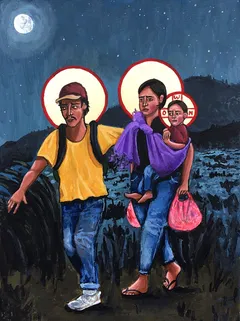
A painting depicting a family of three traveling at night through dark terrain under a moonlit, star-scattered sky. On the left, a man in a yellow t-shirt, jeans, and white sneakers carries a backpack and looks back over his shoulder with an expression of watchful urgency. Beside him, a woman in jeans and sandals carries a young child on her back in a purple wrap and holds a pink plastic bag in her hand; both she and the child look directly at the viewer with solemn, steady expressions. All three figures are crowned with Byzantine-style halos, golden circles rimmed in red, aligning the family visually with sacred iconography. Dark hills rise in the background. The painting's style blends folk art and religious icon traditions.

How and Why I Believe in God: The Ballad of Tragic Theism

#165

My testimony, from Dawkins on an iPod Shuffle down a back alley, through Buddhist libraries and a children's hospice, to Matthew's Gospel in a break room chair. My case for tragic theism: a God who creates, risks, makes mistakes, grieves them, and does not stop.
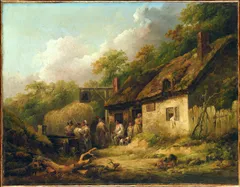
Oil painting of a rustic countryside inn scene. A thatched-roof whitewashed cottage with two brick chimneys serves as a wayside inn, identified by a hanging bell sign on a wooden post. Several figures in 18th-century rural clothing gather outside — some standing and conversing near a haycart, others seated by the inn's entrance with a dog. A wooded hillside rises behind the building under a partly cloudy sky. A small stream or puddle is visible in the foreground. The painter's signature appears in the lower right corner.

Earning My Keep

#156

On the poets who found different terrors inside the phrase 'earn my keep'—Jeong Ho-Seung, Brecht, Heather McHugh, Kim Hyesoon—and the theological dispute over whether grace can be deserved, turning thirty in borrowed time, and the nuthatches outside who do not know the feeder was set out for them.
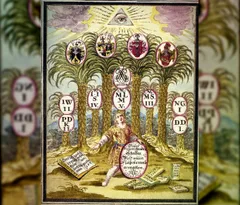
An ornate, hand-colored illustration in an old European style shows a person standing in a grove of stylized palm-like trees, surrounded by symbolic emblems and text. Above, a radiant triangle containing an eye (the “all-seeing eye”) shines through clouds. Each tree bears oval crests and circular plaques with letters, Roman numerals, and heraldic symbols. The central figure gestures outward while holding a shield-shaped panel with decorative script.

STORYTELLING Part Two: The (Literal) Magic of Writing

#144

Grammar/Glamour/Grimoire. 言霊 & heka. Spelling & spellcasting. The Word. Writing is generative, not descriptive. Cultures across millennia have understood that words conjure reality. Writing conjures, symbols activate the brain, serving as telepathy across distance and time.
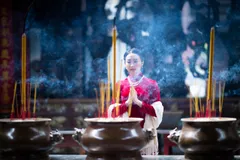
A young woman in traditional red and white Asian attire stands with hands pressed together in prayer position (anjali mudra) at a temple altar. She is centered among three bronze incense burners filled with burning incense sticks, with smoke rising around her. The atmospheric scene shows ornate temple architecture with decorative murals in the blurred background.

More Than One Way: On Ritual, Morality, and the Darkness Beyond Knowing

#91

What is the meaning of life? Is there more than one correct answer? I've decided to take a rather long-winded exploration of how different cultures approach the sacred, the dead, and the transcendent, suggesting that multiple paths can lead to the same fundamental truths.

↑ TOP