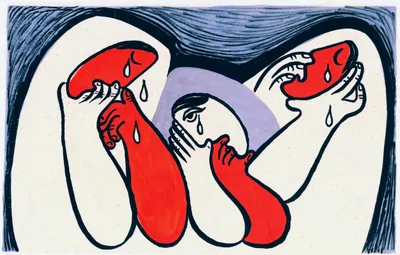
Crying Women by Mikuláš Galanda. 1938. | Web umenia (edited by the Author)
issue #262 of brennan.day
In Defence of Vent Posting

brennan.day — issue #262
Publisher: Brennan Kenneth Brown
Place of publication: Calgary, Alberta, Canada
Available at: https://brennan.day
Contact: mail@brennanbrown.ca
If you've been on the Internet, you've seen someone venting. The act of sharing anger, sadness, grief—usually with vulnerable, personal details.
Almost universally, these get a bad rap. People are often drained, or annoyed, or resentful towards those who vent, and communities go out of their way to prohibit it. Not to pick on 32-bit Café, but they have a detailed section on mental health topics and discussions in their community guidelines:
The 32-Bit Cafe is not a replacement for support groups, therapy, or mental health organizations.
There are excellent arguments against venting that they list, and I'm not trying to change any minds here; however, I do want to write a post in defense of the venters, because I think someone has to.
Something I haven't written about on this blog yet is that I've been a Listener on 7cups for over ten years. I've had text conversations with hundreds of strangers, trying to console and comfort them to the best of my abilities as a layperson crisis support volunteer. The spectrum ranged from people who just needed someone to talk to about minor stresses, and say what they've been harbouring out loud in order to let it go. And on the other end, people who had active dangerous plans they were enacting and that I was not qualified for, nor what the site was intended to handle.
What I learned quickly is that, for the most part, people just want to be seen and heard. To have the immeasurable weight of their burdens and trauma they carry to be a gravity felt by others, no matter how temporarily. People want to know that the intensity of their emotions isn't irrational, or too much.
Psychologist Bernard Rimé studied the social sharing of emotion, between 88% and 96% of emotional experiences get talked about with someone else, usually within hours of happening. It's just something we do. And when someone listens well, the sharing strengthens the bond between people, because the listener's attention and empathy are reflected back to the person who vented, and the venter feels closer to the listener. A related study on friends working through stress together found benefit comes from both parties in the exchange, not from one person tolerating the other. Venting is how we've always regulated emotion. Together instead of alone.
And we are talking about the web, here. #vent channels on Discord have allowed people to "meet their needs for social support via vent channels by receiving commiseration, advice, and validation from the responses of others" according to research done by Kayode Oladeji et. al.
James Pennebaker's research on confiding and expressive writing (which can absolutely include blogging) started as he observed trauma survivors who never told anyone about what happened to them showed worse health outcomes than the ones who did. He built a theory of inhibition arguing that holding back our thoughts and feelings takes a physiological toll similar to chronic stress. Follow-up studies found writing or talking through difficult material caused measurable gains in immune function, including in people suffering from HIV, asthma, and arthritis. How a vent works depends a lot on the person listening. Responding with real empathy, rather than passive sympathy, changes the outcome entirely. The idea that keeping your feelings to yourself is the mature, healthy default is backwards and harmful. Bottling things up has a cost that is sometimes irreversible.
The reason why people end up dumping their emotional baggage and trauma in a one-sided manner, sometimes without even asking first, is because their cup is full. There is simply no more room to hold everything in any longer.
When we aren't privileged enough to be raised in an environment surrounded by emotionally mature, thoughtful people, what do you think happens? Even further, when we are unfortunate enough to be raised surrounded by cruelty or malicious intent instead?
The answer is that we do not vanish. Remarkably, we endure. But we only do so by coming up with mechanisms of defence and survival on our own. And these coping mechanisms are often maladaptive or self-destructive, because what else do we know? There are dozens of ways to mitigate emotional pain, and only a handful are healthy, and the healthy ways typically don't give us the same intensity of catharsis.
Recommending people seek professional, clinical help comes from a privileged assumption that people can afford professional, clinical help—and that they have the time and energy.
Beyond this, certain mental health issues and problems are considered (incorrectly) as "treatment resistant". The frameworks of Western psychology and our pharmaceuticals are just not sufficient for some people.
And I don't think that maladaptive coping mechanisms like emotional dumping are sufficient either, but people need outlets. People need harm reduced. We cannot ask others to start at an acceptable starting point, we must meet others where they actually currently are.
And we need each other, because all we have is each other. Community is not just a group of people, or a setting. Community is a living medicine. You cannot expect the medical industry to do all the hard, difficult work and only deal with tolerable, semi-healed folks. The mind, body, spirit and emotions all need healing and tending to. People need connection to others, as well as language, ceremony, and the land.
Some people simply need to feel loved and understood by people they love, and they will heal. Other people though? Some are just inherently miserable. And I frankly think it's absurd to ostracize people for their inherent demeanour and character. Likewise, I think it's awful that venting is weaponized and moralized by others, as though it's evidence of negative character traits.
Being anti-venting—and being pro-snark or pro-gossip—these too are just other unhealthy modalities of catharsis, and mechanisms for dealing with our own mental health. You are not "better" than someone who vents if you do not. You are not "better" if you have figured out healthier ways to deal with your shit. People are just people. Some of us have lost the ability to look outward, and others to look inward.
If you don't have the capacity to be around people who vent, that's understandable, and it's within your right and similarly good to be able to articulate and express your boundaries. But I'm not one of those people. I would always rather someone vent to me than bottle it up, or far worse, going to a genAI chatbot to vent instead. That's why I've been a volunteer on 7cups for so long.


Comments
To comment, please sign in with your website:
How it works: Enter your website URL. IndieLogin signs you in through your site's IndieAuth server if it has one (e.g. IndieKey), or checks your rel="me" links on GitHub, GitLab, Codeberg, and email. Setup instructions.
Signed in as: