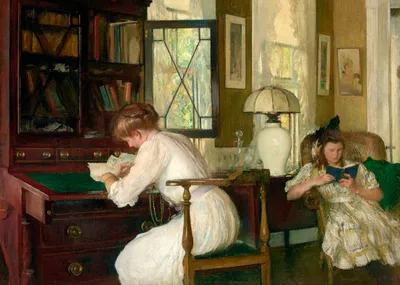
'Josephine and Mercie' by Edmund Tarbell. 1908. | National Gallery of Art (edited by the Author)
issue #222 of brennan.day
There Are People Who Would Give Anything For Your Ability to Read and Write

brennan.day — issue #222
Publisher: Brennan Kenneth Brown
Place of publication: Calgary, Alberta, Canada
Available at: https://brennan.day
Contact: mail@brennanbrown.ca
It's seven in the morning, with the golden hour of the day filled with freshly brewed coffee and the buzzing noise of lawnmowers working before it gets too hot. I'm writing this blog post from my Intel Celeron Vivobook instead of my MacBook Air—it's slower, but sometimes slower is enjoyable. (Not to mention the keyboard is somehow better.)
If you can read this, you're one of the lucky ones. I've touched briefly on literacy rates before, but I think it's important I dedicate a blog post to drive such an important point.
It's easy to take for granted the ability to read and write. It can feel ubiquitous—universal, as though this is a solved problem. It's easy to falsely believe we're all on an even playing field and that other people understand and comprehend the world just as you do.
But this isn't the case. Worldwide, UNESCO estimates that 739 million adults still can't read or write a simple sentence about their own lives, and two-thirds are women. That's a population larger than Europe.
In the United States only 79% of adults are literate, which means one in five—more than 43 million people—struggle with the basics of reading. More than half of American adults read below a sixth-grade level. This is a problem happening everywhere. It's happening down the street, in line at the pharmacy, at the kitchen table where forms need signing tonight.
What does this look like? Well, you can't read a menu, so you order what the person next to you ordered, or you point, or you memorize the shape of a word. You can't read a prescription label, so you guess at "twice daily." Nearly half of patients with limited literacy misinterpret dosage instructions. You don't walk into a public library, because a library is built on the assumption that you want to be surrounded by the very thing you're most ashamed of. You don't vote, or you vote and hope. You rely on your kids to read the mail, which means they know things about your finances and your health before it's too late. Nearly 40% of adults with low literacy report feeling ashamed of it, and some never tell anybody. Not their spouse, not their own children, not anyone.
This is important to bring up for multiple reasons. For starters, being aware this is still a major (if not existential) problem means you can do something about it. You can tutor with organizations like ProLiteracy and your local literacy council will train you; you just need to be patient and available. You can put money or books toward groups like Room to Read or the World Literacy Foundation, who move books and trained teachers into the places with the least of both. If you can, read to kids—a parent's own literacy is one of the single greatest predictors of her children's, and someone has to break that chain. You can advocate for library funding and adult-education budgets, unglamorous line items that keep these programs alive in your city.
Or, smaller than any of that, you can simply stop assuming. Stop assuming the form in front of someone is easy. Stop assuming silence is disinterest instead of fear.
Gratitude
Beyond advocacy, though, I think it is a good place to practice gratitude. My God, we are the lucky ones. We are the ones that made it. We were given the necessary schooling (or maybe had the means to teach ourselves) to imbue ourselves into vast channels of knowledge, of stories in fiction, of poetry. These are no small things.
One of the most famous examples of the power of literacy is Frederick Douglass. He was enslaved as a boy in Baltimore and had his reading lessons cut off the moment his enslaver, Hugh Auld, caught his wife teaching Douglass the alphabet. Auld's reasoning was explicit: an education would ruin a slave for slavery, would make him discontented and unmanageable and worth nothing to his master. So, Douglass built his own curriculum. He traded bread with the poor white children in his neighborhood for reading lessons from those same children on the street, later calling it "that more valuable bread of knowledge." He learned four letters off timber in a shipyard, where planks were marked with abbreviations for their place on the ship, then challenged boys who could out-write him to prove it, harvesting a few more letters every time he lost. He filled in the blank pages of old copybooks and worked his way through a battered Webster's spelling book. By twelve he was reading The Columbian Orator, a book of speeches on liberty, in secret. He was assembling the tools of his own freedom one stolen half-lesson at a time, inside a system engineered to keep that tool out of his hands. If you don't know Douglass, I really encourage you to read more about his life.
That's the kind of hunger we're talking about. That's what this can mean to a person.
To Be a Writer
I want to bring this up because, also, I feel as though being aware of the rare privilege you have changes the perspective of the often-asked question of "what do I write about?"
I encounter many aspiring writers and would-be bloggers who want to write, but don't feel as though they have anything unique or meaningful to contribute—that they don't have stories worth sharing or worth reading.
And I also encounter many people who wonder how I am able to write so frequently and so consistently, and the answer to both of the above questions is the same:
My God, how lucky you are to be able to write at all. I promise there will be an interested reader. And I promise there is a story worth telling because you're a human who's experienced living.
This base sense of gratitude and the urgency created by how fleeting life is a large part of the compulsive drive at play for me. Because not only can you read and write, but you're also alive at a time where there are plenty of tools that make it easy and free to get you writing available to the broader world.
To Be Censored
There are also, right now, places on this earth where writing freely online is itself the crime. Iran spent much of this past winter and spring under a near-total internet blackout, and connectivity dropped to roughly 1% of normal international traffic during the protests. Journalists and human rights documenters described the horror of being cut off not just from the world but from their own country, unable to verify a testimony or publish a single sentence. North Korea doesn't bother with a blackout; it simply doesn't give its 25 million citizens the global Internet to begin with, confined to Kwangmyong, a domestic intranet of a few thousand state-approved pages with no route to anything you or I could search in half a second. And in Afghanistan, it is now official policy that girls are barred from all education past the sixth grade, over 2.2 million girls shut out of school, a restriction that exists nowhere else on the planet. A generation of women growing literate only up to a threshold.
If anything, I think this is the golden reason why you should keep a diary—why you should keep a notebook in your pocket at all times. Not because it'll make you more productive or smarter, but simply because you can. We get so caught up in the busybody, in the dire flames of a near-apocalyptic world. And I totally understand that there are a million problems and that you're most likely burnt out and exhausted, and yet writing is a great way to process and channel and vent our anxiety and dread. A way to connect with others who are feeling the same.
I say often that writing is good medicine, but not everyone is lucky enough to have the means for it. But if you are one of the lucky ones, then it is limitless. It's a free act of mercy towards your own mind.


Comments
To comment, please sign in with your website:
How it works: Enter your website URL. IndieLogin signs you in through your site's IndieAuth server if it has one (e.g. IndieKey), or checks your rel="me" links on GitHub, GitLab, Codeberg, and email. Setup instructions.
Signed in as:
No comments yet. Be the first to share your thoughts!