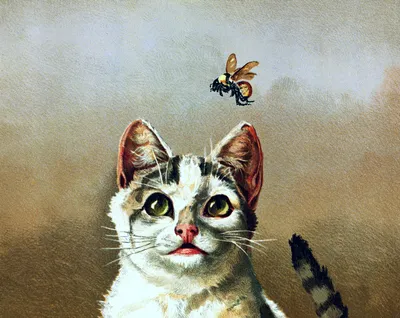
White Cat with Bee by Harry Beard, 1876. Original image from Digital Commonwealth | Rawpixel (edited by the Author)
issue #196 of brennan.day
The Internet Needs More Cross-Pollinators

brennan.day — issue #196
Publisher: Brennan Kenneth Brown
Place of publication: Calgary, Alberta, Canada
Available at: https://brennan.day
Contact: mail@brennanbrown.ca
A few days ago, I launched a silly little web project the same way I have been doing for years. This one was different though, because people cared about it. Or at least, they cared about talking about it.
As I wrote a few days ago, I launched fanfiction.lol, a fork of the open-source repository Archive of Our Own. I decided to post about it on my poetry Tumblr, since the only reason I use Tumblr at all is to post my poetry. And I also blazed the post $10 for fun, which is the Tumblr version of advertising a post.
I've blazed posts in the past, trying to get people interested in my low-cost writing school or my values-driven webdev studio and they got a dozen or so notes. So I naïvely assumed that this project would have a similar fate.
It didn't, it got thousands of notes, and the site got nearly 200 sign-ups so quickly that I exceeded the free plan of my email provider SendGrid—who then blocked me from paying for a monthly plan because their KYC policy meant I needed to send them my identity.
No thanks. I switched to Resend which has a much more generous free tier of 3,000 emails a month. If I exceed that, then I'll freak out and figure out something else.
However, the amount of people talking about my project on Tumblr was far, far higher than the amount of people signing up. I received a lot of negative feedback at first:
"And do you have a legal fund to defend authors?"
"how is this actually different from ao3?"
"There already is a fanfiction website. Wtf"
"1. nothing will replace ao3 2. i feel like you could have at least changed the ui?? the layout is identical"
"Will you be able to host it for 5-10-15-20 years like ao3 does?"
"all of this is somehow weirder and sketchier than ao3 already is"
All because I started a website running in my basement on a 2012 CPU, wow!
It didn't take long for the tides to turn and for the vast majority of people to be kind and defend the site and my choice to start this project, though. The backlash to the backlash, for a thing that's just begun.
But the truth is, I understand the small amount of negative, hostile reaction I got.
When I first encountered SuperLove, before I even met the owner Melo, I could instantly tell it was a fork of AO3 and that, therefore, AO3 must be open-source. I've been a web developer for over a decade, and that kind of thing is intuitive to me.
But if you're someone who's grown up on the siloed corporate social media dystopian landscape of the Internet, and you've never encountered "forks" of projects or people creating websites for the sake of creativity and joy instead of for profit or clout, I can very much understand that upon first glance, it looks as though fanfiction.lol completely stole AO3's design and purpose.
Many people online are skeptical and paranoid of new websites and new ventures on the Internet because, for the past decade, the Internet has only been the oligarchy of Meta, Twitter, Alphabet, and Amazon. Anytime anybody has launched something new, it's been an NFT or crypto rugpull or AI-generated or some other horseshit.
Furthermore, these corporate oligarchs have instilled an idea of irrational platform loyalty and that the Internet is a zero-sum game. That you must dedicate yourself to a particular platform, with a particular subculture, and these other massive sites have their own subculture.
All of this is exactly why I've become such a loud, strong advocate for the IndieWeb. None of this is inherently true. The Internet is supposed to be hundreds of websites, created and owned by people and not massive for-profit companies. Take a look at NeoCities or NekoWeb or BearBlog if you want a few positive examples. There are hundreds, if not thousands of websites on each of these platforms.
And there are thousands more made from scratch just like mine, brennan.day.
All of this is to say we are in desperate need for cross-pollination on the Internet. About a month ago, I wrote a post where I neurotically worried about being taken seriously as a writer because the kind of writing I do on this blog felt out of place compared to many other writers on the IndieWeb. But then I got this brilliant reply from researcher Lori Ramey:
"or -- hear me out -- you are perfectly positioned to bring some of the intellectual intensity of the typical substack person into the cozier spaces where folks may find that they enjoy having something bigger to chew on once in a while.
In org theory (one of my research areas), a while back it was trendy in the research to talk about individuals in organizations who inhabit multiple spheres. Sometimes they were called "border-crossers" or "boundary-crossers" (positive connotations). Those folks in an organization are literally worth gold. They're the designers who walk to another building to "go check in with the engineering team" or the PR person who makes sure they eat lunch at a different table every day so they get a sense of what's happening throughout the building. They seed ideas around, make friends, introduce people to others simply because they're aware that both people have similar interests.
Cross-pollination pushes ideas forward. Writers who straddle spheres are important to that flow."
The idea has a body of literature behind it. The formal term goes back to organizational theorist Michael Tushman's landmark 1977 paper in Administrative Science Quarterly, as "boundary spanning." Tushman studied 345 researchers across 58 R&D projects and found the people who drove real innovation weren't the most technically brilliant people in the room. They were the ones who were well-connected both inside and outside their unit. Those who could hold two rooms in their heads at once and carry something living between them.
Like pollen. A bee doesn't know it's doing anything revolutionary. It just moves. And in that movement, it carries what one flower made into the waiting dark of another.
Tushman called these people gatekeepers and organizational liaisons. Different roles, but the same gift of permeability. The ability to exist on the edge of one world without fully leaving it, while pressing into another. Later researchers, building on his work, described boundary spanners as "creative, lateral thinking rule-breakers" with "an appetite for opportunism," people who operate somewhat independent of formal structures, nurturing relationships that institutional walls would otherwise prevent. They don't wait for permission to go have lunch at the other table. They just go.
The web has its own version of this. Not in an office building where someone makes their rounds, but in the stranger, more diffuse architecture of hyperlinks and RSS feeds and posts drifting across platforms like seeds on wind. Someone posts a thinkpiece on Substack, a YouTuber makes a video essay, someone on Tumblr webweaves quotes from it, and it lands in a Discord server, and three weeks later the idea has its NeoCities page and webring. That's cross-pollination. That's how the living parts of the Internet metabolize.
But it only works if someone actually moves. If someone is willing to be the weird person who is both here and there—in the fandom space and the IndieWeb space, in the literary blog world and the tech writing world, in the Tumblr reblog economy and messy craft of the independent personal site.
The Internet's structural holes—the gaps between communities that never talk to each other—don't close themselves. Someone has to be willing to be the bridge, willing to be nowhere solid.
And this outlook changed everything for me. Yes, this is how the Internet moves forward and repairs and is liberated. The only reason I got that comment in the first place is specifically because I crosspost to Medium!
As I mentioned in my announcement post, I haven't been in fandom spaces for a long time. And I bring a lot of things from the other subcultures I'm involved in that I think could benefit the norms of fandom culture. I'm in contact with a lot of people who understand the philosophy of the IndieWeb, sure, but they are not on websites like Tumblr.
And I can think of no better example of a border-crosser than Melo, the creator of the AO3 instance SuperLove. She is someone who is deeply invested in various fandoms and the IndieWeb and has gone out of her way to develop web infrastructure that is difficult to develop. I would have never gotten the idea to make fanfiction.lol if I hadn't met her or seen her project, and I certainly would have never been able to make it without her guide.
If the independent Internet is going to thrive, we must branch out. We must make the norms of radical generosity and creativity and creation into norms in the places we say we try to actively avoid out of principle. I deeply believe we must meet people where they are. That's all I've ever been trying to do since I began the brennan.day experiment.


Comments
To comment, please sign in with your website:
How it works: Enter your website URL. IndieLogin signs you in through your site's IndieAuth server if it has one (e.g. indieauth.com), or checks your rel="me" links on GitHub, GitLab, Codeberg, and email. Setup instructions.
Signed in as: