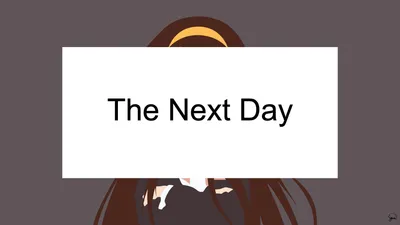
'Haruhi Suzumiya {Haruhi Suzumiya Series}' by greenmapp... Hey wait a minute, was that déjà vu? | Inspired by Bowie's cover art
issue #191 of brennan.day
Groundhog Day, Groundhog Day, and Variations on a Theme

brennan.day — issue #191
Publisher: Brennan Kenneth Brown
Place of publication: Calgary, Alberta, Canada
Available at: https://brennan.day
Contact: mail@brennanbrown.ca
One of my favourite tropes (or maybe it's a genre at this point) in media is the Groundhog Day time loop. Most people know this well—the classic 1993 film starring Bill Murray where he finds himself waking up to the exact same day—
Okay, jokes aside, I did actually find myself thinking more about the topics of yesterday's essay, and continued pulling on the thread. I really couldn't help myself.
Ferb, I Know What We're Going to Do Today
Let me start with one of the best animated television shows ever. Phineas and Ferb's plot pattern is extremely structured and formulaic, a narrative system where each episode is always split into two interconnected stories. It revolves around the boys' wildly ambitious invention, Candace's attempts to "bust" them, and Perry the Platypus fighting Dr. Doofenshmirtz, culminating in the automatic destruction of all evidence.
The formula is a contract. Every episode makes the same promises. It's because the audience knows the formula so well that the writers can play it like an instrument.
The formula becomes increasingly subverted over time. Some beats are rushed, some are reversed, some intersect. In one episode, Ferb glances at the camera and deadpans, "that usually takes us an entire montage", the joke works after you've sat through dozens of montages. The lampshade hangs only after the lamp.
The show is self-aware about this. In "Leave the Busting to Us," Candace looks around at her own life—the same thing happening, again, every single day of summer vacation. She exclaims, "my life is like a bad sitcom!" She knows she is trapped inside a loop she cannot break. Her inability to win is an inevitability, not a predictability.
The show ran for 222 episodes across four seasons. People kept watching, as familiarity is a form of pleasure.
We Are Repeated Things
Almost everything we do, we will do tens of thousands of times. We find ourselves trying to go to sleep each night. Throughout the day we eat, and most often eat the same meals frequently. We will go on the same commutes, see the same landmarks until our brains tune them out.
The repeated becomes safe becomes invisible. This is how life is for nearly every being on earth, not just us. To find food, shelter, and of course, companionship. It gets existential quickly.
Why do we crave the same thing, over and over again?
In 1968, psychologist Robert Zajonc demonstrated what he called the "mere exposure effect". People prefer things they've encountered before—people, words, melodies—without remembering the prior exposure. We misattribute our increased fluency with quality. Instead of thinking I've seen this before, we think I like this.
Cognitive scientist Elizabeth Margulis, in On Repeat: How Music Plays the Mind, traces mere exposure through music. Repetition, she argues, invites us in as active participants rather than passive listeners. Your brain procedurally encodes the music, until the next note can be anticipated without effort. I know the words to the theme songs of the cartoons I watched as a child, even if I haven't encountered them in twenty years.
And when I find a new song or album that I absolutely love, I'll listen to it on repeat, sometimes for hours until there's semantic satiation. When I go to Village Ice Cream, I have the go-to flavour I always order. There are a handful of films and books I'd happily rewatch or reread despite having an impossibly long list of other media I still need to get to.
This isn't static or fixed—people get bored of the same thing and move on, maybe to a more intense version, a different variation, or something else entirely. There is a spectrum. People live in the dichotomy between the comfort and safety of the known and the excitement of the novel and different. But for the most part, we will always orbit the same few things.
We find ourselves talking to the same classmates and coworkers on a daily basis, sometimes for years. Our romantic partners for even longer, what else is there to say?
The rollercoaster will always press G-force into us and flutter our stomach with butterflies. Alcohol will always metabolize in our liver the same way. My page will always have the same 26 English letters rearranged in various different ways. There will never be a new colour to witness, never a new planet to live on. You know the greatest films of all time were never made. I previously wrote about how there is more than one way to skin a cat, but really, there are only so many ways to.
The unfamiliar trail might have had a predator. An unfamiliar fruit might be poison. Novelty is risky. The known food and face and path, they all mean survival.
Familiar environments demand less cognitive processing. The brain runs on autopilot, conserving resources for new threats and novel problems. In times of acute stress, people don't explore new behaviors, but instead retreat to the deeply-grooved ones, even harmful ones, the behaviours they've been trying to quit. The brain under pressure defaults to the known.
Mary Oliver, writing about what makes great poetry, said that "rhythm is one of the most powerful of pleasures, and when we feel a pleasurable rhythm we hope it will continue." Murakami said something similar about his running routine: "The repetition itself becomes the important thing; it's a form of mesmerism." The known rhythm carries you somewhere outside the noise of having to decide anything.
Overexposure leads to satiation, and then boredom. We drift. We find something new and the cycle resets. The trick is that the new thing, once we've lived with it long enough, becomes the familiar thing we can't imagine living without.
Not Safe for Working Minds
There are only so many ways to have sex—despite the seemingly endless creative kink and fetish. In 2019 alone, 13 videos were uploaded to PornHub per minute. Meaning each minute, almost three hours of content were uploaded.. And if you take a step back, you have to ask why?
The Coolidge Effect, named after an apocryphal joke about President Calvin Coolidge, describes a phenomenon observed across mammalian species: sexual interest dampens with a familiar partner, and reliably revives at the introduction of a new one. The dopamine spike that novelty produces is amplified in the context of sexuality in ways that dwarf almost every other stimulus.
The internet gave this infinite fuel and removed all friction. The primitive brain wired for novel mates now has access to an endless scroll, each new image producing a dopamine hit, none becoming familiar enough to lose charge. There's always another.
The seeking becomes the thing. The next video is identical to the last in structure. Novelty is cosmetic.
The Refrain, The Reframe
Let me be blasphemous and quote Ecclesiastes 1:9 right after that section,
9 That which has been is what will be,
That which is done is what will be done,
And there is nothing new under the sun. —NKJV
For creative endeavours, there is good argument to be made that you should always create, no matter how similar or repetitive or stale you think your creation is. That is one thing that is so contradictory and paradoxical here. Any two humans are 99.9% identical in their genetic makeup, and yet each and every one of us holds an entirely unique mind and life.
The German choreographer Pina Bausch, whose dance-theatre pieces built entire worlds out of repeated gestures, said:
Even if you return to the same river bank, the same bend, the same cold shallows where the reeds catch the light, the water is different. You are different.
Gilles Deleuze argued in Difference and Repetition that each instance of a repeated act carries uniqueness, producing something new through returning. Repetition, for Deleuze, is the process by which creativity becomes possible.
The musician practicing the same melody for the thousandth time has different neural pathways. Her hands are different. The weight of the emotion in the phrasing shifts. Think of Bach's Goldberg Variations, Beethoven's Diabelli Variations, the passacaglia and the fugue. In the repetition you find everything the idea contained that wasn't there the first time. The fugue returns to its subject again and again, until there's revelation. Jazz does the same thing with 12-bar blues progression. The chord structure doesn't change, the player does. The night does.
This is what Ecclesiastes actually means. It is not a eulogy for novelty, it's a permission slip. The pressure to invent something unprecedented, something that has never existed in the history of the world? It's bullshit. The invitation is to do what Kyoto Animation did with Endless Eight. Take the same plot, the same beats, the same dialogue, and change the camera angle. Change the outfit. Change what the character is eating. Do it again. Do it again. Find what the next iteration holds that the first one couldn't.
A sunset will never look as good in a photograph as it does in real life. And yet a sunset will never stop being photographed by people, until it stops setting.
I guess that's kind of how I go about writing love poetry. Hm.


Comments
To comment, please sign in with your website:
How it works: Enter your website URL. IndieLogin signs you in through your site's IndieAuth server if it has one (e.g. IndieKey), or checks your rel="me" links on GitHub, GitLab, Codeberg, and email. Setup instructions.
Signed in as:
No comments yet. Be the first to share your thoughts!