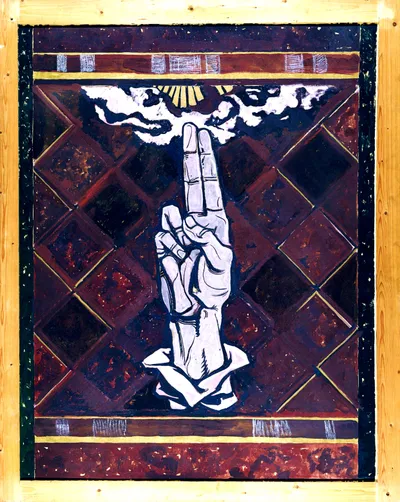
'Zwerende hand; ontwerp voor figuur van de marmerdecoratie in de Hoge Raad te Den Haag' by Richard Roland Holst. ca. 1868–1938. | Rijksmuseum (edited by the Author)
issue #310 of brennan.day
Let Justice Be Done, Though the Heavens May Fall
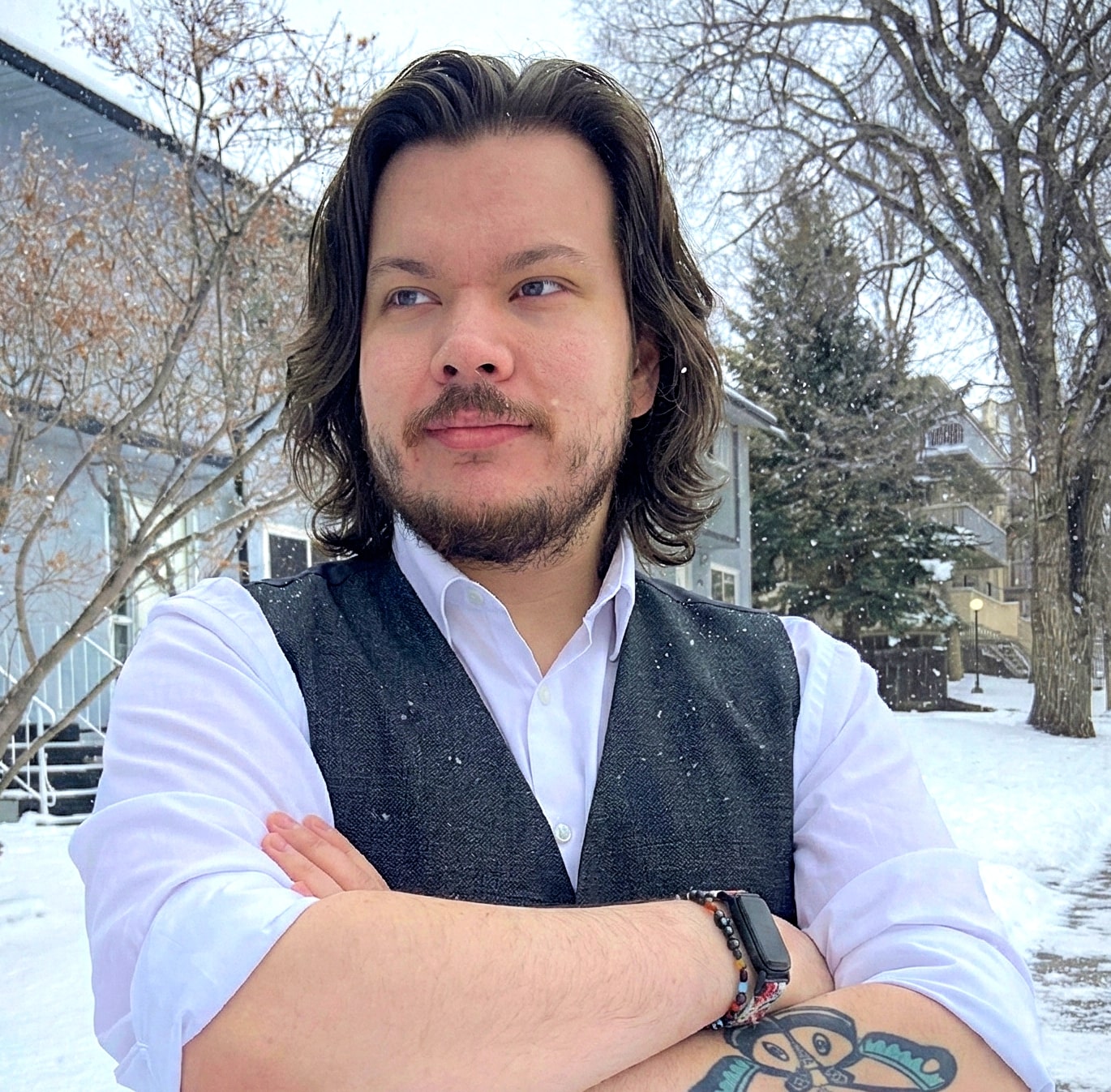
brennan.day — issue #310
Publisher: Brennan Kenneth Brown
Place of publication: Calgary, Alberta, Canada
Available at: https://brennan.day
Contact: mail@brennanbrown.ca
Do you know what you want to be doing? I think about when we do have the rare time to sit down and figure out what we want to do with the precious free time we have, where do we end up allocating it to? During the new year, we tell ourselves the multitude of "good" things we want to start doing. Taking better care of our one and only body, finally quit drinking, learn how to meditate, or a new language, or start an embroidery and crochet Etsy. Maybe finally visit a new continent.
But when push comes to shove, are you actually doing those things? Sometimes the answer is yes, and other times you find yourself doomscrolling and bedrotting instead.
Why?
Free Will
There's the controversial trend of people doing completely unhinged things, recording it for clout, and comments will usually say "excellent use of free will" or "11/10 use of free will," "free will at its finest." In our lives, we always have a radical will and freedom, and it's rarely acted upon.
You can go to a salon and get your head shaved. Or you could quit your job. Get SCUBA certified, or convert religions. Sell your furniture and move somewhere you haven't heard of before. Or go show up to a roller derby tryout. Legally change your name. Finally text the person you've been avoiding for years.
And yet, we mostly don't do such things. Kierkegaard called this the dizziness of freedom, the vertigo of standing at the edge of a tall cliff and realizing nothing is really stopping you from jumping. Sartre said that what we do about this vertigo is bad faith: we flee our own freedom by pretending we're either pure circumstance ("I just can't") or pure possibility ("someday"). A gambler who resolves never to play again, only to walk up to another table and discovers his former resolution is just a memory, no longer having any grip on him.
Sound familiar?
Lockdown Experiment
When March 2020 happened, many of us received the accidental experiment of finally having time and space. A UK survey found people cooking and walking more, and about one in four saying they wouldn't have started exercising without lockdown, sure. But a review of over 600 studies found lockdown negatively affected diet, activity, sleep, and stress for most people. Lockdown gave room for sourdough, but also gave the world doomscrolling, which was a word coined that year.
40% of Canadian jobs can be done from home, but it's very lop-sided. In dual-earner families, just 8% of the lowest earners could work from home, versus 54% of the highest.
It goes without saying that essential workers were stocking shelves, driving buses, and working hospital shifts. Ensuring society still functioned properly, they did not get the luxury of free time others did. It's never only will, or willpower. It's not about trying harder, or having more grit.
Our Worst Self
This is the rub of it: the truth is we are as capable of being deceptive with ourselves as we are of being honest. Our cognitive brilliance and mental faculties, which could be devoted to our best selves, are always equal to the brilliance of our worst selves.
We are always able to cleverly twist our working reality to bend towards our vices, or at the very least, to the path of least resistance.
Say you book the evening flight instead of the morning one, and you tell yourself it's so you'll have more time to get organized. Somewhere in you, you know you'll be out drinking the night before and terribly hungover. The "responsible" you gets the credit while the other you books the ticket. The harder you lecture yourself, the more clever your justification and dissonance for your vices will become.
Plato's Socrates denied anyone really acts against their own better judgment. Short-term pleasures look better because we picture them more vividly. Socratic ignorance isn't ignorance of facts—it's a deception about our own inner condition. The excuse is part of the vice.
Mercier and Sperber's "argumentative theory" argues that our capacity for reasoning didn't evolve for finding the truth, no. We are good at reasoning to justify ourselves and persuade others! The conscious "you" is informed, rather than actually making the decisions. In choice blindness experiments, researchers secretly swapped a photo that participants picked, and people didn't notice, instead happily explaining why they'd chosen the face they'd actually rejected.
Your wants and desires inform which evidence you notice and emphasize. Self-deception is a persistent refusal to spell something out and avow it. You don't have to believe a lie, really, just never say what's true. Not even in your own head.
Attention, Not Will
So, what's the answer then? All of this might sound like self-help motivational bullshit, or that I'm blaming you for simply not working hard enough, but it's the opposite, really.
I recently read Will and Attention, a memoir by Meghan O'Gieblyn and this dichotomy she asserts really stuck with me: it is not a matter of will—of white-knuckling ourselves to do the damn thing with gritted teeth. Rather, it's about paying attention to ourselves. To witness what we want and value, and who we are with clear sober eyes. We do not spend ourselves on the task, but rather on examining what's actually going on internally.
O'Gieblyn writes of secret drinking, a relapse after eleven years of sobriety, and being pulled back toward religion. Working through Simone Weil, Iris Murdoch, the Desert Fathers, Schopenhauer, and Catholic theology, O'Gieblyn reckons with recovery. A self "who both wants and wants not to want." She keeps an index card above her desk reminding her: faults get cured by attention, not by will.
The Greek word for acting against your own better judgment is akrasia, and as I read her, O'Gieblyn takes the Socratic line that it's a kind of ignorance. The ignorance isn't of facts. It's of ourselves.
Willpower is a tightening attempt at control, and attention is an opening surrender to witnessing. O'Gieblyn used prayer to cultivate attention. For a moral life is about seeing accurately, and the enemy is "the fat relentless ego" and its consoling fantasies. But we can't separate and discern the clear, honest vision from a flattering distortion. Our minds will always make the distortion feel like clarity from within.
Evagrius, the fourth-century monk, understood that whether our tempting thoughts show up isn't up to us, but we are responsible for whether they linger. The answer was watchfulness: after a fall, sit down and retrace where you went, and where you got caught.
Addiction psychiatrist Judson Brewer had smokers paying close attention to cravings instead of fighting them. The mindfulness group quit at twice the rate of the American Lung Association's program. When you pause and examine a habit, when you write down each step and say each action out loud, you notice it isn't as rewarding as it feels when you allow yourself to go on autopilot with it. Which is what we nearly always do with bad habits.
That said, attention cuts both ways. Sometimes, after a close and honest reckoning, you find out that yes, you do actually like the thing. What then?
Fiat Justitia
The title of this post is a Latin legal maxim, "Fiat justitia ruat caelum." It comes from the idea that justice and the rule of law must be pursued completely, regardless of the severity, cost, or chaos of the consequences. The maxim rejects "floodgates" arguments, or outside political pressure, pleading for the judge or official to bend the law out of fear of a messy outcome. It stands against how those in power, and with fame, get away with harmful crimes.
The internal version of the "floodgates" argument for us goes: if I admit what I actually want, I'll never change, or I'll turn into a monster. We keep up the cognitive distortion—dishonest about our true wants and why we keep the behaviours—because then we aren't a monster.
But I don't think that's actually how it is.
I think it's okay to want the vice, the path of least resistance, or to avoid the ethical good. It's unreasonable for us to all be good people all the time, and most of us who fail do so with a multitude of cognitive dissonance and excuses rather than just being honest and articulate about it.
Augustine prayed to be made chaste, "but not yet," as he was afraid God would answer too soon and cure the lust he wanted satisfied rather than extinguished.
What separates the "unwilling" addict from the "willing" is whether you endorse the craving when you truly reflect on it. In Foddy and Savulescu's liberal account of addiction, addictive desires are just strong ordinary appetites, and many addicts are simply willing.
If we quit the hard things in life that bring us no joy, on impulse, we might actually be doing the right thing. If acting against your judgment is considered the ultimate failure, we're incentivized to rationalize, and revise our judgment until the status quo is palatable enough. In reality, I think staying clear-eyed about your reasons while you fail is the lesser failure.
Heavy drinking can, controversially, be better understood as a way of life than as a disease. Drugs have real, compelling value for the people using them, which is why they stay stuck, and there's no one-size-fits-all story. Most people who meet addiction criteria eventually quit, without treatment.
It is important to distinguish that wanting and liking are separate systems. Addiction will exaggerate how badly you want something without making it more enjoyable.
So, again I ask. What do I want? What do I actually like? What would I be doing if I examined every act with honest and sober eyes?
It's important that I state that, while I think it's okay to want the thing you've been telling yourself you don't want, there will be consequences. You will be disrupting the status quo, and you will be shedding a false/better self for a new, honest/worse self.
Grace
More important than anything else, though, is that we must give ourselves grace. We must understand we are trying our best even when we don't measure up to the supposed best version of ourselves we have in our mind.
When you accept yourself as you are, you change. In four experiments, people who treated a failure with self-compassion were more motivated to improve, not less. Students who forgave themselves for procrastinating before one exam procrastinated less before the next. Pickard's responsibility without blame states that you can own what you did without condemning yourself for it.
Life or Death
A major reason I have a vested interest in addiction and recovery studies and frameworks is because, unlike most of our so-called problems, they deal with behaviour that's life-or-death. And because of that, there is a far stronger motivation to compel a person to both be honest and to change. The WHO estimates 2.6 million deaths a year were attributable to alcohol in 2019, and 13% were people aged 20 to 39.
Step Four of AA is to do a "searching and fearless moral inventory," to finally face the lies you have told yourself. But even then, you will be warned that there is a danger you will rationalize when dealing with yourself. Your cleverness will follow you into recovery.
Addiction is a "terrifying breakdown of reason". When the stakes are death, people find out fast that willpower alone isn't the thing. Attention and honesty can be, though. I'd like the rest of us to borrow that lesson before it's too late.
Let justice be done, though the heavens may fall. And let us be kind to the defendant.
Comments
To comment, please sign in with your website:
How it works: Enter your website URL. IndieLogin signs you in through your site's IndieAuth server if it has one (e.g. indieauth.com), or checks your rel="me" links on GitHub, GitLab, Codeberg, and email. Setup instructions.
Signed in as:
No comments yet. Be the first to share your thoughts!