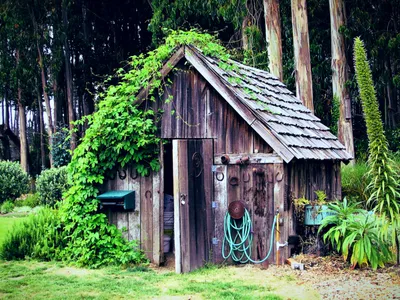
'An old tool shed in the vegetable garden at Mendocino Coast Botanical Gardens' by Larry McCombs, 2006. | Flickr (edited by the Author)
issue #269 of brennan.day
Being a Toolshed of Optimism
brennan.day — issue #269
Publisher: Brennan Kenneth Brown
Place of publication: Calgary, Alberta, Canada
Available at: https://brennan.day
Contact: mail@brennanbrown.ca
A few days ago, I noticed on Umami that there was a small uptick of referrals coming from Reddit, so I searched the site for my URL and found this lovely little post in r/IndieWeb recommending me and James. I later discovered this was posted by Billy, creator of Ctrl+Shift+3, which has been an enjoyable indie social media platform these past few weeks I've been using it.
It's always interesting to hear how others describe you, and it gave me pause for contemplation. Billy wrote that I'm someone that doesn't take myself too seriously, and I certainly agree there. But "nice"? Hm. Is that how I'm viewed?
Let me take a step back and say, first, that it is weird to have a readership at all. I've gone most of my life being invisible, and I've been writing online since 2015 mostly to just myself and have been content with that. This past year of creating my own independent publication and posting on a near-daily basis has changed that.
Being a Jester
Without a doubt, there comes a responsibility when people begin reading your work and taking you seriously. I've had Jester's privilege, the historical right of a court jester to mock and speak hard truths without facing punishment, because their words are disguised as mere jokes and—more so in my case—because nobody cared what the jester has to say, or takes it seriously.
As a result, I've found myself making off-hand remarks and having a flippant attitude. I've developed a bad habit of rubbernecking and gravitating towards mess and disaster. Thankfully, I've been able to channel my compulsive morbid curiosity into healthy avenues, such as the various topics I write about on this blog.
Yet, Being Virtuous
At the same time though, in contradiction, I have tried to live a values-oriented life and be vocal about what I think is important and right. And doing so puts you and your actions under a vigilant lens of scrutiny.
Similarly, I think many people (myself included) have the assumption that somebody who cares deeply about virtue and justice is then also rigid, unforgiving, and views those who are less virtuous as inferior, and perhaps even irredeemable.
And so I'm writing this out for a number of reasons.
I want to make it clear that I've never been interested in scolding, pearl clutching, and certainly not infighting. When I've reported on the actions and behaviours of people in the past, I have done so trying my best to shine light and awareness where I thought it was both important and dark. I have been frustrated and disappointed by people, sure, but nothing beyond that.
Going forward, I want to be more careful and mindful with my subject matter—what can be healed, what injustices can be redeemed? What good can be made more accessible?
Helpful Frameworks
I've been looking towards the work of others that I can use as reference. To start, Solutions journalism insists on rigour—a solutions story shows evidence of what's working, insight into why it's working, and its limitations. Similarly, constructive journalism focuses on the three pillars of solutions, nuance, and democratic conversation. Newsrooms need to facilitate conversations society needs to move forward, and not just aspire to document evidence neutrally. And though I am not a newsroom, I do aspire to be a good citizen journalist.
Restorative narrative is a related genre that grew out of the folks at Images & Voices of Hope, and says stories cannot skip past the hard truths of tragedy or rupture. The story must continue with a person or community long enough to document progression toward repair.
I will never look away from what's broken, and that's many things, and I will also honour attempts at rebuilding.
When you're writing day-to-day like me, it can be easy to get caught up in the trees and begin to forget about the forest. It can be easy to get wrapped up in the particular actions of particular people simply because of things like proximity bias. I need to remind myself that, just because I see something on my timeline or feed a lot, does not automatically mean it's what deserves my attention and effort.
I want my little publication here to be a toolshed of hope and stubborn optimism—by that, I mean I want to focus on compassion, grace, benevolence, and hope—but in a tangible, practical way that's actionable and verb-oriented. I want my humble shed to have the tools needed to change things for the better.
Rebecca Solnit wrote that hope lives in the uncertainty between optimism and pessimism and in the action we take. Hope is the room not-knowing leaves for you to act in. Solnit looks at the Zapatista uprising and the 1999 shutdown of the WTO meetings in Seattle among forgotten wins on the left. Most of what changes the world never gets photographed, it looks like something that didn't happen. A war that didn't start, or a law that didn't pass. Do you know the names of the people that stopped the world from ending?
Mariame Kaba says hope is a discipline, rather than an emotion. Hope is a ritual and daily practice, done whether or not you feel like it. Kaba herself has been running Project NIA and organizing the Chicago Torture Justice Memorials reparations campaign for decades. She does the unglamorous work of bail funds, court watching, and participatory defense campaigns. Hope as a discipline is showing up to unfinished work again and again.
Joanna Macy says active hope is three steps you take: see clearly what's happening, name the direction you want things to move in, then act. adrienne maree brown has principles of emergent strategy for hope: move at the speed of trust and focus on critical connections over critical mass. We must trust the people, because if you trust the people, they become trustworthy. Small is good, small is all, the large is only ever a reflection of the small. This is why I am doing this on a daily blog trying to be a toolshed.
Christiana Figueres calls hers stubborn optimism, and she used it to broker the Paris Agreement, when 195 nations agreed, six years after the Copenhagen summit collapsed in tears and screaming. Stubborn optimism is also a discipline, chosen because the alternative is unthinkable, not because the odds favour you.
What This Means
I need to remind myself to meet people where they are, and to focus on the human and what can be restored. I also need to hold every piece I write against the question: will this look worthwhile from my deathbed, in retrospect?
I am extremely privileged both in my platform and my attitude—for whatever reason, I was built with the ability to endure and survive with the image of a positive future still intact in my mind, despite everything.
Which is to say that I want to use this unique, absurd opportunity I have to try to leave the world a better place than I found it. And that starts with where my focus is. This isn't about ignoring the grave injustices, but it is about figuring out what can be done about them. And that will always include righteous fury and anger and grief.
Regardless of all of the above, I am a deeply flawed person. I will try my best to write something that you'll find worth reading, but as a person, I will continue to make mistakes and disappoint you. And that's okay. I want to operate on good faith. If others mess up, that's okay! Because I will as well.
So, what does the toolshed of optimism look like in practice? Before I publish anything, I will ask whether it points toward what can be healed, what the reader can do with it. I will tether any anger or grief I write to a concrete next step: a tool to try, a campaign to support, a question to keep asking, or an attempt at repair already underway. I will keep building this site by hand, one word and one page at a time, and use it for the stubborn work of optimism. That is the toolshed I want to tend.


Comments
To comment, please sign in with your website:
How it works: Enter your website URL. IndieLogin signs you in through your site's IndieAuth server if it has one (e.g. indieauth.com), or checks your rel="me" links on GitHub, GitLab, Codeberg, and email. Setup instructions.
Signed in as:
No comments yet. Be the first to share your thoughts!