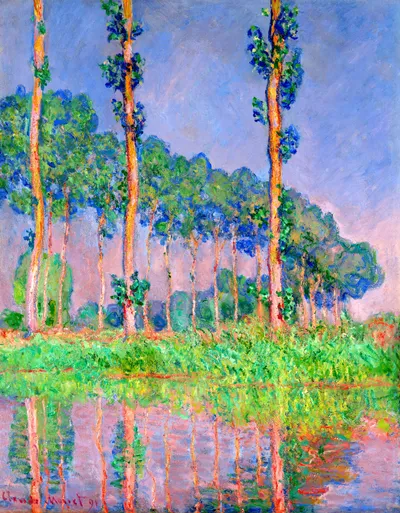
'Poplars, Pink Effect' by Claude Monet. ca. 1891. | Dallas Museum of Art (edited by the Author)
issue #318 of brennan.day
What Fades, and What Stays? On Guilt, ADHD, and Left Politics

brennan.day — issue #318
Publisher: Brennan Kenneth Brown
Place of publication: Calgary, Alberta, Canada
Available at: https://brennan.day
Contact: mail@brennanbrown.ca
Before dinner is ready, daylight is gone. The sky over 17th Ave. curdles from tangerine into the grey of dishwater at a quarter to five. And the warm chinook arch, camping over the mountains, folds itself back into the dark horizon. Poplars on my street are stripped to the bark, naked. When I walk to the 7-Eleven, the snow squeaks under my shoes. A magpie rattles branches like a fistful of nails in a tin above me.
The light fades. The leaves faded weeks ago. The day's warmth fades the moment the sun drops behind the downtown towers. The black scaffold of branches stays, the smell of woodsmoke riding the alley stays.
Stuck On a Loop
I've seen a sentiment shared across social media explaining that those with neurodivergence—particularly ADHD—have a different psychological process when it comes to guilt and shame compared to those who are neurotypical. Statements like this:
BREAKING: Scientists confirm that ADHD brains do not process regret the same way neurotypical brains do. The guilt doesn’t fade. It replays at full volume. On a loop. For years. This is not a character flaw. This is a documented difference in how the ADHD prefrontal cortex stores emotional memory.
You can find it repeated on Instagram and Facebook. A content-farm piece on neurolaunch.com makes the same claim, and another page on ADHD guilt on the same site says there's "neurological fallout," again without any citation.
After seeing this, I went searching to find the original scientific paper or journal article that made the claim. I couldn't. I don't think it exists. The claim is significant, and would require significant evidence. Of course, this is just one example of many where pop-sci social media embellishes and plays telephone with real research.
There's no scientific evidence showing that ADHD brains cannot process regret—emotional memory is mediated by the amygdala and hippocampus, not "stored in the prefrontal cortex." Meta's AI account similarly debunked it, akin to being corrected by a vending machine. If you do more digging, you realize that these posts that "put into words what we all feel" often are just marketing funnels. In this case, it's a paid four-week "Autism and ADHD Protocol," per the end of another thread. A rather cynical but unsurprising business model.
In my research, I did find a few relevant papers. Schepman et al. (2012, Journal of Attention Disorders) surveyed 275 undergraduates on things like ADHD symptoms, restlessness, maximizing tendencies, and regret. A separate study of 237 college students found a moderate correlation between ADHD propensity and regret (r = 0.479), mediated by perfectionism. Both are self-report correlations in students, and neither says anything about guilt persisting or failing to fade.
McGill et al. (2026, Journal of Attention Disorders) is a systematic review of qualitative studies of adults diagnosed late. It found people often attributed their difficulties to their own deficiencies for years, and over half reported relief once blame shifted to the condition. Beaton et al. (2022) found in 162 adults with ADHD traits that criticism lowered self-worth and heightened sensitivity to criticism. Again, accumulated criticism is not a brain that can't release guilt.
In 2020, a meta-analysis of thirteen studies found adults with ADHD show substantially more emotion dysregulation than controls (Hedges' g = 1.17). Emotions hit harder and are slower to settle. But again, "more intense" is not "never fades." And "slower to settle" is not "replays at full volume for years."
Pop-sci articles make claims the correlational and qualitative findings don't actually support. But there are related findings. The slop sells permanence as pathology, and then conveniently requires a product that'll fix it.
More Pure Than Thou
There's a reason this claim has spread across social media. I'll admit that I can't help but feel as though it rings true for me, personally. But I think it also connects to the larger topic of purity litmus tests and pearl-clutching. Neurodivergent people, on the whole, are both more sensitive and more politically left. I can't help but wonder if a community of people who feel guilt and injustice more keenly is a community primed for infighting and lateral violence.
Rejection sensitive dysphoria, coined by psychiatrist William Dodson, is the sudden, overwhelming pain of perceived rejection or criticism, wildly out of proportion to the cause. You will often see it spoken about in ADHD communities. But RSD isn't actually in any diagnostic manual, and has no agreed-upon measure. The empirical evidence is sparse, as there are only five small qualitative studies on RSD, the largest with 43 participants. A critical reflection published this year on RSD also notes the "limited empirical evidence" and warns the label can flatten social causes into an innate trait, and that "social-environmental influences remain underemphasised."
Justice sensitivity is how often a person perceives injustice, how intensely they react to it, and how long they think about it afterward. Schäfer and Kraneburg's pilot study found adults with ADHD scored higher on observer and profiteer justice sensitivity than controls, with the inattentive subtype highest on every dimension. A sample of 1,235 German children and adolescents demonstrated that those with ADHD symptoms reported significantly higher victim justice sensitivity and both anxious and angry rejection sensitivity—the sensitivities partially mediated the link between their symptoms and other problems. That's beautiful fuel for solidarity. It's also beautiful fuel for score-keeping and burnout.
A Polish study of neurodivergent Gen Z voters found a clear tendency toward left-wing parties, which its author attributes to a strong sense of social justice and firsthand experiences of exclusion. And a survey of 1,369 adults found that those who screened positive for ADHD participated in politics more than their peers—online and off—and were (unfortunately) significantly more prone to support silencing other opinions. More engaged, but also more censorious.
Paulo Freire wrote in Pedagogy of the Oppressed that people denied power against their oppressors can become "sub-oppressors" toward each other instead, lashing out at peers because that feels safer. Lateral violence is the gossiping, bullying, shaming, and social exclusion colonized peoples direct at each other. A CANZUS-wide review documents both how this violence is enacted by young people, and also how communities undo it through what they call lateral empowerment.
Mark Fisher came up with Vampires' Castle back in 2013—the online left specializing in "propagating guilt," driven by a priest's desire to excommunicate and a hipster's desire to be in the in-crowd. Gavin Haynes came up with the purity spiral, when a community is fixated on a single value that has no upper limit and no agreed interpretation, producing a perpetual one-upmanship. His case study was Instagram's knitting community, which tore itself apart so completely that one knitter, Nathan Taylor, was hospitalized after a suicide threat—over a hashtag meant to welcome knitters of colour. Frances Lee came up with the Church of Social Justice, "the fear of appearing impure," where social death follows being labelled a "bad activist" enough times.
Ngọc Loan Trần asked us to call in instead of calling out—"a less disposable way of holding each other accountable." adrienne maree brown, in We Will Not Cancel Us, warned how our call-outs replicate the master's tools—the mob's instant judgment and instant punishment—because, as she writes, "we think it will assuage our fears and make us safer if we can clarify an enemy." The glass house will shatter, and the point of giving people undeserved grace is that we will need it ourselves.
So does unfading ADHD guilt cause leftist infighting? No—that would be slop-science neat. But communities of sensitive, justice-attuned people—with many participants carrying lifetimes of accumulated criticism and negative self-talk—are communities where shame and mistakes have tremendous trouble fading with time. Every misstep is interpreted as betrayal. The guilt loops and the litmus tests tighten. We do struggle to put our guilt down, and a movement made of people like this needs even more grace, not less.
The Chasm
Let me focus again on myself. I have an amazing life. I have so much opportunity. But I also need to be honest about who I am and what I want.
I'll be honest, there's a chasm between who I present myself as, and who I perform as in my writing versus who I think I am. I've tried being candid and honest, talking about the unglamorous life of being a full-time writer and how I have clown burnout, but it is still a performance nonetheless.
It's hard to not see myself as a failure. I know I am traumatized, exhausted, and overwhelmed. I am trying to survive in a world that has failed people like me in profound ways. I've called myself a late bloomer, but there are some milestones that have come to pass that I won't reach. I'll always be a high school dropout. I didn't get married in time for my grandma to officiate (a side hustle she had). I have an eye-popping amount of student loans. And, worst of all, I've hurt people who've loved me.
I've been writing and writing ceaselessly—I created brennan.day and have written essays on community, Indigenous sovereignty, and the open web. I try to link to as many different sources and people as possible when I do. I've also built dozens of free open source blog themes and projects.
I've realized that the digital world is one I can control. I create websites and I understand how they work. I have total control over what I post and when. In that way, it's a safe space for me. Meanwhile, the physical world—with volatile relationships and debt collectors and grief and trauma—is something I have far less control over. There is overwhelming chaos and it is unforgiving.
I pour myself into this, my desperate need for meaning, my aching heart, into the only place I feel safe enough to do so. I've tried to tend a digital garden and archive of text as my real life feels like a collapsing building. Of course, I know my worth isn't determined by my bank account or zip code or accolades. And my worth is also not determined by how much work I do, either.
My worth, like everyone else, is intrinsic. All living beings deserve unconditional compassion. I've made awful mistakes, and in a lot of ways, my status quo is bullshit. But I'm still here, still breathing, still writing. I am a person who cares deeply about the land, about craft, and about people. I love people, and I have so much grace and optimism for the world.
Marcescence
What fades, and what stays?
Poplar leaves don't fall randomly—the tree lets go of the leaf on purpose. In autumn, the tree grows a thin seam of corky cells at the base of each leaf stem—an abscission zone. This seals the leaf off, like a scab over a cut. Only then does the wind pull it off. This fading isn't passive. Fading is an intentional decision the tree makes to survive the cold.
But there are also trees that don't let go. Oaks, beeches, hornbeams—species that keep their dead leaves clattering on the branch all winter. Botanists call this marcescence, from the Latin marcescere: to fade. The leaf is dead. The season is over. And still, the tree holds it. Brown and papery and useless, until spring growth pushes it off the twig for good.
My own guilt is a marcescent leaf, dry and rattling in the cold, long past use. Still holding what I haven't yet learned to shed.
But the beech lets go eventually—not by force, but by growth. The new leaf arrives in spring, and the old brown leaf no longer can stay. Is that the work?
We're not permanently damaged—I know we need to keep growing until there's no room left for the dead leaf to hang on. What fades is the shame, eventually, if we let the abscission happen. We still have the ring count, and the buds already folded up small under new scales.
The branches outside my window are naked twigs, oscillating in math patterns, the harshest winds nearly causing them to snap off and die. Every one of those bare tips ends in a bud that was packed last summer—a leaf already folded, sealed under its scales, waiting for the cold to end.
What fades, and what stays? For the tree, the answer is easy. The leaves go, the buds remain. May I learn the difference in myself.
Comments
To comment, please sign in with your website:
How it works: Enter your website URL. IndieLogin signs you in through your site's IndieAuth server if it has one (e.g. indieauth.com), or checks your rel="me" links on GitHub, GitLab, Codeberg, and email. Setup instructions.
Signed in as:
No comments yet. Be the first to share your thoughts!