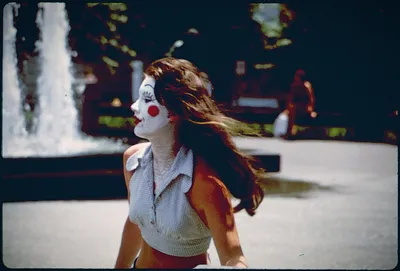
'Girl Made Up for a Sorority Initiation Crosses Fountain Square 06/1973' taken by Tom Hubbard. | Flickr (edited by the Author)
issue #228 of brennan.day
CLOWN BURNOUT

brennan.day — issue #228
Publisher: Brennan Kenneth Brown
Place of publication: Calgary, Alberta, Canada
Available at: https://brennan.day
Contact: mail@brennanbrown.ca
Last week was the Calgary Stampede, known as The Greatest Outdoor Show on Earth. I am no stranger to carnival performance, the joyful screams of the midway coasters, the bright-coloured stripes of a circus tent.
There is always a certain feeling at the end of the day when you go out to a place like this, hands sticky from cotton candy that looks like wall insulation and caramel-covered apples. The air is raspberry-blue electric even at the dusking golden hour, when you're minutes away from falling asleep in the car ride beside your new, hard-won stuffed animal won in a water-gun squirt race.
There is a ceremony when the spectacle of the day finally winds down.
Clown-white face makeup doesn't come off in one pass. It's zinc oxide suspended in tallow and lanolin, formulated to sit unbroken under hot stage lights, for ten hours at a stretch. Removal takes cold cream first, worked in circles to cut the grease, then a washcloth pressed into the hairline, the jaw, behind the ears where paint likes to hide. Professional clowns keep a second, softer cloth just for the corner of the eyes, where the red of a painted-on smile bleeds into real crow's-feet.
Circus people have a name for this ritual. They call it coming down.
I hold nothing but respect and reverence for the people who put that face on for a living. The wig, the red ball nose, the ten-hour zinc mask, who are honest about every second of the joy they're handing out. I know of no more generous trade.
My problem is different. My problem is I never learned the cold-cream part. I never learned to come down.
There are two founding faces in circus tradition.
Whiteface came first, the oldest of the archetypes. The dignified leader painted in a full unbroken white with none of the skin showing through, features drawn on in careful red and black. Whiteface directs the bit, plays straight man to the chaos, can be taken seriously enough to be blamed when the chaos goes wrong.
Then there's Auguste, flesh-toned under the paint, the fool who takes the pie and the bucket of water, whose every attempt at competence backfires by design. Auguste is beloved. Auguste is never, ever in charge.
A blogger spent years unpacking Fellini's The Clowns and interprets Whiteface as the mask which circumstance hands you. Parent, boss, the version of yourself you're required to be in public.
Auguste, on the other hand, is the truer self underneath, straining to exist, turning the whiteface's rigid nature into an ongoing joke just to survive standing next to it.
Except the essay's own punchline undercuts the comfort of that: Auguste is a mask too. There's no floor to hit. Masks all the way down.
Me? I was cast as Auguste before I had any say in it.
Both my parents are charismatic, filling a room by talking fast and finding the punchline first; my father treats a serious conversation like a dare he'd rather lose than take. And it makes sense, you will always find a belly laugh in an NDN. Somewhere in early childhood I learned the bit was reliable. Nobody leaves a room mid-joke. Nobody stops loving the person currently making them laugh. Right?
You're too young to realize what's happening to you, and you end up being called quick-witted, when in reality the jokes are so deeply embedded they leave your mouth without a second thought.
The act of taking a conversation seriously, of biting your tongue, becomes far more effortful than the near-compulsive tic of telling a joke.
I built myself out of the premise, and it worked. I lost the ability to locate the whiteface underneath, who's supposed to stay standing to say no, actually, this is serious, please stop laughing.
The oldest clowning society in the world, Clowns International, keeps an archive, a registry of every member's makeup, painted face-by-face. That isn't really unusual, the weird part is that they're painted on blown eggs. It started in the 1940s as one man's hobby. Chemist Stan Bult sketched the clowns he met onto hen's eggs so he wouldn't forget which face belonged to which performer. It grew into an unofficial copyright system, as no two clowns are permitted to share a design, and the egg is the proof, the hen fruit head-shaped ledger that settles any dispute. Real eggs proved too fragile, and most of Bult's original four hundred and fifty broke, so the registry naturally moved to ceramic. Still breakable, just less often. A new artist takes every decade or so. Janet Webb, then Kate Stone, then Debbie Smith, and now Julie Proctor.
A face, fixed the moment someone else decides it's finished, kept in a locked cabinet whether or not the man underneath it is still willing to perform it that night. Some of the oldest eggs belong to clowns who have been dead for decades. The face outlasts the person by design. Isn't that the point of a registry? Permanence and protection? A bit that can't be stolen because it's been catalogued.
I am ceramic and egg-faced. The joking stopped being a choice I was making in any given room, and became the entry already on-file. Ask around and the answer to what's Brennan like? or what's Kenneth like? would come back reliably: ridiculous, jokester, impossible to read, always on. Nobody was wrong. I'd painted it myself, years back, and then handed the egg over to be catalogued.
Milton
I want to circle back to a story I wrote a few days ago. Before he was anyone's fitness guru, Richard Simmons was a kid named Milton, overweight and effeminate in a New Orleans childhood that punished both. One Maintenance Phase episode traces his wonderfully energetic persona back to a trauma defense: a father who disciplined him with total silence. Days where the boy went unacknowledged, forgotten in domestic ways, showing him how little space he's allowed to take up. Loud, funny, and impossible to ignore became the only shelter available. He built Milton into Richard, and Richard into a persona that became celebrity and public utility. Thousands of phone calls to strangers trying to lose weight, four decades of a workout class he never once seemed to tire of teaching.
Then in 2014, he simply stopped. Left the public sphere indefinitely. A second episode of Maintenance Phase picks through the wreckage of theories that followed his disappearance. Was it kidnapping? Coercion? A secret transition? Of course, none of the theories substantiated. A difficult truth sits underneath the tabloids: Richard Simmons dedicated his life to being the funniest, most reliably "on" person in every room. That stops being sustainable when there's nowhere established to put down whatever he was actually carrying. Nobody in four decades had been introduced to the alternative. There was no whiteface on file. Just the Auguste. The egg, still smiling, in a cabinet somewhere.
This is the true answer why Richard went missing. It was known and in plain sight since he attempted to speak the grief he felt when his mother passed. There was nowhere for Richard to come down and be Milton again.
Comedy is, largely, a subversion of expectations. There is an unpredictable element of surprise. Or even shock. George Carlin famously rejected the term "shock value," stating, "Surprise is essential in comedy, and if people are shocked by what I consider merely surprising, then that's their shock."
Within the surprise is often untruths, fabrications, sarcasm. The joke often requires a detachment from sincerity to function. We've learned this the hard way in the past century, in the shell-shocked hardening of humanity's psyche in response to the onslaught of terrors and war.
There was a rejection of a shared, underlying foundation of reality. A future beyond modernity. The post-modern. The lack of objective truth, and the rise of irony.
Irony will always become a corrosive poison. David Foster Wallace made the case in 1993, in an essay called "E Unibus Pluram", that a culture or a person fluent enough in constant ironic distance will eventually lose the incredibly important ability to mean anything at all.
Wallace's verdict was blunt. "Irony tyrannizes us." He argued that an ironist is impossible to pin down, as the whole mode runs on the unspoken I don't really mean what I'm saying! Acceptable as a joke, and totally unlivable as a personality. Sincerity becomes the one move the ironist can't make convincingly, because nobody believes the register has room for it.
Rod Martin's research sorts humour into four camps: Affiliative, self-enhancing, aggressive, and self-defeating. That last one—using a joke at your own expense to hold a relationship together, consistently—takes a deep toll to the self doing the joking. Martin's data ties that style to higher neuroticism and worse well-being. Most funny people already know this about themselves. The sad clown paradox isn't folklore, and a 2014 Oxford study surveying 523 comedians found significantly higher rates of unusual thinking and psychosis-linked traits than the general population, a pattern other researchers trace to childhoods marked by deprivation and isolation, humour learned early as the only release valve available.
Medicine Clowns
But laughter is good medicine. Riches and wonders. To be a storykeeper means to pass down the tales of humour and jokes. Wisakedjak, the Cree trickster, and Chi-Jean, his Métis cousin in the old stories, are troublemakers. Gluttonous and foolish and always getting caught out. And they're given real standing in tradition because of the foolishness, not despite it.
There is a clown in Métis stories, the Windigoken, sometimes called the Backwards Medicine Clowns. The clowns arrive doing everything wrong-way-round on purpose. Elsewhere on the plains, the Lakota gave their sacred fools a name too, Heyoka, the contrarians whose whole ceremonial job was to point at what the community had gotten wrong by publicly doing the opposite of it.
Indigenous humour scholars describe this as "the heart of our resilience and survivability" rather than a symptom of anything pathological. The way of holding trauma that doesn't require setting it down, to be able to tease someone back into step with the community instead of out of it.
The medicine clown has a season, a ceremony, a bounded moment where the backwardness is invited, understood, and then it ends. Mine doesn't end.
I recognize the good medicine, here. And I also recognize how the irony brought from the Western-settlers bastardized this medicine into poison. How the very tool designed to allow us to survive and cope and teach and storytell became a weapon of numbness. Of distance and detachment.
If you've been a regular reader of mine for a while, none of this probably makes much sense to you. If anything, my writing has always been too dry and humourless. I've rarely written anything funny, satirical, or rooted in laughable humour. Instead, I've been here writing about community, about love and unity. I've been pouring myself into trying to build for humans, trying to figure out how to conjure connection out of the thin air of desperation and isolation.
Writing has always given me a vehicle to be earnest, to be thoughtful in a way my lifelong compulsive trickster nature doesn't when I'm in social situations. After spending my years performing as a clown in public, I can sit down and write sincerity to the world, and so I do.
But this is just another shade of compartmentalization. What you see on this blog, and the past ten years of my writing, is a different persona altogether. People in my life have always been trying to do the work Erving Goffman described as the labour of trying to get behind a performance to the person (supposedly) resting backstage. Front stage, in Goffman's terms, is built to sustain a controlled impression; backstage is supposed to be where a person is finally allowed to let the impression go.
But in the backstage, when my mask is hung on its hook, there's no face underneath to find.
There are people in my life who, I'm sure, enjoy me because I'm a clown. They enjoy how reliable I am for lightening the mood and never taking myself seriously and the ability to find a witty reply to near anything under the Sun. These are the people who do not really know me, or what I look like if I were to somehow manage to wipe off the white face makeup of zinc oxide, tallow, and lanolin. There would always be an uneasy distance, a disappointment when I try to bring up something dark and heavy instead of playing the character.
But there are far more people in my life who are exhausted with the theatrics—who never wanted to ask me to be an entertainer and instead deeply yearn for the real personhood and vulnerability I bury underneath.
They don't ask why did you stop performing?, but rather can you tell us clearly which performance you're choosing, so we know how to stand next to you? People want to be able to take me seriously, and want to figure out whatever shape our friendship needs to survive, so long as I say the true thing, out loud.
But I've been fully costumed in public, and fully absent in private, and no announced difference between the two.
I'm exhausted. I'm not in crisis though, I'm at peace in a way that looks like withdrawal, because it is withdrawal. The version of me dedicated to building community, the performance I'd put on showing up for everyone was just a masking, running on the red arrow pointed at "E", fumes as laughing gas.
This is a serious confession. Unjoked, ungarnished, without a bit riding shotgun to make sure the room didn't get uncomfortable.
The Middle Path
The Buddha's first sermon names two extremes and asks that neither be practiced: indulgence on one side, self-mortification on the other. Most retellings flatten this into a bland halfway point, moderation as the path of least resistance. It isn't that. It's closer to refusal. A rejection of both fixed positions, not a negotiated compromise between them.
Not less Auguste and more Whiteface in a careful ratio. Not a permanently serious writing voice built to overcorrect for a permanently unserious speaking one. That's just another wig and costume, the greasepaint smile traded for a scowl.
The dichotomy of Whiteface and Auguste is false. There is never any particular label we can point to and find our whole selves. These have always been placeholders and shortcuts for trying to reckon with being a messy, deeply contradictory thing such as a human.
The middle path asks to leave the continuum entirely: to let a joke be a joke without it standing guard, and let a serious sentence be serious without needing three jokes to walk it back afterward.
I am still not there, still not naked in honesty. This essay itself is yet another performance, a song and dance to try to have the audience understand the struggle I wrestle with, with flourish and poetics. Perhaps I am really just a Matryoshka doll. Open me in half and find yet another version that is capable of opening.
A recursive nightmare, anxious and neurotically obvious only at night, when the sun of the carnival has finally set, the fanfare and tents folded and collapsed, and you're left alone with the stars above. You've found yourself returning to the world, present in the moment. There is a faint wind, and the summer heat is cooling. You look down and wonder if you're finally brave enough to drop the act. And the answer is that you are. Until tomorrow comes, and you find yourself in the white face paint all over again.
The registry keeps growing. Someone is always willing to sit for a new portrait.


Comments
To comment, please sign in with your website:
How it works: Enter your website URL. IndieLogin signs you in through your site's IndieAuth server if it has one (e.g. indieauth.com), or checks your rel="me" links on GitHub, GitLab, Codeberg, and email. Setup instructions.
Signed in as:
No comments yet. Be the first to share your thoughts!