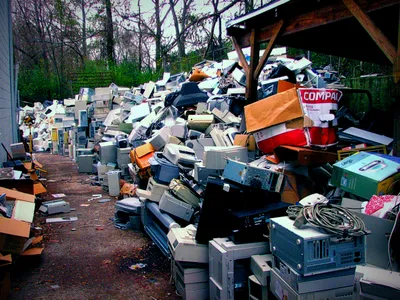
'e-Waste' by Curtis Palmer. 2007 | Flickr (edited by the Author)
issue #317 of brennan.day
The Shoebox Mindset

brennan.day — issue #317
Publisher: Brennan Kenneth Brown
Place of publication: Calgary, Alberta, Canada
Available at: https://brennan.day
Contact: mail@brennanbrown.ca
My storage system is rather simple; in my bedroom, I have a wooden storage table with multiple shoeboxes packed underneath. A shoebox is good enough, it's the right size to hold papers and sentimental items, and it can also store millions of documents and media, with USB sticks and SD cards.
It's crazy to me that you could go to IKEA or HomeSense and buy an organizer for $30 that does the same thing. These are boxes you get for free when—obviously—you buy new shoes. Online orders arrive in cardboard boxes of every size. Glass jars from jam or peanut butter hold coffee beans, rice, and spare change. Just soak the label off. You don't need to buy a plastic box.
The History of the Shoebox
Using a shoebox to hold things is as old as the shoebox itself. Until the 19th century, cobblers made shoes by hand to order, so there was little need to store them, but once shoes were mass produced they needed boxes, and cardboard boxes were first mass produced in England in 1817. The University of Colorado Boulder Archives has a post about 1923 shoeboxes that originally held part of the James F. Willard collection, which was the collection the archives started with.
In 2012, Guerrilla Games admitted that when it needed the original Killzone source for a PS3 port, parts of it were found in an old shoebox that served as their offsite storage, kept in the cellar of an IT support staff member.
The Zettelkasten, the note-taking method that the German sociologist Niklas Luhmann is known for, is German for "slip box." Each note holds a single idea and has its own number, which is how notes get linked to related ones. Luhmann's version was six wooden boxes holding 90,000 index cards by the end of his career. Six wooden boxes, no different than shoeboxes.
The shoebox is just one example of many. What you have is good enough. The best tools are the ones you have. Scribblers and coilbound notebooks from the dollar store work just fine for keeping analogue records. You don't need a Moleskine or a Leuchtturm1917. There are plenty of tutorials online for how to make your own pocket notebook—you don't need Field Notes for that either.
The Cookie Tin & Mint Tin
Danish butter cookie tins—especially the classic blue Royal Dansk tin (or historic biscuit tins like Huntley and Palmers)—are expected to hold sewing supplies, rather than cookies. The tinplate construction keeps sharp needles and pins from poking through and protects notions from crushing, and snap-on lids prevent spills of loose buttons, bobbins, and thread.
Similarly, there are dozens of ways to repurpose an Altoids mint tin, ranging from a mini garden to an emergency first-aid kit or a tackle box.
Coffee cans (plastic or metal) have lids that snap on tight and are used to store things like coins, birdseed, or dog food. Family-sized cereal boxes can be turned into magazine organizers, and yogurt tubs, butter tubs, and baby food jars all work as storage for leftovers or for supplies just as well.
Decade-old Hardware
When it comes to technology, the same applies. Whenever I announce a new web project or platform I plan to run, people are always concerned that I'm not budgeting enough towards computation—that money is going to be a concern because I'm going to need beefy CPUs, as well as plenty of RAM and storage.
As I've written about before, a site I host that now has over 1,600 members runs on a homemade desktop tower with an AMD FX-4130 (a 4-core chip from 2011), 8 GiB of DDR3 RAM, and a 230 GB hard drive. And folk.zone? That's 30 active services, all running on a 2017 ThinkPad X270 with an Intel i5-7300U, 8 GB of RAM, and a 240 GB NVMe SSD, running headless Xubuntu.
One of my favourite computers to work on right now is nearly a decade older than that X270: it's my ThinkPad X200T that I bought off Kijiji for only $40. It's currently running AntiX and I've had a lot of fun customizing it. In fact, I'm writing this blog post from it right now, and I'll rsync it to a custom CMS I have running on another computer later. Here are a few screenshots:
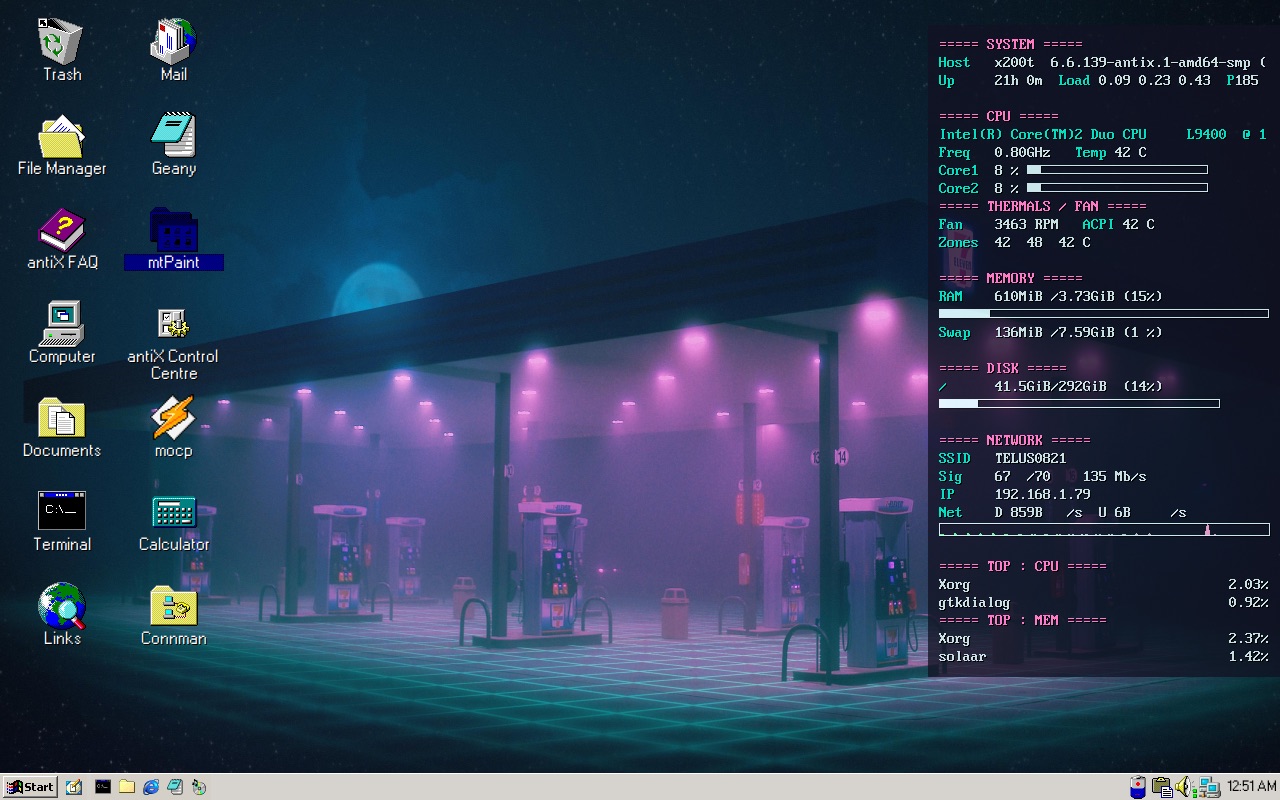
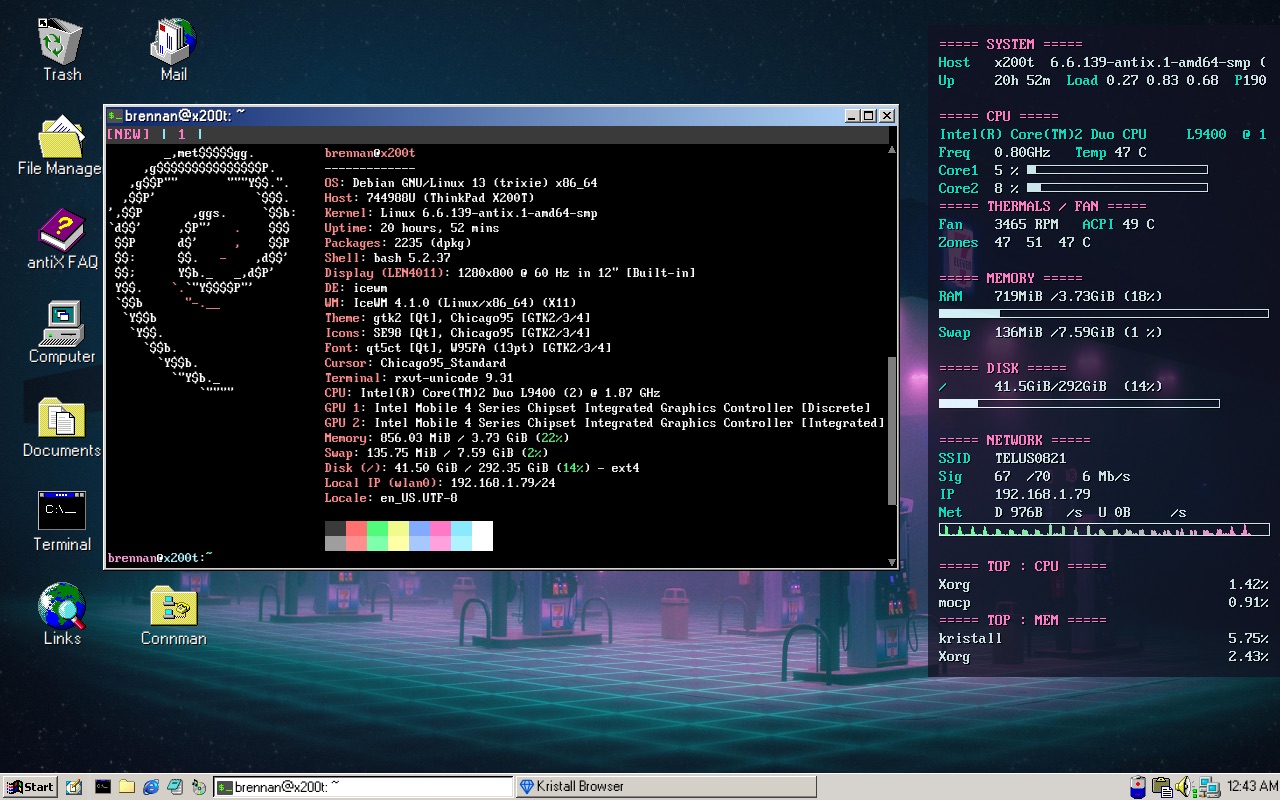
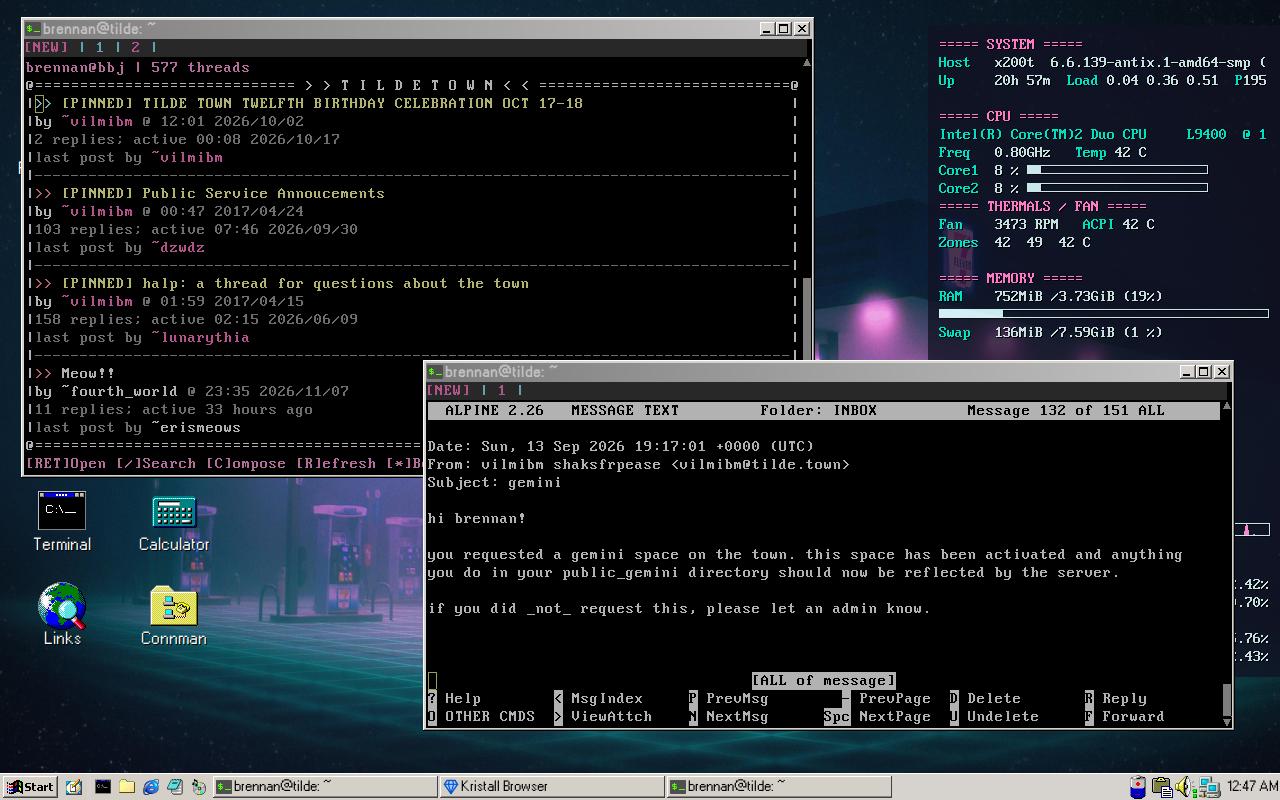
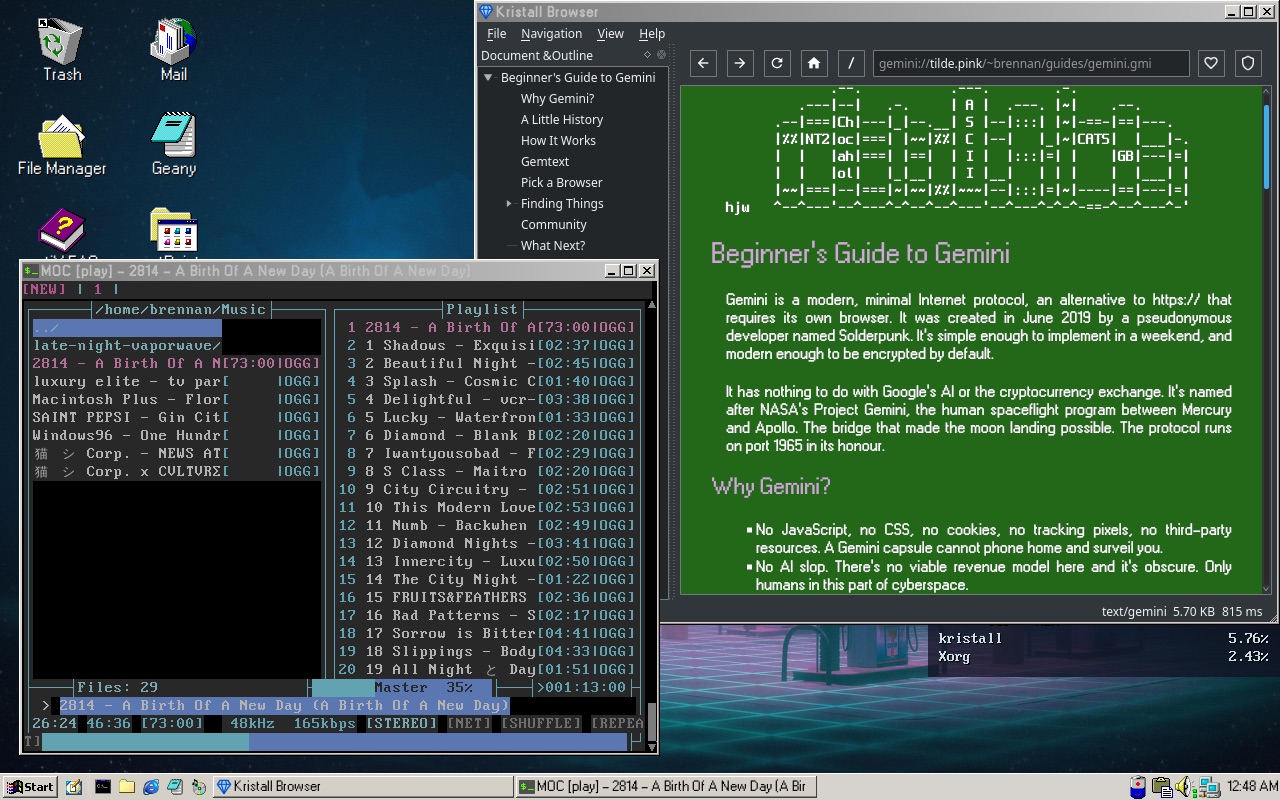
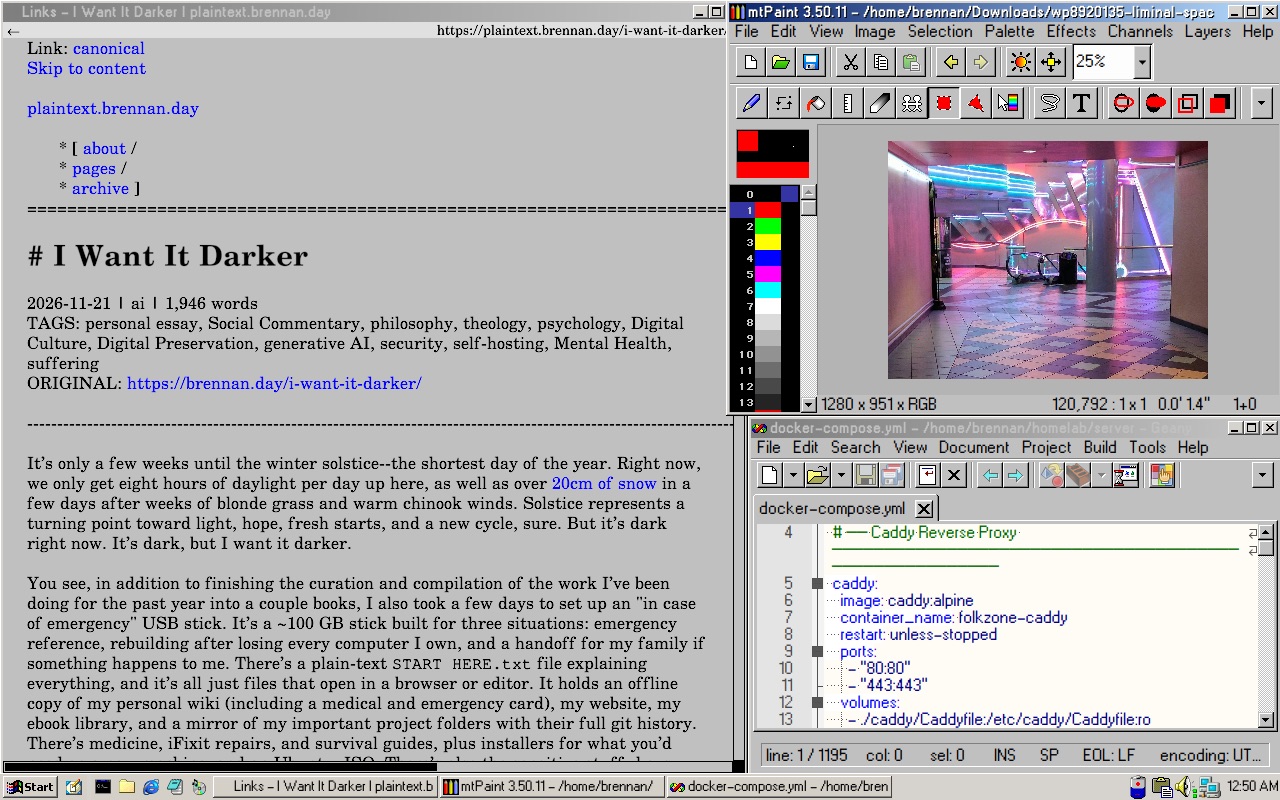
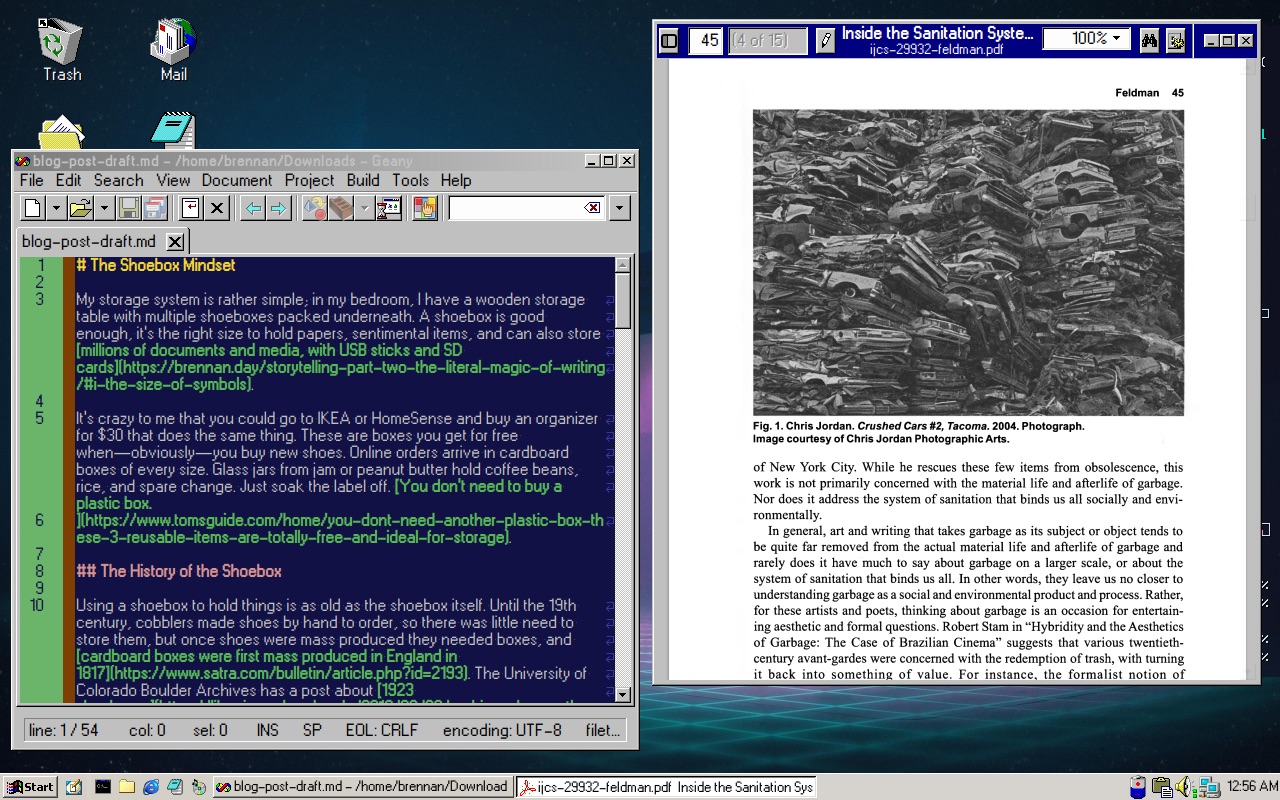
This is a laptop that was manufactured back in 2008, the same year Grand Theft Auto IV was released, and the same year Barack Obama was elected president of the United States. The friction and design language (and, yes, build quality) of older machines bring me joy.
For the ThinkPad's 25th anniversary, Lenovo released a retro ThinkPad with modern internals and a keyboard bringing back the old clacky keys and layout. One writer who misses the older models described the traditional ThinkPad as a plain machine built for getting work done, rather than to draw attention. Interestingly, Lenovo began using the US military's MIL-STD 810G as a guideline for designing and testing ThinkPads in 2007, around when my X200T was made.
To be honest, the entire concept of ewaste baffles me. ThinkPads are still easy to repair because spare parts and service manuals are easy to find. Computers in general, though, are incredible, and there's so much utility and function you can get out of any machine if you're willing to put in the work. My ThinkPad L412 (a Core i5 M 520 from 2010, 4 GB of RAM, and a 320 GB spinning hard drive) is a LAN micro-server. My HP Compaq 8200 Elite (an i5-2400S, 8 GB of RAM, and a 1 TB SSD) also runs 24/7 as an offline library with Wikipedia, ebooks, and maps that work without the internet. And my ASUS VivoBook (a Celeron N4020 with 4 GB of RAM) doubles as a writing machine and a tiny server.
The Sociology of Garbage
It isn't even just ewaste, but waste in general. Garbage isn't a specific, defined thing. Trash depends on time, place, and culture. There are always economic systems at play, along with conspicuous consumption, planned obsolescence, and the drive for continuous growth.
In Purity and Danger (1966), anthropologist Mary Douglas writes how dirt is just matter considered out of place. Nothing can be dirty on its own; the label depends on context. Michael Thompson's Rubbish Theory (1979) divides objects into transient ones that lose value over time, like a used car, and durable ones that gain value over time, like an 18th century Queen Anne chest. Rubbish is its own third category, valueless and mostly invisible. A transient object that has become rubbish can be rediscovered as durable, and people with the most power decide which objects count as which.
Historian Susan Strasser, in Waste and Want, wrote that before the 1890s, Americans produced nearly no trash since scarcity meant that families mended and reused almost everything. The change from careful stewardship of objects to a disposable society is, unsurprisingly, largely influenced by consumer culture and planned obsolescence.
The UN's Global E-waste Monitor found that 5.1 million tonnes of e-waste crossed borders in 2022, and about 3.3 million tonnes of that went from high-income to middle and low-income countries through uncontrolled, undocumented movements.
What I'm explaining here as an alternative is one of the foundational principles of Solarpunk and ways towards a positive, better future. Our beautiful world is inherently renewable, and we already have everything we need. Another reason I love the shoebox is because it gives you a physical size limit. It is an excellent way of keeping things, but you can only keep so much. The rest? Donate and give away.
When you focus on the creativity of repair and reinvention, instead of chasing the artificial high of consumerism and gear acquisition syndrome, you are tending to a garden instead of buying tomorrow's landfill. The limitations you think exist with the outdated and inferior are psychological rather than material. Those of us willing to be resourceful, scrappy, and thrifty will inherit the Earth.
Comments
To comment, please sign in with your website:
How it works: Enter your website URL. IndieLogin signs you in through your site's IndieAuth server if it has one (e.g. indieauth.com), or checks your rel="me" links on GitHub, GitLab, Codeberg, and email. Setup instructions.
Signed in as:
No comments yet. Be the first to share your thoughts!