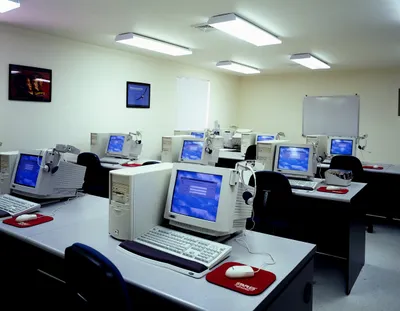
'School Computer Lab' Photograph taken by Carol M. Highsmith. ca. 1980-1990. | Library of Congress (edited by the Author)
issue #242 of brennan.day
Wow, I Love the 'Puter!

brennan.day — issue #242
Publisher: Brennan Kenneth Brown
Place of publication: Calgary, Alberta, Canada
Available at: https://brennan.day
Contact: mail@brennanbrown.ca
I have been a computer nerd my entire life. I think if you spend a few minutes on this website, that becomes obvious. I remember when my family first got an HP Pavilion Media Center TV PC, bundled with a copy of Windows XP Home Edition. Playing flash games on AddictingGames.com, and chatting with my friends on MSN Messenger, and unwisely downloading virus-addled MP3s on Limewire.
Even before we got our own computer, before I was even in Kindergarten, my Mom would take me to the West Kildonan Library in Winnipeg where I'd play games on PBSkids.org, barely understanding what was going on.
But when I pause and meditate on the computer, I realize I never had a positive association with it, despite how much I've used it. My parents would tell me I was spending too much time on it (I was), and of course the misery spread by corporate social media has made any digital screen malicious in nature.
It took until this year, when I started making friends with people like Melo and many others on the IndieWeb who share unabashed love for the computer that I realized, "oh, I should also love the computer and all that it's capable of and all that it's given me!"
The shift from guilt to gratitude has made me want to understand what a computer actually is and not just what it does.
A 1970s article in Scientific American measured the energy efficiency of locomotion for various animals. The condor won as the most efficient, while humans ranked poorly in the middle. However, when a human used a bicycle, their efficiency blew past the condor and every other animal on Earth. Steve Jobs used this metaphor to famously call the personal computer a "bicycle for the mind."
I think we (or at least I) take for granted how much you can do with a computer, how much it is capable of. Now, what's exactly defined as a computer is incredibly broad—the phone in your pocket is one, absolutely, and maybe also your refrigerator or lightbulbs and sprinklers if you've opted for Smart Devices and the Internet of Things.
What I'm talking about is a specific kind of computer: the desktop tower. It is truly amazing, totally modular with every part replaceable. I can't help but think about the similarities it has to a public library, in that if it were made today rather than being a legacy machine grandfathered into today's personal computing devices, it would have never been allowed to be successful.
Portrait of a Core Duo
Abstract discussion about technology only gets you so far. To understand the miracle of computation, you should look at the CPU. So let’s pick a chip no one would call miraculous anymore.
To drive home how amazing computers are, I am going to be going over how a CPU is made. But not a state of the art CPU, no. I'm going to be writing about the Core Duo, codenamed Yonah, meaning "dove."
It's a processor that might be sitting in a laptop from 2008 in your closet with a film of dust and dried-up thermal paste, the Intel sticker still clinging to the palm rest. That chip was released in 2006. Yet, inside the metal is a reality staggeringly complex, layered with inhuman precision.
It begins with sand. The silicon of the processor begins as ordinary quartzite, purified into metallurgical-grade silicon, then refined again to 99.999999999% purity. You would find one foreign atom among billions. This hyper-purified silicon is then grown into perfect crystal, an unbroken lattice of atoms stretched into a cylindrical ingot. Diamond saws slice this into wafers thinner than a human hair, polished to a mirror finish, and any remaining surface irregularity is measured in angstroms (tenths of a billionth of a meter).
On that wafer, human beings work through machines of incomprehensible precision and paint a city. Projecting stenciled patterns of a processor’s design with ultraviolet light through lenses costing millions of dollars. This is done dozens of times, interspersed with chemical baths, plasma etches, and metal depositions. Silicon is doped with boron or phosphorus atoms shot into the lattice like cannonballs to change its electrical character, in regions only a few dozen atoms wide.
The result is a labyrinth of 151 million transistors, small enough that over 100 of them could stretch across the width of a human red blood cell. During every single second, a transistor in the chip switches over a billion times, channeling electrons along copper interconnects that would span 50 miles if laid end-to-end. All sealed inside a package the size of a postage stamp.
The 2GHz clock means it ticks two billion times per second. At each tick, a wave of state ripples through those 151 million gates, completing a tiny fragment of a computation that, when fused with billions of others, resolves into a program like a word processor or web browser. The program is built on an operating system virtualizing memory, scheduling threads, managing hardware interrupts, and maintains the illusion that this single machine runs hundreds of tasks at once. In reality it’s doing one thing at a time and swapping contexts endlessly.
For example, when you press a key, a keycap descends a few millimeters, bridging a contact that sends a scan code to a microcontroller. This queues an interrupt, triggering a driver, an input system, an application loop, a font rasterizer, a GPU shader, a pixel voltage, and a photon emission from a liquid crystal display. All faster than the mechanical sound of the keypress reaching your ears.
The Core Duo will run for years, executing trillions of instructions without an error despite thermal expansion, flipping memory bits (error-corrected in memory silently), voltage fluctuations, and physical wear. Billions of moving electrons never making a mistake.
This processor was the culmination of sixty years of exponential progress since the invention of the transistor, housing more computational power than the entire planet possessed in 1960. The machinery and intellect required to design and assemble that processor is thanks to the concentrated effort of tens of thousands of the most brilliant minds across centuries of accumulated physics, chemistry, materials science, solid-state theory, Boolean algebra, and computer engineering.
And despite all that, we treat it like a disposable commodity. A billion tiny lightning storms per second. All of this to write “Hello, world!”, or play a song, or load a webpage that itself crossed the globe through fiber optic strands, routers, and servers, materializing on your screen within a few seconds. And we become irritated if a program takes three seconds to open instead of one. We toss the laptop into e-waste dumpsters when the battery dies.
We’ve so thoroughly normalized the miraculous that we’ve lost the capacity to be shocked by it. The Intel Core Duo cost around $240 for the chip at launch. Today, you can buy a used Core Duo laptop for the price of a pizza.
I think about all of that, and how little we actually think of these machines. So here's my scattered, still-incomplete attempt at everything you can do with a computer. Nothing that costs money. Just the machine and what's freely available. Since the hardware is a miracle, I think we should honour it by using it, creatively and freely.
Without Internet
To start with offline capabilities, you can install a terabyte drive (or several) and fill them thousands of albums, films, TV shows, and books. You can also write endlessly, with plain text files of a million words only a few megabytes each.
Beyond that, there is an enormous world of free, open-source software that does not require expensive or recent hardware to run. LibreOffice instead of Microsoft Word, GIMP and Krita instead of Adobe Photoshop, Inkscape instead of Illustrator, Blender for 3D modelling and animation, Audacity and Ardour for audio, Kdenlive for video editing, OBS Studio for recording and streaming, LMMS for making music.
You can download any of a dozen free SDKs, compilers, or IDEs like GCC, Python, or VSCodium and contribute real code back to these open-source projects.
You can try out dozens of different variants of GNU/Linux and BSD. There's Debian's stability, Arch's minimalism, NixOS's reproducibility, or OpenBSD's security. And if you're patient and a little unhinged, write your own operating system kernel from scratch.
You can emulate old game consoles and computers. You can run Stockfish locally and play chess against an engine stronger than any human ever. You can typeset a book in LaTeX. You can model in Blender or FreeCAD and hand the file to a friend with a 3D printer. You can generate your own PGP keypair. You can run simulations, plot fractals, and solve differential equations with Octave or Sage. You can take an old laptop and turn it into a local home server that backs up your family's photographs.
You can carry the internet in your pocket with Kiwix containing the whole of Wikipedia, Wiktionary, and Project Gutenberg inside a single file, usable on a boat in the middle of nowhere. You can improve your memory with Anki, an open-source spaced-repetition flashcard program quizzing you based on how close you are to forgetting.
You can draw a typeface in FontForge, or build a game in Godot, a 2D and 3D engine with no royalties. You can use Tesseract on a box of scanned family letters and turn handwriting into searchable text. You can use ffmpeg for audio, video, any container format really, and it'll convert, compress, or stitch.
You can create a VeraCrypt container or a KeePassXC vault for anything you want to keep encrypted, local. Or, you can pick up a $30 RTL-SDR dongle and suddenly you're using the electromagnetic spectrum, listening to air traffic, amateur radio, the ISS passing overhead, even the hydrogen line hissing in from deep space, no internet required.
With Internet
And then you plug in the ethernet cable, and the list gets exponentially longer. There are so many learning resources and beautiful pieces of art and culture you can find. Wikipedia alone is one of civilization's greatest achievements—free, collaboratively built, and you don't need an account to read or edit.
The Internet Archive holds millions of scanned books, recordings, and obsolete software. The Wayback Machine has decades of the Internet that no longer exists. Project Gutenberg and Wikisource hold tens of thousands of public-domain texts. arXiv puts out primary research literature in physics, math, and computer science with no journal paywall.
If you'd rather listen than read, LibriVox's volunteer readers have been putting public-domain books into audio since 2005. Standard Ebooks takes rough Gutenberg transcriptions and turns them into properly-formatted editions for e-readers. IMSLP does the same for sheet music, with three-quarters of a million public-domain scores.
MIT OpenCourseWare and Khan Academy teach material ranging from grade school to university-level. freeCodeCamp and the Odin Project teach programming skills for free. PeerTube proves federated video hosting. Lichess is a free, ad-free, fully open-source chess server, no account required to play. OpenStreetMap is our world map built and maintained by volunteers, and you can add your own neighbourhood's sidewalks and trails to it. Zooniverse lets you help classify galaxies or transcribe old ship logs for real research, and Folding@home will happily take your computer's spare cycles and put them toward modelling proteins for disease research.
SDF is a public-access Unix system that's been running as a members' club since 1987 with shell accounts, email, Gopher, and now a Mastodon instance too. The Tildeverse carries that same spirit forward today, a loose federation of "pubnixes" like tilde.club and tilde.town where anyone can get a free shell account and share a server with strangers making art, hosting Gopher holes, and just poking around Unix together.
And down at the smaller end of things, Gemini and Gopher are protocols available if you want an alternative Internet altogether.
The Decline
I find it almost unbearably sad, then, that the desktop computer is slowly becoming an enthusiast’s relic. Smartphones and tablets do more each year, yes, but they also fence you in, strip away the file system, the tinkerability, the ownership.
The share of adults online who use a laptop or desktop computer dropped from 72% in early 2020 to 61% by the third quarter of 2024. Globally, desktops now account for around 45% of web traffic, a share that only continues to shrink as phones continue to replace usage.
That said, worldwide shipments of traditional PCs actually ticked up slightly in 2025, to about 274 million units, so people are still buying towers and laptops—but how people spend their day is not in doubt. Smartphones are amazing in their own way, but they severely limit what you're capable of doing. We now walk around with supercomputers in our pockets, magnitudes more powerful than the Core Duo, and we use them to doomscroll, or watch dancing cats.
All of this was built on the shoulders of giants. Maxwell, Boltzmann, Shockley, Turing, von Neumann, Hopper. People who understood the universe is a puzzle box of physical laws that could be engineered into computation. Every line of assembly code is Ada Lovelace’s vision that a machine could manipulate symbols and not just numbers.
We’ve outsourced wonder to science fiction and think of the present as mundane, when in fact it’s a daily explosion of the impossible.
We need to stop and stare in awe at the metal and silicon, and feel the weight of what it represents. Your computer is a monument to human ingenuity. It is the envy of civilizations. And yet it sits forgotten in storage, cosmic significance invisible. It’s the concentrated miracle of a billion minds, etched in sand, pulsing with light, waiting for you to notice.
I think all of this is why you should take the time and effort to become a system admin and webmaster. Is it technical, and often dry and mechanical? Yes, absolutely. But you gain the capability to understand this wonderful, impossibly complex machine and wield it for purposes of good. Of building things you love. Of truly connecting with others.


Comments
To comment, please sign in with your website:
How it works: Enter your website URL. IndieLogin signs you in through your site's IndieAuth server if it has one (e.g. indieauth.com), or checks your rel="me" links on GitHub, GitLab, Codeberg, and email. Setup instructions.
Signed in as:
No comments yet. Be the first to share your thoughts!