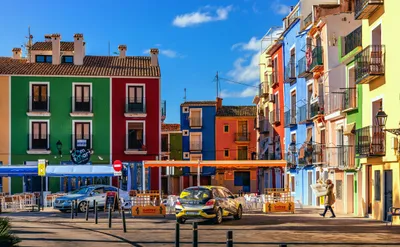
'Colorful buildings of the historical village of La Vila Joiosa, Alicante, Spain in 2022 January' taken by Simo Räsänen | Wikimedia Commons (edited by the Author)
issue #248 of brennan.day
Five Interesting Indie Platforms You Might Not Have Heard Of

brennan.day — issue #248
Publisher: Brennan Kenneth Brown
Place of publication: Calgary, Alberta, Canada
Available at: https://brennan.day
Contact: mail@brennanbrown.ca
It's already been almost a month (how??) since I deleted all my corporate social media accounts. Reddit, Facebook, Instagram, Discord, among others. And as a result I've found myself looking at other social platforms and communities to fill my time with.
Because social media is not inherently bad—it only starts becoming bad when multi-billion dollar businesses are created around using people as products and extracting as much information and value as possible out of every single one of them.
Now, I'm also a bit of a maximalist—that's one of the reasons I kept my corporate social media accounts for so long. I love being everywhere, trying out everything, and having a big-tent mindset.
So I already have a fair share of communities I'm already in. Of course I'm active on Mastodon and Bluesky. And there's omg.lol, of course. And also forums I browse often like 32-bit Café and Melonland. Then there's the tildeverse, which is extremely fun and a great way to get more comfortable and familiar with terminal. And the IndieWeb Wiki has many frequently occurring Homebrew Website Club meetups which I need to attend more often.
But in the past couple weeks, I've stumbled upon and discovered even more niche websites that I thought I'd share. I don't think a few would be properly defined as "social media" platforms, but they're online digital communities of people nonetheless!
And because of my big-tent mindset, I'm certainly not afraid to share these places openly and have new people join—if a platform is interested on hiding away from people and practicing gatekeeping, then I'm certainly not interested in it. (All of these platforms are also genAI-free, as far as I can tell.)
I also want to note that I've only discovered these platforms myself recently, so I still am green and don't know that much about them. If any of my readers are users, please share!
With all that out of the way, let me begin my list.
1. Special Fish
special.fish describes itself as a "community word processor with light social features," which is a description I adore. It has a stark brutalist web design which I also really dig. It's been running since February 2, 2020.
Built and maintained by a solo working artist based in St. Johns, Oregon, special fish is funded directly by its users instead of ads or investment. This means there is an upfront payment required to make an account. The directory page lists a suggested $40/year contribution, with paying members effectively subsidizing users who can't.
The main content area of the platform is called the Garden, where user pages sit, loosely linked together. There are journal entries, poem drafts, food logs, and open questions posted to the whole community. There's also a bulletin where you can share open calls, events, projects, or a new website. Every Sunday morning, there's a collaborative writing room.
According to the about page, "communities" were originally just called "places" in the site's early design. (and there's an easter-egg DJ feature built into the platform?) Registration requires users to be 18 or older, and the terms page states the site could shut down at any point if it becomes too costly to run, that backups are made only "occasionally." New accounts go through the join page.
2. Ctrl + Shift + 3
ctrlshift3.com describes itself as "a calm, chronological, text-first community platform" built by a single developer, Billy Wilcosky. It's minimalist in its design, as you'd expect.
There are no likes, follows, or other vanity counts. Instead, there's just a shared Feed in chronological order, with an optional "Wave" view that surfaces posts with more comments while still favoring newer content and adding light randomization.
Private, invite-only groups are called "Clicks", and users can privately subscribe ("Sub") to each other without visible follower counts. Comments are flat rather than nested, and related posts can be manually linked together as "connected thoughts." You can add posts that are either plain text, timed polls (1–30 days), or a 40×40 pixel-art grid. There's also a site-wide Polling Place for community-level questions, and an experimental feature called Direct Connect that offers ephemeral, browser-to-browser chat over WebRTC, with no history saved once the session ends.
Participation is tracked through a system called "Bits," which awards a symbol for each post, comment, or daily login, with different symbols and colours at milestone counts (10th, 50th, 100th, 10,000th). The platform has a released iOS app (with acknowledged bugs pending an update) and was recently featured on Product Hunt.
One feature I absolutely love is the sound design, which is credited to Romain Raynal, and the ASCII art engine is credited to Yikuan Sun.
3. web1.0 Hosting
If you're looking for an alternative to Neocities and Nekoweb that's specifically designed to have you design websites that work on old computers and cell phones, then web1.0hosting.net is what you're looking for. It's a free static-hosting provider based in Helsinki, Finland, explicitly built around accessibility from old and low-powered devices. You might know them from their sister site, the ELPiS zine.
web1.0 hosting gives you functionality that you can't really find anywhere else. All sites work as HTTP-only, accessible through IP-only (no DNS), and they have a dedicated WAP gateway for old mobile phones.
The free tier includes 100MB of space and a third-level domain on .w10.site, .w0.am, .narod.ws, or .oldcities.org; registered "community" users (via the platform's Discord/Telegram/forum) get 500MB, with more available by donation through the asdc donation page.
There's a browser-based file uploader, and they also have a built-in no-code site builder called HamsterCMS, designed for users without coding experience. Server Side Includes (SSI) let users reuse headers and footers across static pages. There's also a webmail client, web chat, forum, and an IRC channel at irc.retronode.org:6667, channel #webdev, plus a dedicated search engine for hosted and old-web sites.
Hosted sites are also mirrored onto Yggdrasil, a decentralized, encrypted peer-to-peer mesh network, accessible via .ygg addresses.
I know I'm listing out a lot of features, but that's because there's so many! I think this platform is criminally underrated.
4. Pillowfort
One of the better-known platforms, pillowfort.social launched in open beta in 2017, founded by Julia Baritz and headquartered in Austin, Texas. It was positioned from the start as a fandom-oriented alternative to Tumblr, and it grew fast in 2018 after Tumblr's adult-content ban pushed creators to look elsewhere. The site passed 20,000 users in its first two and a half years, and had surpassed 100,000 users by October 2020. Fanlore frames Pillowfort as having tried to fill the same post-Tumblr community-space role that Dreamwidth also attracted, without what some users felt was Dreamwidth's tendency to split fandom into smaller, more siloed spaces.
The platform is independently and user-funded, with no venture capital or outside investment, and there are two ways to join. A one-time $5 fee for instant access, or a free rolling waitlist (it's really quick!). Pillowfort maintains an explicit anti-AI stance, stating it does not allow AI-generated text or images anywhere on the platform.
Other features include per-post visibility control (public, followers-only, or private), user-created communities kept separate from personal blogs, threaded comments, NSFW tagging with filtering, and mutual blocking, where a block prevents both users from seeing or contacting each other. A mobile app is also available directly from the site.
Note on Blue Dwarf
This post originally included a recommendation for Blue Dwarf, but after further conversation with the platform owner about their moderation philosophy and where they draw the line, I have decided to rescind that recommendation. You can read more about my reasoning in "Free Speech and the IndieWeb".
Go Forth and Socialize! (And Support!)
As I wrote about recently, discovering all of these different platforms has made me realize I need to focus more on cultivating and engaging with the already-existing communities online rather than continuously attempt to make my own. No need to reinvent the wheel.
If you're like me, then you're looking for somewhere to hang out and be chronically online that is made by good people and full of good people. I'm sure I'm preaching to the choir if I explain why companies like Meta or X Corp. are not places worth your time or attention.
And regardless of whether you're interested in signing up, I would ask you to consider contributing or supporting these platforms regardless, because the only way the Independent web flourishes is both with users, yes, but also with monetary funding as well. Buy these indie devs a coffee, why don't you?



Comments
To comment, please sign in with your website:
How it works: Enter your website URL. IndieLogin checks your rel="me" links on GitHub, GitLab, Codeberg, and email. Setup instructions.
Signed in as: